How to Stop Overthinking: 9 Things That Actually Work

On this page
You have typed a message, reread it six times, and still cannot decide whether to send it. You are hoping to find the perfect words, or proof that nothing will go wrong. You may not get that certainty by thinking harder. But you can interrupt the loop and choose one useful next step.
Overthinking often starts as an attempt to solve a problem or stay safe. It becomes less useful when you keep replaying the same question without finding new information or taking action. The aim is not to force your mind to go blank. It is to notice the loop, then give your attention somewhere more helpful to go.
On this page
- Why overthinking happens
- Nine ways to stop overthinking
- How to stop overthinking at night
- How to stop overthinking in a relationship
- When to get extra support
- FAQ
Why overthinking happens
Your mind is built to notice possible problems. If something feels uncertain, it may scan for risks and replay what happened, hoping to prevent a mistake next time. That can be useful when it helps you prepare. It is less useful when you keep returning to the same thought but gain no new facts or options.
A helpful distinction is the one between reflection and rumination. Reflection tends to produce a clearer understanding or a next step. Rumination circles around the question, often making you feel worse without helping you decide what to do.
The NHS suggests writing worries down and sorting problems you can act on from hypothetical worries you cannot resolve right now. Its guide to tackling worries offers practical steps for doing that.
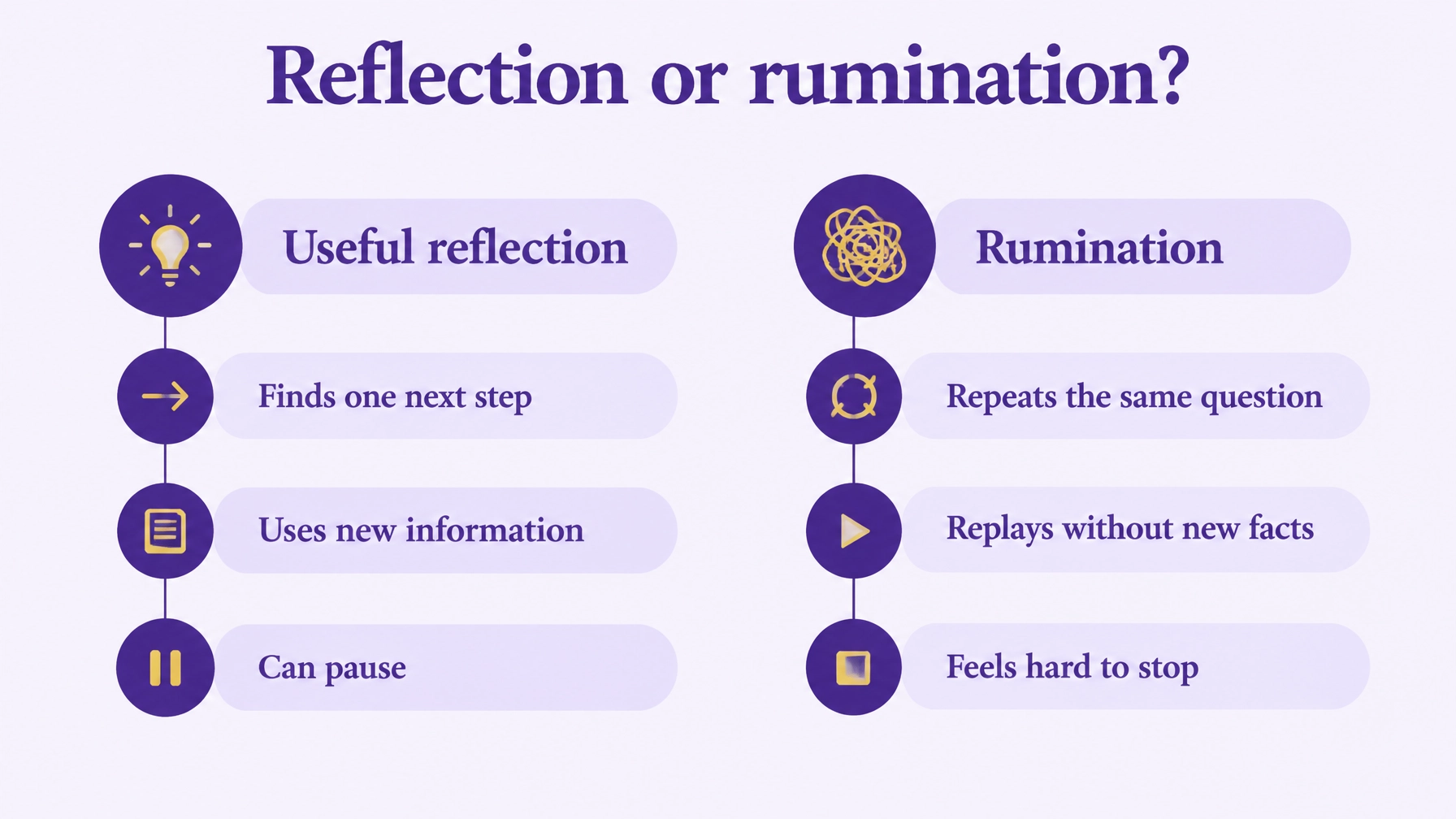
Practical rule: if thinking is not giving you new information or a workable next step, switch from analyzing to interrupting the loop.
Nine ways to stop overthinking
1. Name the thought
Instead of treating a worry as a fact, describe what is happening: "I am having the thought that I embarrassed myself." This small shift can help you see the thought as something your mind is producing, not a verdict you have to accept.
Keep the wording plain. "I am predicting the worst" or "I am replaying that conversation" is enough. You do not have to argue with the thought or make it disappear.
2. Sort a problem from a worry loop
Ask yourself: "Is there a specific action I can take now?" If the answer is yes, write down the action. If there is no action because you are guessing about something you cannot know yet, label it as a what-if and set it aside for now.
For example, "I need to confirm the meeting time" is a problem. "What if they think I am difficult because I asked?" is a prediction. You can send the confirmation without solving the prediction.
3. Schedule a 10 minute worry window
Pick a regular 10 minute slot earlier in the day, rather than just before bed. Write down the worries that keep showing up. During the window, separate each one into something you can act on and something you cannot settle today.
If a worry appears outside that time, jot down a few words and tell yourself, "I will look at this during my worry window." This is not pretending the issue does not matter. It is choosing when to give it your attention. The NHS worry guide recommends setting aside a short period to review worries and plan for solvable problems.
4. Write the next action, not the whole story
A page of repeated questions can keep a worry alive. Try writing three short lines instead:
- What am I worried about?
- What do I know for sure?
- What is one action I can take?
If there is no action yet, write when you will check again. "Ask my manager about the deadline tomorrow" is more useful than a full page guessing what they meant by a short email.
5. Ask what is in your control
Divide a page into two columns: "I can influence" and "I cannot control." You might be able to control whether you ask a clear question, prepare for a conversation, or set a boundary. You cannot control another person's private thoughts or guarantee their response.
Put your effort into the first column. The second column is not a challenge to think harder. It is a reminder that some answers are not available to you right now.
6. Move your body for a few minutes
A short walk, a stretch, or a few minutes of tidying can help break the spell of sitting still and replaying the same thought. You do not have to turn it into a workout or wait until you feel motivated. The point is to shift your attention and give your body something simple to do.
While you move, pick a small detail to notice: the feel of your feet on the ground, the air on your face, or the next turn in the path. This will not solve every worry, but it can help you pause the loop.

7. Delay a decision when you are caught in the loop
Not every decision needs an immediate answer. If you are tired, upset, or checking the same options for the tenth time, choose a sensible time to return to it. Write down what information you still need and when you will review the choice.
Delaying is different from avoiding. A clear review time gives you a chance to step away without pretending the decision has vanished.
8. Use a fairer question
When your mind starts making a case for the worst outcome, ask a question that leaves room for facts:
- What do I know, and what am I guessing?
- What else could explain this?
- What would I say to someone I care about?
- What would be a reasonable next step, even if I do not feel certain?
You do not need to replace a negative thought with a cheerful one. A balanced thought is often more believable: "I do not know what they meant yet. I can ask instead of guessing."
The NHS guide to reframing unhelpful thoughts explains how to examine a thought and consider a more balanced view.
9. Practice stopping without solving everything
Sometimes the useful move is to notice the worry and return to what you were doing. Choose a simple focus for the next few minutes: make tea, take a shower, read one page, or finish a small task. When the thought comes back, name it and gently return to the activity.
This is not a test. If your attention wanders again, bring it back again. You are practicing how to stop feeding the thought, not proving you can control every thought you have.
Practical rule: pick one technique and try it for a few minutes. Switching methods every 20 seconds can become another form of overthinking.
What you are doing, and what may help
| What you are doing | What it can look like | What may help |
|---|---|---|
| Reflecting | Reviewing a choice and finding a next step | Write the next action |
| Ruminating | Replaying the same conversation without new facts | Name the loop, then change activity |
| Worrying about a solvable problem | Thinking about a bill you need to pay | Choose a time and make a short plan |
| Worrying about a what-if | Guessing how someone might respond | Separate what you know from what you are predicting |
How to stop overthinking at night
At night, a quiet room can leave more space for worries to get loud. You may also be tired, which makes it harder to judge a thought calmly. If you are lying awake replaying tomorrow's conversation, try this:
- Write the worry down. Keep it brief, so the page does not become a new place to rehearse it.
- Name one next step. If there is something you can do, write what and when. If not, write, "Nothing to solve tonight."
- Return to a simple focus. Notice your breathing or the sounds in the room. You are not aiming to force sleep, just to stop working on the worry in bed.
The NHS also suggests writing down worries or a to-do list before bed. See its advice on falling asleep faster and sleeping better. If sleep problems keep happening, consider speaking with a health professional.
How to stop overthinking in a relationship
Relationship worries often involve trying to work out what another person meant or what they will do next. You can notice the worry without treating your guess as evidence. Ask what you know directly, and what you could clarify in a calm conversation.
If something needs discussing, write down the specific issue and what you want to ask. Try not to turn a text delay, a change in tone, or one awkward moment into a full story about the relationship. You can ask for clarity, state what you need, or decide what boundary feels right for you. You cannot think your way into certainty about someone else's feelings.
Practical rule: in relationships, separate observed facts from interpretations, then choose whether to ask, wait, or set a boundary.
When to get extra support
Self-help tools can be useful, but they are not therapy, and they will not work for every person or every situation. If overthinking is taking up much of your day, disrupting sleep, affecting your relationships, or making it hard to manage everyday life, consider talking with a qualified mental health professional. Persistent anxiety or low mood deserves support, not self-criticism.
A CBT meta-analysis published in Psychological Medicine found that cognitive behavioral therapy can help reduce repetitive negative thinking, including worry and rumination. A professional can help you find an approach suited to your needs.
Tarot can be one optional reflection tool if you find it useful. A card can prompt questions such as, "What do I know?" or "What small step is mine to take?" It cannot tell you what another person thinks or replace mental health care. You can start a free reading if you want to use it as a prompt for reflection.
Frequently Asked Questions
How can I stop overthinking quickly?
Why do I overthink everything?
How do I stop overthinking at night?
How do I stop overthinking in a relationship?
Is overthinking the same as anxiety?
Does writing worries down help?
- how to stop overthinking
- overthinking at night
- self help
- anxiety tips
- rumination
Get a real reading right now
Pick from any of our spiritual readers. Talk by voice, text or chat one-on-one. Get your Free reading now.
Get my free reading