Minor Arcana · Cups
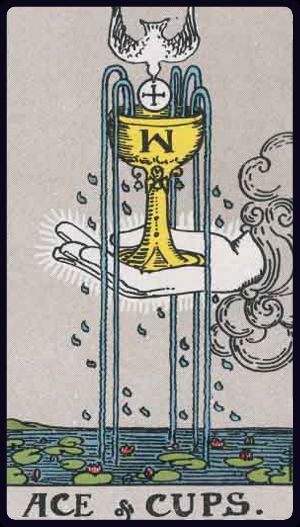
Ace of Cups
The card of the heart opening again. It turns up when feeling returns after a closed stretch, and asks whether you will let it.
When the card lands in a Tarot Chats session, we read the Ace of Cups as an offer rather than an arrival. Something is being held out emotionally, and the card is mostly interested in whether you can receive it.
Introduction
A hand comes out of a cloud holding a cup that is overflowing, with five streams running out of it and a dove coming down. Nothing has happened yet. Somebody is being offered something, and the whole card sits in that moment before they take it. The Ace of Cups is the beginning of the suit that deals with feeling, connection and the inner life, and it describes the point where something opens up: a new relationship, a friendship that deepens, forgiveness, the return of a feeling you had stopped expecting. It is one of the loveliest cards in the deck and it is not a guarantee of anything. Overflowing cups spill, and plenty of people who pull this card are being offered something they are not ready to hold. If you want a wider sense of how cards like this fit into a reading, our guide on how tarot works walks through it without the mystical jargon.
Upright Meaning
Upright, the Ace of Cups describes an emotional opening. The start of love, the beginning of a friendship that matters, the moment something thaws after a long cold stretch. It is generally a hopeful card and it deals in feeling rather than in fact: nothing is settled, nobody has committed, the thing is only just beginning. What the card asks for is receptivity, which is harder than it sounds for anyone who has been hurt. The cup is being offered and the person has to put their hands out. There is also a creative reading. Cups cover the inner life generally, so this card can describe inspiration of an emotional kind: writing something honest, making something that comes from feeling rather than from craft, the return of a creativity that had dried up. The other quality worth naming is compassion, both directions. The Ace often appears when someone is ready to be kinder to themselves, which usually precedes being able to accept kindness from anyone else.
Reversed Meaning
Reversed, the Ace of Cups usually means the opening is blocked. Feelings that cannot be expressed, a connection offered and not taken, an emotional shutdown that made sense at the time and has outlived its usefulness. The card reversed is sympathetic about why: most people who cannot receive love have a reason, and the reason is usually a person. Another version is emotion that has spilled rather than filled. Overwhelm, crying at everything, feeling too much and having nowhere to put it. That is the same energy unregulated, and it is exhausting rather than dangerous. There is also a reading about giving without receiving. Pouring into other people, being the one who listens, holding everyone's feelings and having nobody hold yours. Reversed, the Ace can be pointing at that imbalance, which tends to be invisible to the person doing it because it feels like being good at relationships.
Love and Relationships
This is the card's home. In love, the Ace of Cups describes the beginning of real feeling: falling for someone, a connection that has become something, the point where you stop pretending you are not interested. If you are single, it is one of the better cards to pull, because it describes an opening rather than a prospect. Often it marks readiness more than circumstance. In an existing relationship, the Ace can describe renewal. Feeling something again after a flat period, a conversation that reopens things, forgiveness that actually lands rather than being announced. It reads well for reconciliation. The card's one honest caution is that it describes the start of feeling and nothing about whether the person is good for you. Plenty of Ace of Cups moments are with entirely the wrong person, and the card reports the emotion accurately without assessing the situation. That assessment has to come from somewhere else.
Career and Money
At work, the Ace of Cups is about doing something you actually care about. It describes work with meaning in it, a job that connects to something you value, or the beginning of a working relationship that becomes important. It is a good card for creative work, caring professions, anything where the point is people rather than output. It also describes the return of enthusiasm for work you had become numb to. With money, this card has very little to say, which is worth stating plainly. Cups do not deal in practicalities, and reading this one as financial good news is a common mistake. If it appears for a money question, it is usually describing your relationship with money rather than the amount: guilt, fear, generosity, the feelings underneath the numbers. That can be a genuinely useful reading and it is not a forecast. For anything about actual income, the Pentacles cards are the ones that answer.
Yes or No
Yes
The Ace of Cups is a warm yes, particularly for anything about relationships, feeling or connection. It describes something good being offered and generally says take it. The confidence is emotional rather than practical: the card is certain about the feeling and says nothing about logistics, timing or whether the thing is wise. For questions about whether to open up, reach out or let someone in, it is one of the clearest yeses in the deck.
When the answer can shift
The answer becomes unreliable when the question is practical. Money, work logistics, whether something will succeed commercially: this card is not equipped and tends to answer about how you feel about it instead. It also shifts if you are asking whether someone is good for you. The Ace reports that the connection is real and has no opinion at all about whether the person is trustworthy, and treating its yes as a character reference is how it most often gets people into trouble.
Example Interpretation
A typical situation. Colette, 51, has been on her own for six years since her marriage ended, and has been telling everyone, including herself, that she prefers it. Recently she has become close to someone in her walking group. Nothing has been said. She has noticed that she checks whether he is coming, and she has also noticed that she has started finding reasons why the group might not suit her anymore. She pulls the Ace of Cups. For Colette, the card is not predicting a relationship. It is naming the thing she has been managing rather than feeling: that something has opened, that she did not plan it, and that her instinct is to leave the group rather than sit with it. The Ace does not ask her to do anything about him. It asks her to notice that six years of preferring it has just been contradicted by her own behaviour, and that this is information rather than a threat.
Another quick example
A quicker one for friendship: Dev, 34, has been messaging an old friend again after two years of nothing, following a bereavement. He pulls the Ace of Cups. The card is not about the loss. It is about the reopening, and it suggests he says something real rather than staying in the safe part of the conversation.
Common Misconceptions
The most common misreading of the Ace of Cups is as a promise of love arriving. It describes an offer or an opening, not a delivery, and a great many of them are not taken. Another mistake is reading it as only romantic. Friendship, family, self-compassion and creative feeling all sit in this card, and the romantic reading is just the loudest one. People also treat it as proof that a relationship is right. The card measures feeling, not fit, and it is entirely capable of describing genuine emotion for someone who will not be good for you.
Final Thoughts
The Ace of Cups is a gentle card that asks something that is not gentle at all, which is to be open when you have reason not to be. Most people pulling it have a history that makes receiving harder than giving, and the card knows that. It is not telling you to trust blindly. It is pointing out that something is being offered, that the offer is real, and that cups held out do not stay held out forever. Whether you put your hands up is the only part of this card that is actually yours.
Related Reading
Want a Free tarot reading
Get a free readingTarot readings are for entertainment and personal reflection. They offer perspective, not predictions, and should not replace professional advice for medical, legal, or financial matters.