Minor Arcana · Cups
Five of Cups
The card of grief with your back turned. It appears after a real loss, and gently notes what is still standing behind you.
When the card lands in a Tarot Chats session, we read the Five of Cups as honest grief. It does not rush anyone, and it does quietly point at the two cups still standing.
Introduction
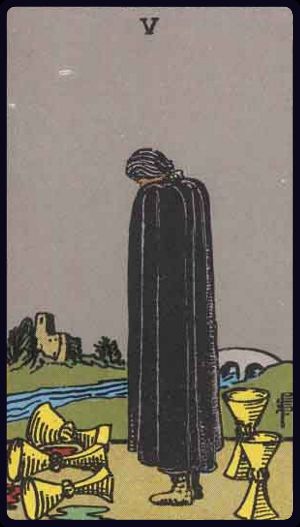
A figure in a black cloak is looking down at three spilled cups. Behind him, unnoticed, two are still upright, and past them there is a bridge leading to a house. Everything you need to know about this card is in that arrangement. The loss is real and it is in front of him, taking up the whole view. What remains is behind him, and so is the way home. The Five of Cups is the grief card of the deck, and it is one of the few that does not try to hurry anyone through. What it offers is not comfort exactly, more a piece of information held quietly at the edge of the picture: there is something left, and there is a route, whenever you are ready to turn round. If you want a wider sense of how cards like this fit into a reading, our guide on how tarot works walks through it without the mystical jargon.
Upright Meaning
Upright, the Five of Cups describes loss and the grief that follows it. A bereavement, a relationship ending, a failure, a disappointment that mattered. The card does not minimise any of it, and it is worth reading plainly rather than optimistically when it appears. Something has been lost and the feeling is appropriate. What it adds, without pushing, is the two cups. There is usually something remaining that has not been counted, because grief narrows the view to what is gone. That is not a moral failing, it is how loss works. The card also carries a note about regret specifically. Where the loss involves something you did or failed to do, the Five is the card of going over it, and it tends to appear when that reviewing has stopped being useful. There is no instruction to cheer up anywhere in this card. The only thing it suggests is turning round at some point, and it leaves the timing to you.
Reversed Meaning
Reversed, the Five of Cups usually means the turning has begun. Acceptance arriving, grief loosening slightly, the ability to look at what remains rather than only at what went. That is rarely a clean or complete process and the card reversed marks the start of it rather than the end. Another version is grief that has become the position rather than the passage. Holding on to a loss because letting it soften feels like a betrayal, or because the identity built around it has become familiar. Reversed, the card can name that, and it does so without accusation, because it is one of the most understandable things people do. There is also a reading about forgiveness, of yourself or someone else. Reversed, the Five can appear when that becomes possible, usually later than anyone expects and rarely as a single decision.
Love and Relationships
In love, the Five of Cups is the card of the ending you have not finished feeling. A break-up, a divorce, a person who left, a relationship that failed in a way you still turn over. It describes the period afterwards accurately: the disproportionate weight of what went wrong, the difficulty of seeing anything else. If you are single after something painful, this is a common card and it does not mean you are stuck. It means the loss is still being felt, which is different. The two remaining cups in a relationship context often mean people. The friends who have been there, the family who turned up, sometimes a person waiting patiently at a distance while you are still facing the other way. The card does not suggest moving on before you are ready. It does note that the grief is currently occupying the whole frame, and that this is temporary even when it does not feel it.
Career and Money
At work, the Five of Cups describes failure and its aftermath. A business that did not make it, a redundancy, a project that collapsed, a job you wanted and did not get. The card is honest about the disappointment and particularly good at naming the private version of it, the part people do not say at dinner. It often appears when someone is still explaining to themselves what went wrong months after anyone else stopped asking. The two cups at work usually mean something salvageable: skills gained, relationships that survived, a reputation that is better than you think. People coming out of a professional failure routinely underestimate all three. With money, the Five can describe a genuine loss: money gone, an investment that failed, a financial setback with real consequences. It does not promise recovery. It does point out that grief and assessment are different activities, and that decisions made while facing the spilled cups tend to be poor ones.
Yes or No
No
The Five of Cups is generally a no, though it is more a description than a verdict. It appears when something has been lost, and questions asked from that position usually get an answer about the loss rather than about the future. If you are asking whether something will be restored or whether a situation will reverse, the card is not agreeing. It is a no about this, and specifically not a no about everything.
When the answer can shift
The answer changes if you are asking about what remains. Is there anything left worth having, should I look at other options, will I be all right: the Five is quietly positive about all of those, because the two upright cups are the part of the image people miss. It also shifts if the question is about time. The card describes a stage rather than a state, and a question framed far enough ahead is not really the one it is answering.
Example Interpretation
A typical situation. Stuart, 58, ran a small printing business for twenty-two years and closed it eight months ago. The decision was right and he made it himself, and he still goes over the last three years looking for the point where he could have turned it round. He has not applied for anything since. Two former clients have asked whether he does freelance work and he has not replied to either. He pulls the Five of Cups. For Stuart, the card is not telling him the business could have been saved or that he should feel better. It is describing what he is doing with the eight months, which is standing in front of the spilled cups going over them. The two unanswered clients are the part of the picture behind him. The card does not say they are a new career. It says they are still standing, and that he has not turned round far enough to see them.
Another quick example
A quicker one for love: Talia, 31, split up with someone four months ago and still narrates the relationship to herself as a list of her own mistakes. She pulls the Five of Cups. The card is not disputing the mistakes. It is noting that the reviewing has become the activity, and that she is the only person still doing it.
Common Misconceptions
The most common misreading of the Five of Cups is as a card about ingratitude, as though the message is that you should be grateful for the two cups. That is a fairly cruel thing to say to someone grieving and it is not what the card does. The remaining cups are information, not an instruction. Another mistake is reading it as permanent. It is a five, in the middle of the suit, and the cards after it describe recovery. People also miss the bridge and the house, which are the quiet promise in the image: there is a route out, and it was there the whole time.
Final Thoughts
The Five of Cups is the kindest of the difficult cards, mostly because it does not ask anything of you. It lets the loss be as large as it is. If you have pulled it, something has gone and the feeling is proportionate, and anyone telling you to focus on the positives has not understood the situation. The only thing the card offers is that the view is currently partial. Not wrong, partial. At some point, and not necessarily today, it is worth turning round far enough to count what is still standing.
Related Reading
Want a Free tarot reading
Get a free readingTarot readings are for entertainment and personal reflection. They offer perspective, not predictions, and should not replace professional advice for medical, legal, or financial matters.