Minor Arcana · Swords
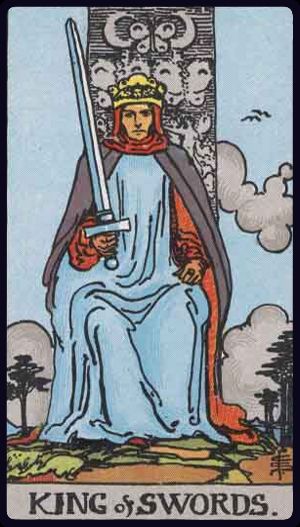
King of Swords
The card of judgement without sentiment. It turns up when a decision needs to be made properly, and asks what the fairness is costing.
When the card lands in a Tarot Chats session, we read the King of Swords as authority based on reasoning. He decides well and the card often asks what the deciding leaves out.
Introduction
The King of Swords sits facing forward, sword held upright and slightly tilted, one hand on the arm of a throne carved with butterflies. Unlike the other kings he looks directly out at you. He is the end of the suit that began with a single flash of clarity and has run through grief, paralysis, fear and collapse, and this is what thought becomes when someone has survived all of it: judgement. Not cleverness, not argument, but the ability to weigh something properly and decide. He is the fairest figure in the deck and the least warm, and those two facts are related. Most people pull this card when a decision is required that cannot be made on feeling. If you want a wider sense of how cards like this fit into a reading, our guide on how tarot works walks through it without the mystical jargon.
Upright Meaning
Upright, the King of Swords describes clear, principled judgement. Assessing a situation on its merits, applying a standard consistently, making the decision that is correct rather than the one that is comfortable. The card is admiring of this, and it is specific that the authority comes from reasoning rather than from position. People listen to him because his conclusions hold up. There is a strong theme of intellectual honesty. He will follow an argument to a conclusion he does not like, change his mind when the evidence changes, and say plainly when he does not know. That is rarer than it should be and it is the thing that makes his judgement worth anything. The card also describes structure: rules, systems, fairness applied evenly, the boring machinery that protects people from whoever is loudest. Its practical instruction is usually to take the emotion out of the decision long enough to see it, without pretending the emotion is not there.
Reversed Meaning
Reversed, the King of Swords usually means judgement misused. Logic deployed to win rather than to find out, rules applied selectively, an argument constructed backwards from a conclusion that was decided in advance. It is persuasive and hard to challenge, which is exactly what makes it dangerous. Another version is coldness. Decisions made correctly and delivered without any acknowledgement that a person is on the other end of them, which produces technically defensible outcomes that nobody accepts. Reversed, the card can describe someone who has confused being right with being fair. There is also a reading about paralysis by analysis: everything reasoned about, nothing decided, thought used as a way of never being wrong. And occasionally the reversal describes authority abused outright, a person who uses their position and their eloquence to control rather than to serve, which is worth naming when the card appears about somebody else.
Love and Relationships
In love, the King of Swords is not the most comfortable card. It describes a partner who is fair, consistent and honest, and who will address problems by analysing them, which is not always what someone in distress needs. Relationships with this energy tend to be stable and can become arid: everything discussed reasonably, nothing quite felt out loud. The card is not saying that is wrong. It is asking whether the reasonableness has become a way of avoiding something. It also describes the moment in a relationship where a genuine decision has to be made and cannot be made on feeling alone: whether to stay, whether to move, whether something has actually changed. The King is useful there in a way that warmer cards are not. If you are single, the card can describe an approach that is clear-sighted about what you want and slightly clinical about people, which is efficient and occasionally excludes the ones who would have grown on you.
Career and Money
At work, this is the strongest judgement card in the deck. It describes senior authority based on competence, people whose decisions are trusted because they are reasoned rather than political. It is excellent for law, finance, medicine, academia, anything where getting it right matters more than getting it quickly. It also describes being the person who sets the standard: writing the policy, making the call, taking responsibility for a decision that will not please everyone. With money, the King is the most rational card available. Decisions made on figures rather than feelings, terms read carefully, advice taken from people who know rather than people who are enthusiastic. If you are facing a significant financial decision, this is the card you want, and its one caution is that a decision which is correct on the numbers and wrong for your life is still wrong. The King is capable of missing that, and it is the failure he is most prone to.
Yes or No
Yes
The King of Swords is a yes, reached by reasoning rather than by enthusiasm. It supports the decision that stands up to scrutiny, so for questions about whether your plan is sound, whether to proceed on the evidence, or whether to take the principled option, the card agrees. It is one of the more trustworthy yeses available, because it is not based on how anyone feels about it.
When the answer can shift
The answer becomes less useful when the question is emotional. Whether someone loves you, whether you will be happy, whether to follow an instinct that does not survive analysis: the King will answer these logically and the logic will miss the point. It also shifts if the right decision is one the evidence does not support yet. This card requires proof, and some of the best decisions people make are taken before it arrives.
Example Interpretation
A typical situation. Arjun, 57, is a trustee of a small charity where a long-serving employee has made a significant error. The board is split: two want him dismissed, two think the circumstances were extenuating, and everyone has known the man for fifteen years. Arjun has been asked to review it and make a recommendation. He has read everything twice and has arrived at a conclusion that he believes is correct and that will end a friendship. He pulls the King of Swords. For Arjun, the card is confirming the method rather than the conclusion. He has done this properly: the evidence, the standard, the consistent application. What the card adds is the part his reasoning has excluded, which is that a fair decision delivered coldly is experienced as a cruel one, and that how he communicates this will matter as much as what he decides. The judgement is sound. The fifteen years are also real, and the King's characteristic failure is treating the second fact as irrelevant because it is not evidence.
Another quick example
A quicker one for money: Shreya, 44, is being pressed by a family member to invest in a business, and every number she has been shown is optimistic. She pulls the King of Swords. The card is not asking her to be unkind. It is noting that the relationship and the investment are separate questions, and that she has been treating them as one.
Common Misconceptions
The most common misreading of the King of Swords is as cold or unfeeling, which mistakes discipline for absence. He has feelings and has decided they do not get a vote in certain decisions. Another mistake is assuming he is always right. Reversed, this is one of the most persuasive wrong people in the deck, precisely because the reasoning sounds impeccable. People also read him as describing a man in authority, usually a lawyer or a judge. The energy belongs to anyone who thinks rigorously and holds themselves to what the thinking produces.
Final Thoughts
The King of Swords is where the hardest suit in the deck ends up: not in damage, but in judgement. Everything before it was the cost of getting here. If you have pulled this card, something in front of you needs deciding properly rather than felt through, and you are probably more capable of that than you are giving yourself credit for. The only thing worth adding is the question this card never asks itself, which is what the correct decision leaves out. It is usually a person. That does not make the decision wrong. It makes it worth delivering as though somebody is on the other end of it.
Related Reading
Want a Free tarot reading
Get a free readingTarot readings are for entertainment and personal reflection. They offer perspective, not predictions, and should not replace professional advice for medical, legal, or financial matters.