Minor Arcana · Wands
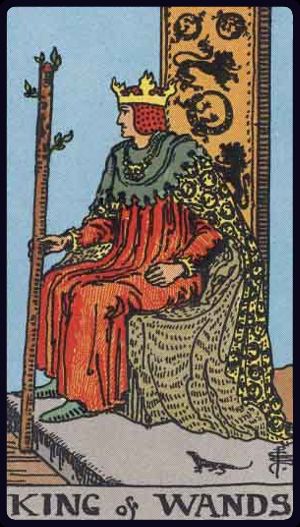
King of Wands
The card of the person others follow. It turns up around vision and leadership, and asks whether you are taking people somewhere or just going.
When the card lands in a Tarot Chats session, we read the King of Wands as vision plus the ability to make other people act on it. The fire has become direction, and the question is usually what it is being used for.
Introduction
The King of Wands sits on a throne decorated with lions and salamanders, holding a staff, turned slightly away as though he is already thinking about the next thing. He is the end of the suit that started with a spark, and this is what the fire becomes when it stops being impulsive: vision with enough authority behind it that other people move. That is a real and slightly dangerous capability. The Knight charges off alone. The King takes a hundred people with him, which is excellent if the direction is right and expensive if it is not. The card usually appears around leadership, ambition and influence, and it tends to arrive with a question about responsibility rather than about capability. If you want a wider sense of how cards like this fit into a reading, our guide on how tarot works walks through it without the mystical jargon.
Upright Meaning
Upright, the King of Wands describes visionary leadership that works. Someone who can see where a thing should go and can persuade others to help get it there. It is the most naturally charismatic card in the deck and, unlike the Knight, it has enough discipline to finish. If the card describes you, it is usually confirming that people are looking to you whether or not you asked them to, and that pretending otherwise is not available anymore. There is a strong theme of ownership. The King takes responsibility for the direction, which means taking responsibility when the direction was wrong, and that is what separates this card from mere charisma. It also describes decisiveness with judgement behind it. Moving fast, but from experience rather than impulse. The practical instruction is usually about delegation and trust. This card fails most often not through bad vision but through the person insisting on doing everything themselves, which caps the whole thing at one person's capacity.
Reversed Meaning
Reversed, the King of Wands usually means authority misused or mislaid. The common version is domineering: leading through force of personality, not listening, treating disagreement as disloyalty. That produces short-term compliance and long-term loss of the best people, and the card reversed names it fairly directly. Another version is vision without delivery. Big ideas, inspiring speeches, nothing finished. Someone who can generate enthusiasm and cannot convert it, which is a specific and common failure in people who are genuinely talented. There is also a reading about abdication. Having the position and not using it, avoiding the decisions, leaving a vacuum that somebody less suitable fills. Reversed, the card can be pointing at that, and it is often more uncomfortable than the domineering version because it is harder to see from inside. A third possibility is impatience with other people, which is the Knight's fault surviving into a role where it does real damage.
Love and Relationships
In love, the King of Wands describes someone with presence and conviction. Passionate, loyal, generous, used to being in charge and not always good at not being. For the right partner that is exciting. It works badly with anyone who needs to be met as an equal in decisions, unless the King has learned to stop leading at the front door, which is a thing this card can be asked about directly. If you are single, the card can describe wanting a relationship with real substance rather than another pleasant nothing, and the readiness to be direct about that. It also describes commitment of an active kind: choosing someone, publicly, and backing them. There is a version about someone whose ambition takes up all the oxygen. Not unkind, just consistently occupied elsewhere, with the relationship fitted into gaps. The card is honest that this happens, and that it is usually invisible to the person doing it until somebody says so.
Career and Money
At work, this is the strongest leadership card in the deck. Founding something, running something, taking charge of a situation that needs direction. It describes the person who sets the vision rather than the one who executes it, and it is particularly good for entrepreneurship, senior roles and anything requiring people to be persuaded. If you are asking whether to step up, it is encouraging. With money, the King is ambitious and comfortable with risk, but more experienced than the Knight: it describes calculated bets rather than impulsive ones. It reads well for ventures, investment in your own business, and negotiating from strength. The card's caution at work is about scale. Vision is easy to have and difficult to hand over, and this card's characteristic failure is the leader who cannot let go of the detail and becomes the bottleneck in the thing they built. If you are already at capacity, the King is usually asking who you trust.
Yes or No
Yes
The King of Wands is a strong yes, and one of the more authoritative in the deck. It supports ambitious plans, leadership, taking charge and going for something substantial. What makes it more reliable than the Knight's yes is experience: this card has done things before and its confidence is based on that rather than on enthusiasm. For questions about whether you are capable of something bigger, it agrees without much hesitation.
When the answer can shift
The answer softens when the question depends on other people cooperating on their own terms. This card assumes influence, and if the situation involves someone you cannot persuade or a system you do not control, its confidence overstates things. It also shifts for anything requiring patience or detailed follow-through. The King is a starter and a director rather than a finisher, and a question about the unglamorous middle of something is better answered by a different card.
Example Interpretation
A typical situation. Olamide, 46, started a recruitment firm eleven years ago and now employs nineteen people. He still personally handles the six biggest client relationships, approves anything over a certain value, and reads every proposal before it goes out. Two good people left last year, and in both exit conversations the phrase used was something like not enough room. He pulls the King of Wands. For Olamide, the card is not questioning what he built, which is substantial. It is pointing at the six clients and the proposals, and at the fact that the thing preventing the firm from getting bigger is the same thing that made it exist. The King's actual power is direction rather than execution, and a leader who cannot delegate has built a very demanding job rather than a company. The two departures are the information; the card is just making sure he has read them.
Another quick example
A quicker one for work: Maeve, 38, has been asked to lead a new team and has spent a week worrying she is not experienced enough, while everyone around her treats it as obvious. She pulls the King of Wands. The card is not addressing her experience. It is noting that other people have already decided, and that she is the only one still holding a vote.
Common Misconceptions
The most common misreading of the King of Wands is as a card about dominance, which collapses it into the reversed version. Upright, this is someone who takes people with them rather than pushes them, and the distinction is the whole card. Another mistake is assuming it means a formal position. Plenty of people carry this energy with no title at all, and it appears for anyone others are looking to. People also read it as a promise of success. It describes capability and influence, not outcome, and a strong leader pointed in the wrong direction is one of the more expensive things in the deck.
Final Thoughts
The King of Wands is where a suit that began with a single spark arrives: fire that has learned to aim. If you have pulled it, you are probably either being asked to lead something or already leading it while telling yourself you are not. The card has very little doubt about your capacity. What it wants to know is what the capacity is being used for, and whether the people following you have somewhere good to arrive. Vision is not automatically a virtue. It is only worth as much as the direction, and the direction is the one part of this card that nobody else can check for you.
Related Reading
Queen of Wands
The same fire held rather than directed. Confidence, warmth and being fully yourself.
King of Pentacles
The other kind of authority. Built slowly, held carefully, measured in what lasts.
How Tarot Works
A grounded explainer for anyone new to readings. Tarot as interpretation, not prediction.
Want a Free tarot reading
Get a free readingTarot readings are for entertainment and personal reflection. They offer perspective, not predictions, and should not replace professional advice for medical, legal, or financial matters.