Minor Arcana · Cups
Knight of Cups
The card of the romantic gesture. It turns up around sincerity and idealism, and asks whether the feeling survives ordinary weather.
When the card lands in a Tarot Chats session, we read the Knight of Cups as sincere feeling in motion. The romance is genuine, and the card is usually asking what happens once the gesture is over.
Introduction
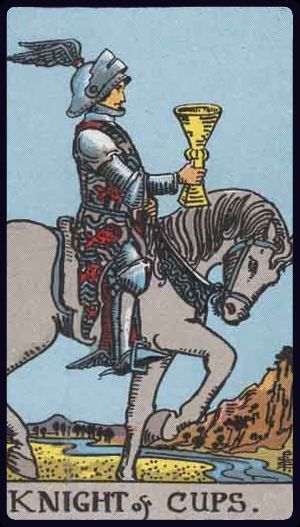
The Knight of Cups rides slowly, holding a cup out in front of him as though offering it. His horse is walking rather than charging, and there are wings on his helmet. He is the gentlest of the four knights and the most likely to disappoint, which is an odd combination until you have met one. This is the card of the grand gesture, the beautifully written message, the person who arrives with flowers and means it entirely. Nothing about the sincerity is fake. The question the card raises is about what happens on an ordinary Tuesday, when there is nothing to offer and nobody is watching, because that is the part the picture does not show. If you want a wider sense of how cards like this fit into a reading, our guide on how tarot works walks through it without the mystical jargon.
Upright Meaning
Upright, the Knight of Cups describes following your heart, usually in a visible way. Making the romantic gesture, pursuing something because it moves you, acting on feeling rather than calculation. The card is warm about it and genuinely encouraging: a great many good things exist because somebody was prepared to be sincere in public. It also describes a person. Charming, emotionally expressive, artistic, a little dreamy, someone who arrives with an offering. If the card is pointing at someone in your life, that is usually the description, and the card is not warning you off them. There is a creative reading too. Art made from feeling, work driven by what you care about, the willingness to put something personal into what you produce. The practical instruction is usually about the gap between feeling and doing. This knight feels a great deal and moves slowly, and the card tends to appear when it is time to actually make the offer rather than continue composing it.
Reversed Meaning
Reversed, the Knight of Cups usually means the gesture without the substance. Promises that are meant when they are made and not kept, romance that stops when the effort starts, someone in love with being in love. The card reversed is not calling them a liar, which is what makes this pattern so difficult: the sincerity is real each time. Another version is moodiness and withdrawal. Feelings ruling everything, retreating when hurt, an emotional weather system that everyone around has to navigate. Reversed, the card can describe that in someone else or in you. There is also a reading about idealism curdling into disappointment. Expecting too much of people, of love, of a job, and then being wounded when the ordinary version turns up. Reversed, the Knight can be pointing at that cycle, which usually repeats until the expectation is examined rather than the people.
Love and Relationships
This is the card's main territory. In love, the Knight of Cups is the romantic approach: being pursued, being courted, somebody making an effort that is genuinely lovely. It often appears when someone is interested and is about to make it obvious. The card is positive and it deliberately leaves the follow-through unaddressed, because that is genuinely unknown at this stage. If you are single, it can describe a new person arriving with real charm, and the sensible reading is to enjoy it while noticing that gestures are cheap compared to Tuesdays. In an existing relationship, the Knight describes romance returning: effort made, attention paid, someone choosing to be affectionate rather than efficient. That is worth a great deal. The card's honest caution is that this knight is better at beginnings than at middles, and that a relationship conducted entirely at this pitch will eventually have to survive becoming ordinary.
Career and Money
At work, the Knight of Cups describes doing something for love rather than money. Creative work, a job chosen because it means something, a project you care about more than it pays. The card is supportive of that and it is not practical, which is the trade. It can also describe an offer arriving: a proposal, an approach, an invitation made warmly. Those tend to be genuine with this card and less well specified than they should be. With money, the Knight is the least reliable card in the suit. It describes financial decisions made on feeling: helping someone because you want to, spending on something beautiful, taking a job for less because it seemed right. None of those are wrong and none of them are calculated. If this card appears for a money question, the useful reading is that the decision is being made emotionally, and that checking the numbers is the thing most likely to be skipped.
Yes or No
Yes
The Knight of Cups is a yes, particularly for anything romantic or heartfelt. Should I make the gesture, should I tell them, will they respond: the card generally agrees. Its confidence is about sincerity rather than outcome, which makes it reliable for questions about whether the feeling is real and less so for questions about whether it lasts.
When the answer can shift
The answer weakens considerably when the question is about reliability. Will they follow through, can I depend on this, is it a solid arrangement: the Knight is not equipped, and its yes there describes intention rather than behaviour. It also shifts for anything practical. Money, contracts and logistics are outside this card's range, and its agreement in those areas is warmth rather than judgement.
Example Interpretation
A typical situation. Rosa, 42, has been seeing someone for three months who is attentive in a way she has not experienced before. He remembers things, he writes properly, he turned up at her work with lunch when she had a bad week. She has also noticed that he has cancelled twice at short notice, both times apologising beautifully, and that she does not actually know very much about his ordinary life. Her friends think he is wonderful. She pulls the Knight of Cups. For Rosa, the card is not telling her he is insincere, which would be unfair and probably untrue. It is naming exactly what she has: someone genuinely romantic, at three months, with the evidence so far consisting almost entirely of gestures. The Knight's question is not whether he means it. It is what he is like when nothing needs to be demonstrated, and three months is about the point where that becomes findable.
Another quick example
A quicker one for work: Adam, 31, has been offered a role at a charity for considerably less money, by someone who spoke about the work in a way that stayed with him. He pulls the Knight of Cups. The card is on the side of the feeling and quietly notes that he has not yet asked a single practical question.
Common Misconceptions
The most common misreading of the Knight of Cups is as a prince charming card, which sets people up for exactly the disappointment the reversal describes. It is about sincerity in motion, not about someone's suitability as a partner. Another mistake is reading the slowness as reluctance. This knight moves at that pace by nature and it is not a signal. People also assume the card always describes a man arriving in your life. Court cards describe an energy, and this one turns up just as often for the person making the gesture as for the one receiving it.
Final Thoughts
The Knight of Cups is the card of being moved enough to do something about it, which is genuinely lovely and genuinely incomplete. Most of what matters in a relationship, or a vocation, happens after the gesture, on the days where nothing is being offered and nobody is watching. If you have pulled this card, something sincere is in motion. It is worth enjoying rather than analysing, and it is also worth remembering that the picture shows a knight on his way somewhere, and that the interesting part is what he is like when he arrives.
Related Reading
Want a Free tarot reading
Get a free readingTarot readings are for entertainment and personal reflection. They offer perspective, not predictions, and should not replace professional advice for medical, legal, or financial matters.