Minor Arcana · Pentacles
Ten of Pentacles
The card of what outlasts you. It appears around family, legacy and the kind of security that is meant to be shared.
When the card lands in a Tarot Chats session, we read the Ten of Pentacles as a card about permanence rather than wealth. It asks what you are building that will still be standing when you are not the one holding it up.
Introduction
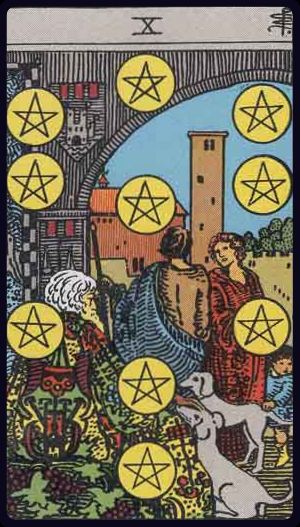
The Ten of Pentacles is the busiest card in the suit. There is an old man with two dogs, a couple mid-conversation, a child reaching out, an archway, a family crest on the wall. Three generations in one frame. After the Nine's solitary garden, this card deliberately fills the space with other people, and that is the shift it describes: from something you built for yourself to something that includes everyone around you. It is the card of houses that stay in families, businesses passed down, traditions nobody remembers starting. It is also, quietly, a card about time. Everything in it took longer than one person's patience, and the old man in the corner is not the one doing the work anymore. If you want a wider sense of how cards like this fit into a reading, our guide on how tarot works walks through it without the mystical jargon.
Upright Meaning
Upright, the Ten of Pentacles describes lasting security, usually involving family or something that will outlive you. Property, an inheritance, a business with roots, a household that works. The stability here is different from the Nine's because it is not dependent on you personally. It has become a structure rather than an achievement, and structures hold people up. The card often appears around long-term decisions: buying a house, having children, marriage, writing a will, merging two families. It is generally favourable for all of those, and it treats them as the serious commitments they are rather than romantic milestones. There is a theme of continuity that people either find deeply comforting or slightly claustrophobic. The card is about being part of something bigger than your own life, which cuts both ways. Some people pull this card and see belonging. Others see obligation, expectation and a path already laid out. Both are in it. The Ten is honest that permanence involves being tied to things.
Reversed Meaning
Reversed, the Ten of Pentacles usually points at family or long-term structures under strain. Arguments about money or property, inheritance disputes, a family business that has become a trap, or the specific misery of conflict with people you cannot simply stop seeing. The card reversed handles those plainly. Another version is instability where there should be foundation. A house that is not secure, a long-term plan that has come apart, the loss of something that was supposed to last. That is a hard reversal and the card does not soften it. There is a third reading worth knowing, which is about breaking with continuity deliberately. Leaving the family business, moving away, declining to follow the path that was laid out, ending a tradition. Reversed, the Ten can describe that as a real and sometimes necessary choice rather than a failure, though it does not pretend it is cost-free. Whatever you walk away from, somebody notices.
Love and Relationships
In love, the Ten of Pentacles is one of the most committed cards in the deck. It describes relationships built to last: marriage, children, buying somewhere together, meeting each other's families properly, becoming part of each other's structure rather than each other's week. If that is what you want, it is a very good card to pull. It is also a card about families rather than couples, which means it often brings in everyone else. In-laws, children from previous relationships, obligations to parents, the question of whose Christmas. Those are the actual substance of long relationships and the Ten does not pretend otherwise. If you are single, the card can point toward the kind of relationship you are actually looking for rather than the kind you have been having. It can also describe pressure, real or imagined, about settling down, and the difference between wanting this and being expected to want it is something the card will not decide for you.
Career and Money
With money, the Ten of Pentacles is about wealth that is stable rather than large. Property, pensions, long-term savings, money that is doing something rather than sitting still. It often appears around the big financial commitments: a mortgage, a family home, planning for people other than yourself. It is a supportive card for those, provided the foundations have been checked. It also comes up for inheritance and for money moving between generations, in either direction. Supporting parents, helping children, the complicated feelings that come with both. At work, the Ten describes established businesses, long tenure, or work that will continue after you leave it. Family businesses sit squarely here. If you are building something, the card asks a useful question: is this designed to work without you, or does it collapse the moment you stop? The first is worth considerably more than the second, and most people building something only realise that late.
Yes or No
Yes
The Ten of Pentacles is a strong yes, particularly for anything long term. Property, commitment, family plans, investments meant to last: the card supports all of them, and it is one of the more stable yeses in the deck because it describes things that are built rather than things that happen. It carries an implicit timeframe, though. This is a yes about the long run rather than the next few weeks, and the card assumes you are asking about something meant to endure.
When the answer can shift
The answer weakens for anything short term or exciting. The Ten is a slow card and it has very little to say about quick wins, new ventures or situations that need to resolve soon. It also shifts if the question is about breaking away rather than building. Leaving the family business, moving abroad, ending a long arrangement: the card's instinct is toward continuity, so it tends to answer conservatively, and that conservatism is worth weighing rather than simply accepting.
Example Interpretation
A typical situation. Omar, 36, and his wife are deciding whether to buy his parents' house. They can afford it, just. His parents want to downsize and would rather it stayed in the family than go to a stranger, and they have offered it slightly under value. It is a good house in the wrong part of the country for both their careers, and taking it would mean staying near his family permanently rather than for now. He pulls the Ten of Pentacles. For Omar, the card is not answering the financial question, which is fairly straightforward. It is naming the actual decision, which is not about the house. Buying it means choosing the structure: his parents nearby, his children raised where he was, a life with a shape already visible. The Ten is genuinely positive about that, and it is also asking him to notice he is deciding it, rather than letting a good property deal decide it for him.
Another quick example
A quicker one for money: Carol, 61, is writing a will and has been putting off the conversation with her two sons about what happens to the flat. She pulls the Ten of Pentacles. The card is not predicting an argument. It is noting that the conversation is part of the inheritance, and that leaving it unsaid does not avoid it, it just moves it to a worse moment.
Common Misconceptions
The most common misreading of the Ten of Pentacles is as a card of riches. People see ten coins and read wealth, which makes it feel irrelevant to anyone who is not wealthy. The card is about permanence rather than amount, and a modest house that holds a family is a purer example of it than a large fortune with no roots. Another mistake is assuming it always means literal family. It applies to anything built to outlast you, including a business, a body of work or a community. People also read it as purely positive. There is obligation in this card as well as security, and for some people the path laid out is the thing they most need to step off.
Final Thoughts
The Ten of Pentacles is the end of a long suit, and it is worth noticing what it took to get here. The Ace was an opportunity, the Eight was years of repetition, the Nine was standing alone in something you built. The Ten is what happens when that stops being yours alone. If you have pulled this card, you are probably near a decision with a long shadow: a house, a family, a commitment that will still be shaping your life in twenty years. The card is broadly in favour. Its only real request is that you choose it deliberately, because things this durable are difficult to undo, and the best version of permanence is the kind somebody actually wanted.
Related Reading
Want a Free tarot reading
Get a free readingTarot readings are for entertainment and personal reflection. They offer perspective, not predictions, and should not replace professional advice for medical, legal, or financial matters.