Minor Arcana · Cups
Three of Cups
The card of the people who show up for you. It turns up around friendship and celebration, and asks who you have let close enough to notice.
When the card lands in a Tarot Chats session, we read the Three of Cups as belonging rather than partying. It is about the people who turn up, and it often arrives when someone has been managing without them.
Introduction
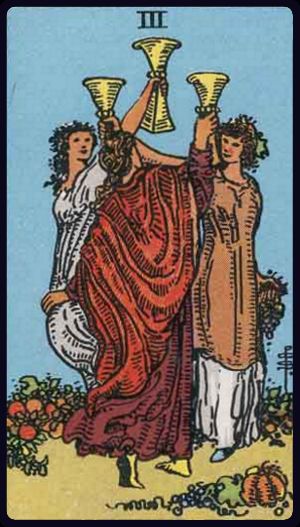
Three figures stand in a circle with their cups raised, in what looks like a harvest. They are not looking outward at anyone. The whole scene is closed and mutual, which is the point: this is the card of your people, the small group who know you and are glad about you. It sits after the pairing of the Two and widens it out. Friendship, community, the celebration that happens because something good happened to one of you. It is a straightforwardly warm card and it carries a quiet question that lands harder for some people than others, which is whether you actually have this, or whether you have a lot of contacts and nobody who would notice. If you want a wider sense of how cards like this fit into a reading, our guide on how tarot works walks through it without the mystical jargon.
Upright Meaning
Upright, the Three of Cups describes friendship, celebration and support. Something good has happened, or is about to, and there are people around you who are genuinely pleased about it. The card also describes the ordinary sustaining version of this: the group chat, the regular pub night, the friends who have known you long enough that you do not have to explain yourself. It is one of the few cards in the deck that treats that as significant rather than incidental, and it is usually right to. There is a theme of receiving support specifically. The Three often appears when someone needs to let other people in, or when help is available from a direction they have not considered. Friends tend to be underused as a resource by exactly the people who most need them. The practical instruction is generally social and unsubtle: see people, accept the invitation, tell someone the good news rather than sitting on it until it goes cold.
Reversed Meaning
Reversed, the Three of Cups usually means something has gone wrong in the group. Falling out with friends, feeling excluded, a circle that has become exhausting rather than sustaining. It can describe the specific loneliness of being surrounded by people and known by none of them, which is different from being alone and often worse. Another reading is isolation, either chosen or drifted into. Withdrawing after something difficult, being too busy for the people who matter, letting friendships lapse because maintaining them felt like one more task. The card reversed names that without scolding, and it usually appears at the point where it has gone on long enough to notice. There is also a version about excess. Socialising as avoidance, drinking as a habit rather than an occasion, using company to not be alone with something. Reversed, the Three can be pointing at that, and the tell is usually that the socialising is not actually enjoyable anymore.
Love and Relationships
In love, the Three of Cups is less about the couple and more about everything around it. Your relationship meeting your friends, a partner becoming part of your wider life, the health of a relationship measured by whether it has room for other people. That is a genuinely useful test and the card is one of the few that applies it. If you are single, the card is generally reassuring: it describes a full life among people who care about you, and it tends to appear when someone has been treating singleness as a deficiency rather than a state. There is also a harder reading about a relationship that has cut you off. Not dramatically, just gradually, until the friendships thinned and the world got small. The Three does not accuse anyone of doing that deliberately. It does notice when it has happened, and it is usually the friends who see it first.
Career and Money
At work, the Three of Cups describes good colleagues and collaborative success. A team that genuinely likes each other, a shared achievement, the kind of workplace where people look out for one another. It is not about hierarchy or recognition, it is about the horizontal relationships, which are often what makes a job bearable or not. It also describes networks in the useful sense: people who help each other because they want to rather than because it is transactional. A surprising amount of work comes through this, and the card's practical instruction is to maintain those relationships when you do not need anything, because that is the only time it works. With money, the Three has little direct relevance, though it can describe shared costs among friends, celebrations that cost something, or generosity within a group. Its reading there is usually that the spending is worth it, which is not advice this deck offers often.
Yes or No
Yes
The Three of Cups is a warm yes, especially for anything social or collaborative. Should you go, should you say yes to the invitation, will the group thing work out, should you involve other people: the card agrees comfortably on all of it. Its confidence is about goodwill rather than logistics, which makes it reliable for questions about people and less so for anything mechanical.
When the answer can shift
The answer becomes less useful for solitary or practical matters. Questions about money, work strategy or anything requiring focused individual effort are not what this card addresses, and its yes there is generic rather than meaningful. It also shifts if the situation involves a group that has already gone sour. Reversed or in a difficult context, the card can be describing the very dynamic you are asking about, in which case involving more people is not the answer it looks like.
Example Interpretation
A typical situation. Steph, 36, moved cities for work two years ago. She has colleagues she likes, a partner, and a life that looks full from outside. She has not seen her three oldest friends since the move, though they message. Last month one of them had a baby and she found out from Instagram, and it bothered her more than she expected. She pulls the Three of Cups. For Steph, the card is not telling her she has no friends, which would be untrue. It is pointing at the Instagram, which is the actual information: people who would have rung her two years ago now assume she is busy, and that assumption took two years of unreturned effort to build. The Three's suggestion is unglamorous and specific: book something. Not a message saying we should catch up, which is what the last two years have been made of, but a date.
Another quick example
A quicker one for work: Priti, 48, has just been shortlisted for something she worked towards for years and has not told anyone outside her family. She pulls the Three of Cups. The card is not about the shortlist. It is noting that good news kept private tends to stay unreal, and that the people who would be pleased are the point.
Common Misconceptions
The most common misreading of the Three of Cups is as a party card, which makes it sound trivial. It is about belonging, and the celebration is a symptom rather than the subject. Another mistake is reading it as exclusively female friendship because of the imagery. The card describes close friends of any kind. People also assume it means socialising is the answer to whatever is wrong, when reversed it frequently means the opposite: that the busy social life is the avoidance rather than the cure.
Final Thoughts
The Three of Cups is about the people who would turn up. Most people have fewer of those than they assume and more than they currently use, and the card sits precisely on that gap. If you have pulled it, something is probably asking to be shared: good news, a difficulty, or just your actual presence somewhere you have been declining. Friendships are maintained by occasions rather than intentions, and the card's whole position is that the occasion is worth the effort of arranging.
Related Reading
Want a Free tarot reading
Get a free readingTarot readings are for entertainment and personal reflection. They offer perspective, not predictions, and should not replace professional advice for medical, legal, or financial matters.