Minor Arcana · Wands
Two of Wands
The card of standing at the edge with the map in your hand. It turns up when the plan exists and the leaving has not happened yet.
When the card lands in a Tarot Chats session, we read the Two of Wands as the gap between deciding and going. It is interested in what is keeping you on the battlements when you have already looked at the map.
Introduction
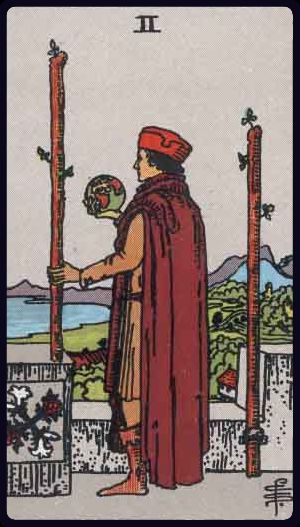
The figure in the Two of Wands is standing on a castle wall holding a small globe, looking out at the sea. He owns the castle. That is the tension in the card: he has something already, it is comfortable, and he is looking at the horizon anyway. This is the card of the person who has made the plan, who knows roughly what they want to do, and who has not moved yet. It comes after the Ace's spark and before anything actually happens, which makes it one of the more psychologically honest cards in the deck. Most big changes spend a long time at this stage. The card does not rush you out of it. It does ask what specifically is holding you, because the reason people give at this point is rarely the real one. If you want a wider sense of how cards like this fit into a reading, our guide on how tarot works walks through it without the mystical jargon.
Upright Meaning
Upright, the Two of Wands describes planning with real intent behind it. You are weighing options, looking at what is possible, thinking further ahead than usual. The card is positive about that: this is not procrastination, it is the stage where a spark becomes a direction. There is often a specific choice in it, usually between staying with something known and going toward something larger. The card has a mild bias toward going, because the figure is looking outward rather than back into the castle, but it does not pretend leaving is free. Comfort is real and the thing you would be giving up is real. The other quality here is scope. The Two is the point where you decide how big this is going to be, and people routinely decide too small. The card tends to appear when someone is quietly capable of more than they are planning for, and part of its work is asking whether the version you are considering is actually the one you want or just the one that feels allowed.
Reversed Meaning
Reversed, the Two of Wands usually means the planning has become a substitute for moving. Endless research, another spreadsheet, one more course before you are ready. The card reversed is direct about this: you have enough information and you are using the gathering of it to postpone the part that frightens you. Another version is fear of leaving. The castle is comfortable, the risk is real, and you have talked yourself out of it with arguments that are genuinely reasonable and not actually why. Reversed, the card asks you to be honest about which reasons are load-bearing. There is also a reading about a plan that has gone wrong. Something did not go as intended, the map was inaccurate, or a choice you made has turned out badly. The card reversed can describe the moment of realising you need a new plan rather than a better version of the old one, which is harder than it sounds because it means admitting the first one is finished.
Love and Relationships
In love, the Two of Wands describes a relationship at a decision point. Often it is about whether to take it further: commit, move in, move country, choose this person properly rather than continuing to see how it goes. The card is about the deciding rather than the outcome, and it notices when someone has been avoiding the decision by staying pleasantly undecided. If you are single, it can describe looking outward. Being ready for something different from what you have had before, or considering dating in a wider circle than the one you are used to. There is a version of this card about wanting more than the relationship currently offers. Not necessarily a different person, but a different shape: more adventure, more ambition, more life. That is worth saying out loud rather than sitting on the wall looking at the sea, because the other person usually senses it long before it is spoken and fills in a worse explanation.
Career and Money
At work, the Two of Wands is the card of the plan you have not executed. The business idea with a name and no customers, the job you are qualified for and have not applied to, the move that would work and has not been made. It is a supportive card for ambition, particularly ambition larger than your current role. It also describes genuine strategic thinking: considering the market, weighing options properly, taking a longer view than the next quarter. If you are in that stage, the card is endorsing it rather than hurrying you. With money, the Two often appears around a decision that involves risk. Investing, leaving a salary, putting money into something you believe in. It does not tell you the outcome and it does have a view about the method: look at it properly, decide, and then actually do it. The card's real objection is to the situation where the analysis is complete and nothing follows, which is where a surprising number of good plans end.
Yes or No
Yes, if you move
The Two of Wands leans yes, and the yes is conditional on action rather than on circumstances. The card says the plan is sound and the opportunity is real, and then points out that neither of those has any effect until you do something. It is not a card that promises things will come to you. For questions about whether something is worth pursuing, it is a clear yes. For questions about whether it will happen on its own, it is not agreeing at all.
When the answer can shift
The answer weakens if you have been at this stage a long time. The Two is a card of imminent departure, and if the planning has been going on for a year or more, the card starts describing the delay rather than endorsing the plan. It also shifts if the question is about whether to stay. The card's instinct is outward, so a question about remaining somewhere comfortable tends to get an answer about the horizon instead, which may not be what you were asking.
Example Interpretation
A typical situation. Zainab, 40, has been offered the chance to move to her company's Berlin office for two years. It is a step up, she speaks some German, and she has been talking about wanting to live abroad since her twenties. She has a flat she likes, a father who is getting older, and a group of friends she has had since school. She has had the offer for three weeks and has made a list of pros and cons four times. She pulls the Two of Wands. For Zainab, the card is not making the decision. It is pointing out that the lists are finished and are now being redone, which means the information is not the problem. The honest question underneath is whether she is willing to be the person who leaves, and the father is doing a lot of work in her reasoning that it may or may not deserve. The Two suggests finding out: ask him. The answer may be different from the one she has assigned him.
Another quick example
A quicker one for work: Matt, 27, has had a business plan on his laptop for eight months and has just started rewriting the market research section. He pulls the Two of Wands. The card is not impressed by the research. It is noting that he is on the wall with the map, and has been for a while.
Common Misconceptions
The most common misreading of the Two of Wands is as a card about travel. It can involve travel and it is really about scope and decision, and reading it literally as a journey misses most situations it appears for. Another mistake is treating it as hesitation. The card describes a legitimate stage of thinking, and not every pause is avoidance. The judgement is in how long it has gone on. People also read it as a small card because it is a two. It often marks one of the larger decisions in someone's life, and the modest number is misleading: this is the point where the size of the whole undertaking gets set.
Final Thoughts
The Two of Wands is the card of the moment before, and almost everyone recognises it. You have the idea, you have thought it through, and you are standing somewhere safe looking at somewhere that is not. The card does not push you off the wall. What it does is separate the two things that get confused at this stage: whether the plan is good, and whether you are willing to go. The first one you have probably already answered. The second is the one you have been circling, and no amount of further planning will resolve it, because it was never a planning question.
Related Reading
Want a Free tarot reading
Get a free readingTarot readings are for entertainment and personal reflection. They offer perspective, not predictions, and should not replace professional advice for medical, legal, or financial matters.