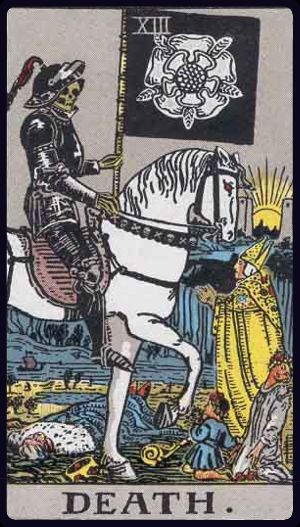
Major Arcana
Death
The card of necessary endings. Almost never literal death, almost always a chapter that is finally complete and ready to make room for what comes next.
At Tarot Chats, we read Death as the card of necessary endings, the kind that make room for what is next. It is almost never about literal death, and almost always about a chapter that is finally complete.
Introduction
The card most people are afraid to pull is also one of the most consistently misunderstood. Death almost never refers to physical death. The card is about endings of a different kind. The end of a chapter. The end of a relationship pattern. The end of a job. The end of a version of yourself you have already outgrown. The figure in the classic imagery is a skeleton on a horse, often carrying a banner, moving through a landscape with people of different stations falling in its path. The image is dramatic on purpose. Endings can feel that big. But the card is not punishment. It is a clearing. The version of your life that comes next cannot exist while the old one is still in place, and Death is the card that tells you the old one is finally ready to go.
Upright Meaning
Upright, Death is naming a real ending. Usually one you have quietly known was over for a while and have not yet allowed yourself to act on. The card wants you to honor the ending rather than cling to the chapter that has been wrapping itself up. Anyone who draws this card is often inside transitions they have been resisting. A job they have outgrown. A relationship they keep restarting. A friendship that has not been mutual in years. A version of themselves they have been performing well past the point it was true. Death is unsentimental about the difference between what is alive and what is being kept on life support. The card is asking which one you are looking at, and giving you permission to let the ending happen so the next chapter can actually start. Where Death is gradual, The Tower is its sudden cousin. Both clear the ground. They just move at different speeds.
Reversed Meaning
Reversed, Death shows up in two main shapes. The first is refusing the ending. The chapter is over and you are still acting like it is not. The card is asking what it would take to actually admit the truth, both to yourself and out loud to the people who need to hear it. Refusal does not preserve the old chapter. It just delays the start of the new one and makes the eventual transition messier. The second pattern is being stuck mid-ending. You started releasing the old version of your life and got partway through, and now the in-between is uncomfortable. You are tempted to reverse course and re-enter the chapter you were leaving. The card is asking you to keep moving instead. The discomfort of the transition is real but temporary. Going back is rarely possible, and rarely useful when it is. The Six of Swords is the quieter picture of that transition: the crossing itself, subdued, with the rough water behind you.
Love and Relationships
Death in love is honest in a way most people prefer the cards not to be. Sometimes it names a relationship that is genuinely ending, even if neither partner has said it yet. The card is acknowledging what both people already know. More often, the card names the ending of a phase within a continuing relationship. The honeymoon stage closing as the more grounded partnership begins. The dynamic where one of you was the caretaker and the other was the cared-for finally collapsing because both of you have grown. The end of an arrangement that worked at one stage of life and does not fit the people you are now. For someone single, Death often shows up around the ending of a romantic pattern. The type you keep dating. The role you keep playing. The story you keep telling about why it never works out. The card is nudging you to let the pattern actually die so a different kind of relationship becomes possible. The pause that often precedes that ending is the territory of The Hanged Man, which sometimes shows up just before Death does its work.
Career and Money
At work, Death is the card of a chapter ending. Sometimes a job. Sometimes a whole career direction. Sometimes a role inside a company that has stopped fitting the person doing it. People who pull Death during a career question are often being told something they already suspect, which is that the current arrangement is not going to be the one they are in a year from now. The card is not pushing you to quit tomorrow. It is calling on you to stop pretending the situation is sustainable when it is not. With money, Death often names the ending of a financial pattern. A debt finally paid. A subscription cycle quietly bleeding you that needs cancelling. A relationship with money that came from a version of you who is no longer here. The card is asking you to let the old financial story end so a new one can take shape.
Yes or No
No to preserving the past
In most readings, Death is a no for any question about preserving exactly what is, and a yes for any question about whether something needs to end. The card is honest. If you are asking whether you can keep the chapter as it has been, the answer is no, the chapter is already closing whether you participate or not. If you are asking whether the ending is really happening, the answer is yes, and the next move is to participate in it instead of resisting.
When the answer can shift
Where it can shift toward a soft yes: when your question is about beginning the next chapter. Death is paradoxically generous toward new starts, because it knows what is already complete. If your real question is whether to step into the next thing, the card says yes, but only after you have actually closed the previous one. Skipping the ending and rushing into the new chapter usually drags the old one in with you.
Example Interpretation
Take Camille, 47, who has been at the same teaching job for sixteen years. She used to love it. The last three years, she has been running on duty rather than energy. The school has changed. Her energy has changed. Her own kids are grown and the schedule that used to fit her family no longer needs to. She has been telling herself that she will stay until retirement because that is the responsible move. She pulls Death. The card is not asking her to dramatically quit and storm out. It is naming what she already knows. The version of this job that she loved is over. The version that exists now is not the same job. The card is nudging her to actually decide what she wants the next decade to look like, instead of defaulting to the old chapter out of inertia. She might leave at the end of the year and pivot. She might stay one more year on her own terms with a real plan to leave after. She might find a new role inside teaching that matches who she has become. The card is not making the call. It is telling her the chapter is closed and she gets to write the next one.
Another quick example
A short example from relationships: Andre, 31, has been on and off with the same partner for four years. They keep breaking up and getting back together for reasons that look slightly different each time but feel exactly the same. He pulls Death. The card is not predicting which way the next round goes. What it is after is for him to notice that the cycle itself is the chapter that needs to end, regardless of what he and the partner decide about each other.
Common Misconceptions
The biggest miss with Death is taking it literally. The card is almost never about physical death. People who panic when they pull this card are reacting to medieval imagery, not to the actual meaning. A second misreading is treating Death as catastrophic. Endings can be sad, but they are also the only way new chapters become possible. The card is honest, not cruel. A third common error is assuming Death means the ending is sudden or violent. Sometimes endings are. More often, Death names something that has been quietly ending for months or years and is finally ready to be acknowledged out loud. The drama in the imagery does not always match the actual texture of the ending.
Final Thoughts
Death is the card that asks you to stop holding onto a version of your life that is already over. Drawing this card usually means the work is not to make a dramatic decision today. It is to be honest about what is actually still alive in your life and what has been finished for a while. The honesty is uncomfortable. The clearing it creates is what the next chapter needs in order to arrive. There is no shortcut around the ending. There is just the choice to participate in it consciously or to be dragged through it. The cards do not love either option, but they prefer the first. For the gentler card that handles the rebuild after a real ending, The Star is the next conversation.
Related Reading
The Tower
Death's louder companion. When the ending is sudden and structural rather than gradual, the Tower is the card.
Judgement
The card that often arrives after Death has cleared the ground, when a real call to the next chapter becomes audible.
The Star
The hopeful renewal that often follows a Death card. About the gentle rebuild after the ending is honored.
Want a Free tarot reading
Get a free readingTarot readings are for entertainment and personal reflection. They offer perspective, not predictions, and should not replace professional advice for medical, legal, or financial matters.