Major Arcana
The Hanged Man
The card of voluntary pause. About letting go of the strategy that has not been working, and letting a new angle on the problem arrive once you stop forcing one.
When we draw this one at Tarot Chats, we read The Hanged Man as the card of voluntary pause, the kind that lets you see the situation from a new angle. The pause is the work.
Introduction
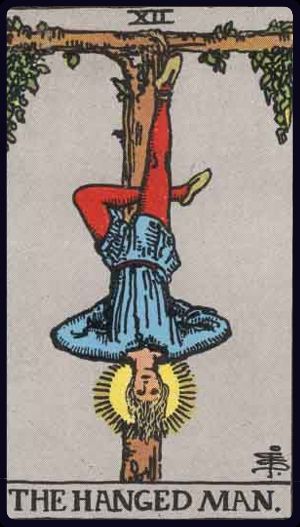
Some problems will not solve while you are still trying to solve them. They need you to stop, get into a different position relative to the problem, and let an answer arrive that the busy version of you was actively blocking. The Hanged Man is the card of that pause. The card shows a figure who hangs upside down by one foot from a tree, hands behind his back, with a look on his face that is not pained. He chose this position. He is suspended on purpose, because the only way to see the situation clearly was to stop trying to fix it from the inside. The card is uncomfortable for action-oriented people because it is asking them to stop. More often than they would like to admit, that stopping is the only thing that will move the situation forward.
Upright Meaning
Upright, the Hanged Man is voluntary surrender. Not defeat. Surrender of the strategy that has not been working. The quieter inward work this card asks for has a lot in common with the territory of The Hermit, where stepping back is the move. The card wants you to stop pushing for a season, not because you have given up, but because you have admitted that the angle you were attacking the problem from has not been productive. The people who tend to draw this card are often deep in a stretch of trying harder at something that is not responding to harder. A relationship being saved through over-explaining. A career being forced into a shape it does not fit. A creative project being pushed past a real block. The card is asking you to suspend the effort, not abandon it. The pause is the move. There is also a perspective note here. The Hanged Man sees the situation upside down on purpose. Whoever pulls this card is often being asked whether the assumptions underneath the problem might actually be the problem.
Reversed Meaning
Reversed, the Hanged Man tends to take one of two shapes. The first is forced suspension. You are stuck in a season of inaction not by choice but by circumstance. A long medical recovery. An unexpected layoff. A relationship in a holding pattern that is not yours to resolve. You have been chafing against the pause, trying to make something happen, getting more frustrated. The card is nudging you to actually accept the suspension instead of fighting it. The lessons it has are not available to people who are still trying to skip past it. The second pattern is the opposite. The card has been asking you to stop and you keep finding new ways to be busy with the same problem. Pretending to take a break while still working on it in the background. The card is calling on you for a real pause this time, not a performative one. The Four of Swords describes what that real pause looks like in practice: stopping on purpose so that something can recover.
Love and Relationships
In love, the Hanged Man often shows up when you are being asked to release the version of the relationship that exists in your head. Not necessarily to leave. Just to let go of how you thought it was supposed to look at this stage. Couples in long relationships pull this card when they have been forcing the partnership to fit a stage they have outgrown. The version of the marriage that worked at year three does not always work at year nine, and the card is asking whether you have been trying to preserve the old version instead of letting the relationship become what it is now. For unattached readers, the Hanged Man can mean a season of suspending the active dating effort, not as defeat, but as a recognition that the angle you have been working from is not producing what you actually want. The card is asking what becomes possible if you stop trying to make a connection happen on the timeline you set, and let the timeline shift on its own.
Career and Money
At work, the Hanged Man is the card of pausing a project, a strategy, or sometimes a whole career trajectory that is not working. When this card lands for someone during a career stretch they are forcing, they are often being asked to take a real step back. A sabbatical. A few unbroken weeks off. A change of scenery. The card is suggesting that the next move is not findable from inside the current grind. It needs distance. Sometimes the Hanged Man also appears for people who have been laid off, fired, or pushed out, and the card is reframing the suspension as useful rather than catastrophic. With money, the Hanged Man is about the value of doing nothing for a season. Most folks who pull this card during a financial question are often being told not to make the move yet. Not to invest. Not to refinance. Not to launch the new income stream. Sit with the situation a little longer. The clarity is on the way.
Yes or No
Wait
In most readings, the Hanged Man declines a yes or no, because the answer is suspension. The card is suggesting that you pause before deciding. If your question is whether to act now, the answer is generally no, the timing is not ripe. If your question is whether the answer will become clear once you stop forcing it, the answer is yes. The Hanged Man is not blocking the decision. He is asking you to make it from a position you cannot reach while you are still in motion.
When the answer can shift
Where it can lean toward a soft yes: when the surrender itself is the action being asked about. If your real question is whether to step back, take the pause, release the strategy, the card endorses that move. Where it can lean further toward no: when you are looking for permission to push harder. The Hanged Man does not endorse force as a solution to a problem that is asking for stillness.
Example Interpretation
Take Naomi, 36, a product designer who has been pushing a side venture for two years. A small product. A specific market. She quit her job nine months ago to focus on it full-time. The launch has been close to working but not quite. She has been iterating constantly, pushing harder on marketing, redesigning the product every few weeks, and the metrics keep refusing to take off. She is exhausted and out of runway. She pulls the Hanged Man. The card is not asking her to quit, and it is not telling her to keep grinding. It is signaling that she should stop for a real stretch. Six weeks off. No tweaking the product. No looking at the metrics. Take a part-time contract to extend her runway and give the project some room. The card is suggesting that the answer she needs about whether to keep going, pivot, or close the project will not arrive while she is still inside the daily fight. It will arrive once she gets enough distance to actually see the venture from outside. Some founders return from that pause with clarity to keep going. Some return with the clarity to shut it down. Either is a clean answer. Neither is reachable from where she is right now.
Another quick example
A typical one in relationships: Liam and his partner have been having the same fight for six months. Same trigger, same patterns, same outcome. He pulls the Hanged Man. The card is not telling him the relationship is broken. It is asking what would happen if both people agreed to stop having the fight for a while. Not solve it. Just let it sit, and notice what each person actually feels when the fight is not running.
Common Misconceptions
The misreading of the Hanged Man we hear most often is treating it as punishment or a sign of failure. The classic image shows a figure who is not being punished. He chose this position. The pause is voluntary. Another way people get the card wrong is reading the card as a sign you should give up entirely. The Hanged Man is suspension, not surrender of the underlying goal. The strategy pauses. The longer commitment can stay intact. A third common error is assuming the Hanged Man is purely passive. He is not. The work being done while suspended is internal. Releasing assumptions, getting honest about what is not working, letting a new angle on the problem actually land. None of that is passive. It just does not look like activity from outside.
Final Thoughts
The Hanged Man is one of the harder cards for action-oriented people, because the assignment is to stop. If you are new to reading the Major Arcana, our how tarot works primer covers why patience-cards like this one are honest rather than passive. Pull this card and the temptation is to find a workaround, a productive version of the pause that still lets you feel like you are making progress. The card declines that workaround. The whole point is the surrender of effort for long enough that the situation can be seen from a different angle. The decisions made after that pause tend to be cleaner, more sustainable, and less driven by panic than the ones made during the grind. For the more dramatic next stage, when the suspension finally produces a real ending, Death handles the transition into what comes next.
Related Reading
The Hermit
The Hanged Man's quieter cousin. Both are about withdrawal, but the Hermit is more chosen and less forced.
Death
The card that often follows the Hanged Man's pause, when an ending becomes the honest next step.
Wheel of Fortune
The card of cycles that often turns once the Hanged Man's surrender has done its work.
Want a Free tarot reading
Get a free readingTarot readings are for entertainment and personal reflection. They offer perspective, not predictions, and should not replace professional advice for medical, legal, or financial matters.