Major Arcana
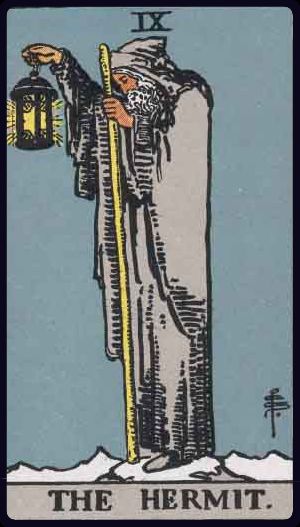
The Hermit
The card of intentional withdrawal. About stepping back from the noise long enough to hear what you actually think, and returning with something useful.
At our Tarot Chats table, we hold The Hermit as the card of intentional withdrawal, the kind that returns with something useful instead of just being away. Solitude is the method, not the goal.
Introduction
Pull back from your phone for one weekend, alone, with no input. No conversations, no scrolling, no shows, no podcasts. The first day will feel restless. By the second day you will start to notice things you have not had room to notice in months. By the end of the weekend, you will probably know things about your own life that have been waiting quietly for that kind of room. The Hermit is the card of that deliberate withdrawal. The traditional image has a figure who stands alone on a mountainside holding a lantern, dressed in a long robe, looking inward more than outward. He is not lost. He is exactly where he chose to be. The card is about the kind of wisdom that only shows up once the noise stops.
Upright Meaning
Upright, the Hermit is asking you to step back from something on purpose. A relationship dynamic. A constant low-grade work stress. A social pattern. A stream of input that has been crowding out your own thinking. The inner knowing this kind of solitude tends to surface has a lot in common with the territory of The High Priestess. The card is suggesting that the answers you have been chasing externally are not going to land until you give yourself real quiet to receive them. People who pull the Hermit are often being asked to take genuine solo time. Not a vacation with a partner. Not a long weekend with friends. Actual aloneness, even just for a day or two. The card respects that this is uncomfortable for most modern people and asks for it anyway. There is also a teaching note here. The Hermit holds a lantern, which is meant to be shared. People who have done their inner work eventually become useful to other people who are starting theirs. The card sometimes appears for someone moving toward that mentor role.
Reversed Meaning
Reversed, the Hermit shows up around two patterns. The first is isolation that has slipped past wisdom into avoidance. You started withdrawing for good reasons and have now been alone too long. Friends have stopped reaching out because you stopped responding. The card wants you to come back, gently, before the isolation calcifies. The second pattern is the opposite. You have been refusing the inner work entirely. Constantly busy, constantly distracted, constantly surrounded by people, and the result is you have not had a real thought about your own life in months. The Hermit reversed names that pattern and asks you to stop running. Both flavors are about being out of balance with your own solitude.
Love and Relationships
In love, the Hermit is unusual because it asks for time away, not closeness. For couples, the card sometimes appears when one or both partners need real solo time and have not been getting it. The relationship has become so enmeshed that neither person remembers what they actually think when the other is not around. The card is suggesting a small structural change. A weekend apart. A solo trip. Time alone without making the time alone a crisis. For anyone single, the Hermit often shows up during a season of being on your own and frames it as preparation rather than failure. The version of you that emerges from this stretch will be steadier, clearer about what you actually want, and less likely to fall into the next available connection just because it is available. The card backs using the alone time well rather than rushing past it. The Eight of Cups is often the step before this card: walking away from something that is fine in order to find out what is missing.
Career and Money
At work, the Hermit asks you to step back from the noise long enough to think about strategy rather than tactics. People pulling this card are often deep in execution mode, getting things done, hitting metrics, never stopping to ask whether the things being done are still the right things. The card is suggesting time off, a quiet morning blocked off the calendar, a sabbatical, a long walk without a phone, anything that creates room to actually think. There is a quieter note here too. The Hermit sometimes appears for people who are considering a career pivot but have not given themselves the silence required to know what they actually want next. With money, the Hermit is about quiet review. Sit down with your numbers alone, not to make a decision yet, but to understand them. Most of the people who pull this card during a money question are often being asked to stop reading more money advice and start looking at their own actual situation.
Yes or No
Wait
In most readings, the Hermit declines to give a clean yes or no, because the answer is closer to not yet. The card is asking you to step back before deciding. If your question is whether to act now, the answer is usually no, take the quiet time first. If your question is whether the answer will become clearer with reflection, the answer is yes. The Hermit is not blocking the decision. He is asking you to make it from a place that is actually yours rather than from the noise around it.
When the answer can shift
Where the Hermit can lean toward a soft yes: when you have already done the inner work and are looking for confirmation. If the silent version of you has already settled the question and you are just second-guessing, the card endorses what you already know. Where it can lean toward a soft no: when the question is being asked in a panicked or pressured moment. The Hermit will not back decisions made under that kind of urgency.
Example Interpretation
Meet Jonas, 39, who has been go-go-go for the last decade. Built a small consulting practice. Got married. Had two kids. Bought a house. Promoted to senior in his industry. By every visible measure, his life is working. He has also not had a single day alone in years. He is constantly tired in a way that sleep does not fix. He has been considering taking a sabbatical and keeps talking himself out of it. He pulls the Hermit. The reading is not telling him his life is wrong. It is telling him that the version of him that built this life never had time to ask whether it is still the life he wants now, at 39, with the people he has become and the work he has been doing. The card asks for a real solo stretch. A week alone in a cabin. A long walk every day for a month. Anything that creates the silence required to hear what he actually thinks. The card is also acknowledging that this is harder for someone with a family and a business than for someone single and unattached, and is asking him to make the structural choices necessary to take the time anyway.
Another quick example
A short example from relationships: Kara, 33, has been with her partner for four years and just realized she has not spent a single full evening alone in over a year. Every dinner, every weekend, every trip has been together or with friends. She pulls the Hermit. The card is not warning about the relationship. It is naming the missing piece, and asking her to take a real solo evening this week, with no agenda, and notice what comes up.
Common Misconceptions
The most common misread of the Hermit is treating him as loneliness or social withdrawal in a sad sense. He is neither. The Hermit is selective and intentional, not isolated and stuck. Anyone confusing the two is missing the lantern in the picture, which is the point. A second common mistake is reading this card as a sign you should give up on relationships or social life. He is not asking that. He is asking for a season of inner work that the rest of your life will benefit from. A third common error is assuming the Hermit is depressing. He often arrives at a moment when the inner work is exactly what you have been avoiding, which can make the card feel uncomfortable, but the discomfort is the doorway, not the verdict.
Final Thoughts
The Hermit is asking you to make room for the version of you that actually thinks for itself. Not the version that reacts. Not the version that performs. The slower one underneath. For the wider conversation about trusting what surfaces in solitude, our tarot vs intuition guide is a useful companion. When this card shows up, the assignment is typically to subtract something rather than add something. Less input. Less talking. Less consultation with friends about your life. More direct contact with what you yourself actually feel and know. The lantern in his hand is not just for him. People who do this kind of work eventually become the steady ones in everyone else's life. For the social, communal counterpart that gets you back into right relationship with others once you have done the inner work, The Hierophant is the conversation about returning.
Related Reading
The High Priestess
The Hermit's quieter cousin. Where she trusts what you already know, he creates the silence required to hear it.
The Hanged Man
The next stage of the inner work, where simply waiting becomes its own kind of teacher.
The Star
The hopeful card that often follows once the Hermit's quiet work has settled and the path forward becomes visible.
Want a Free tarot reading
Get a free readingTarot readings are for entertainment and personal reflection. They offer perspective, not predictions, and should not replace professional advice for medical, legal, or financial matters.