Major Arcana
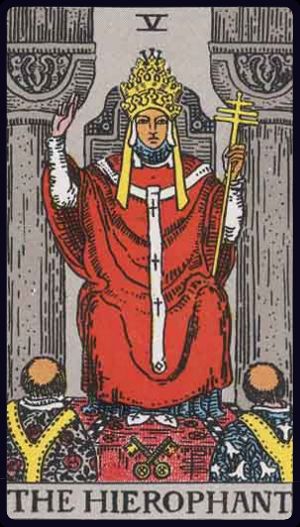
The Hierophant
The card of inherited wisdom. About what you take from the traditions and institutions that shaped you, and where the established way still has something to teach.
At Tarot Chats, we read The Hierophant as the card of inherited wisdom and the institutions that carry it. Useful when followed thoughtfully, costly when followed without question.
Introduction
Modern people are taught to question authority, which is mostly a good thing. But sometimes the established way exists because someone tried every other way for a century and the established way turned out to be the one that worked. The Hierophant is the card of that older, communal kind of wisdom. He sits between two pillars in priestly robes, with two figures kneeling before him. The imagery is overtly religious, which can put some readers off, but the broader meaning is wider than any single tradition. Any tradition you have inherited. Any formal teacher you have learned from. Any institution that has shaped you. The Hierophant is the card that examines what you have taken from those sources, what you have rejected, and where the inheritance still serves you.
Upright Meaning
Upright, the Hierophant is about working within established structures, the kind of structure The Emperor builds and maintains, thoughtfully rather than blindly. Anyone who keeps drawing this card is sometimes being asked to seek out a teacher, a mentor, a therapist, a spiritual community, or a formal program. Whatever you have been trying to figure out alone, the card is suggesting there is value in joining a tradition where someone else has already done the hard work and is willing to share it. There is also a note here about commitment to a longer arc. Marriage. Religion. A profession. A craft. A life lived inside one chosen frame instead of constantly hopping between frames. The Hierophant respects that kind of commitment, not because change is bad, but because some kinds of depth only show up after years of staying inside a single discipline.
Reversed Meaning
Reversed, the Hierophant tends to surface around two patterns. The first is an institution that has stopped serving its original purpose. The tradition you grew up inside, the religious community, the marriage, the corporate structure, the family dynamic, has become a place where the rules are still followed but the meaning has drained out. The card is asking, in much the same way The Lovers asks about values alignment, whether you stay and reform it from the inside or whether you leave. Neither answer is automatic. The second pattern is a person refusing community or guidance they actually need. Lone-wolf energy is romantic and expensive. Some problems are not solvable alone, and the card is gently pointing at the help you have been declining out of pride or independence.
Love and Relationships
The Hierophant in love is about the conventional. Marriage, long engagements, meeting the families, talking about children, operating inside a frame the surrounding culture recognizes. Readers who land on this card are sometimes being asked whether they actually want a relationship that fits the established mold. There is no wrong answer. Some people want that. Some do not. The reading is asking you to be honest about which one you are rather than drifting along assuming. For couples who are deep into a long-term commitment, the Hierophant often surfaces around shared values and shared rituals. Whether you are on the same page about religion, family, money, lifestyle. If not, the card is asking whether you have actually had the real conversation rather than a series of small avoidances. People in unconventional relationships sometimes find this card uncomfortable. It can name the friction that comes from running a partnership the surrounding culture does not have a ready script for.
Career and Money
At work, the Hierophant is the card of formal credentials, institutions, and the long apprenticeship. People who pull him are often being asked whether more training, certification, or formal teaching is worth pursuing. Sometimes it is. The card is generally on the side of doing it the established way when the established way actually works. It is also the card of mentorship. The person who could shorten your learning curve by years is usually someone who has already done the thing. The Hierophant is asking whether you have actually sought them out instead of trying to reinvent the wheel alone. With money, this card favors conventional planning. Retirement accounts. Index funds. Standard insurance. The unsexy advice from a fee-only financial planner. People who pull the Hierophant during a money question are often being told to stop trying to outsmart the system and just follow the playbook that has worked for most people for a long time. At work, the Three of Pentacles carries the same respect for expertise on a smaller scale: building something properly with people who know more than you do.
Yes or No
Yes, by the book
In most readings, the Hierophant leans yes, with a preference for doing the thing the established way. If you are asking whether to pursue the conventional path, the answer is generally yes. The card is not anti-creativity, but it is suspicious of skipping steps that exist for a reason. Doing it the proven way is often the fastest route to the destination, even when the proven way feels slower than improvising.
When the answer can shift
Where it can lean the other way toward no: when the conventional path is conventional in your family or culture but not actually right for you. The Hierophant respects tradition but does not require you to inherit one that does not fit. If your real question is whether to do something just because it is expected of you, the card declines. Distinguish between honoring a tradition and being silently coerced by one.
Example Interpretation
Consider David, 28, who has been teaching himself web development for two years and freelancing on the side. He is decent at the work. He has a few clients. He is also frustrated by how slowly his career is moving. He has been considering enrolling in a formal computer science master's program but has been talking himself out of it because of the cost and time. He pulls the Hierophant. The reading is not telling him every self-taught developer needs a degree. It is calling on him to look at the gap between where his career is and where he wants it to be, and to consider whether the formal credential, the structured curriculum, and the network would actually close that gap. For some people, no. For David, given his specific goals around large-scale infrastructure work that hires through formal pipelines, probably yes. The Hierophant is asking him to stop reflexively rejecting the conventional path just because he started outside of it.
Another quick example
Short case in relationships: Sarah, 33, has been in a six-year relationship and the family pressure to get engaged has gotten loud. She pulls the Hierophant. The card is not asking her to give in to the pressure. It is asking her, separately from the family, whether she actually wants the marriage, or whether she has been avoiding the question because she does not want to upset her partner with the answer.
Common Misconceptions
The thing that trips most readers up about the Hierophant is thinking he is exclusively a religious card. He is not. The religious imagery comes from the medieval origin of the deck, but the broader meaning is institutional, traditional, and communal in any form. Another common miss is treating the Hierophant as a card of conformity in the negative sense, like he is asking you to be a sheep. He is not. He is asking you to take the established way seriously as one option, not to follow it without thought. A third common error is reading the Hierophant as old-fashioned or rigid. Some traditions are. The card is pointing at tradition as a question rather than handing out answers about which traditions deserve to continue.
Final Thoughts
The Hierophant lives in a part of life that modern people have a complicated relationship with. The deeper question of which inherited values you actually choose to keep is the territory of The Lovers. Tradition. Institutions. Long apprenticeships. Doing it the way it has been done. None of those words land softly. But the card is not asking you to surrender your own judgment. It is asking you to consider whether you have rejected the established way reflexively, and whether there is real wisdom in some of the structures you have been quick to dismiss. Pull this card and the question is usually about your relationship to what you have inherited. What you take, what you leave, what you reform, and what you build instead. For the more individual, less institutional counterpart, The Hermit covers the wisdom you can only find alone.
Related Reading
The Emperor
Authority rooted in personal command rather than tradition. Read alongside the Hierophant to see two different versions of order.
The Hermit
The card of solitary wisdom, the natural counterweight to the Hierophant's communal teaching.
Beginner's Guide to Tarot
Useful for anyone meeting the cards for the first time, with no assumed background in tradition or symbolism.
Want a Free tarot reading
Get a free readingTarot readings are for entertainment and personal reflection. They offer perspective, not predictions, and should not replace professional advice for medical, legal, or financial matters.