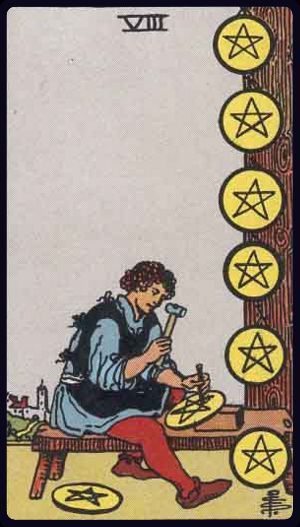
Minor Arcana · Pentacles
Eight of Pentacles
The card of getting properly good at something. It turns up during the repetition nobody sees, and treats that as the point rather than the price.
When the card lands in a Tarot Chats session, we read the Eight of Pentacles as a card about craft. It is interested in the hours you put in when nobody is watching, and it holds that those hours are what actually change things.
Introduction
The figure in this card is at a bench, head down, working on one of eight identical coins. Seven are already finished and hung up behind him. He is not looking at them. That is the card: the person who has done the thing seven times and is doing it again, because the eighth will be slightly better than the seventh. It is the least dramatic card in the deck and one of the most reliable. Almost everything people admire in other people was built this way, in unglamorous repetition that nobody photographed. The Eight of Pentacles shows up for people in the middle of that, often when they are bored of it or wondering whether it counts. It counts. That is essentially the card's whole position. If you want a wider sense of how cards like this fit into a reading, our guide on how tarot works walks through it without the mystical jargon.
Upright Meaning
Upright, the Eight of Pentacles describes diligent, skilled, repetitive work that is making you better. It often appears when someone is learning something properly rather than dabbling, or when they have reached the stage where improvement has become incremental rather than obvious. That stage is where most people stop, which is why the card is encouraging: it tends to show up for the ones who have not. There is an apprenticeship quality to it. The card is comfortable with you not being the best in the room, and it treats being a learner as an active position rather than a lesser one. If you have recently started something you are not good at yet, this card is entirely on your side. It also describes focus. The figure has his back to the finished work, which is worth noticing. The Eight is not interested in admiring what you have already done, or in comparing it to other people's. It is interested in the thing in front of you. For anyone who has been distracted by how it looks rather than whether it is any good, that is the instruction.
Reversed Meaning
Reversed, the Eight of Pentacles usually means the work has lost its purpose. Going through the motions, doing the same thing repeatedly without improving, effort that has become routine rather than practice. That is a specific and common problem, and it is worth distinguishing from laziness. People in this position are often working very hard indeed, just not in a way that is developing anything. Another reversal is perfectionism, where the standard has become a way of never finishing. The eighth coin is never quite right, so the ninth is never started. The card reversed can be quite pointed about that, because it recognises the difference between craft and hiding. There is also a reading about skill being wasted. Doing work far below what you are capable of, in a job that uses a tenth of you, or having trained in something you no longer use. Reversed, the card can be naming that, and it is usually something the person already knows.
Love and Relationships
In love, the Eight of Pentacles is about putting effort in consistently rather than dramatically. It describes the relationships that work because somebody keeps showing up: noticing things, repairing after arguments, doing the small maintenance that nobody notices until it stops. The card is quite unromantic about love, and quite accurate. It also describes learning how to be in a relationship, which is a skill rather than a talent. If things have gone wrong before, the Eight is a good card to pull, because it suggests that getting better at this is possible and that you are doing it. If you are single, the card can describe working on yourself in a way that is genuine rather than performed. Therapy, habits, actually addressing the pattern rather than describing it. The one caution is that the Eight can become a way of postponing. Always improving, never quite ready, the work on yourself becoming the reason you are not available to anyone. The card supports practice, but practice is meant to be for something.
Career and Money
This is one of the strongest work cards in the deck, and its message is simple: keep going, you are getting better. It describes skill development, training, an apprenticeship, or the stage of a job where competence is being built rather than displayed. If you are early in something, the card is reassuring. If you are experienced, it often appears when you have decided to learn something new, and it supports that decision. With money, the Eight is about earning through skill. It rarely describes windfalls or quick returns. It describes the kind of income that rises slowly because you have become worth more, which is the most durable sort. It can also indicate a period where you are investing in capability rather than earning: a course, unpaid practice, a lower-paying role that teaches you something. The card treats that as sensible rather than a step backwards, provided you have a reason. The one thing it asks is that the repetition is producing improvement. Doing the same year eight times is not the same as eight years of experience, and the Eight knows the difference.
Yes or No
Yes
The Eight of Pentacles is a solid yes, particularly for anything involving learning, work or building competence. It says the thing you are asking about will respond to effort, which is the most useful kind of yes. Unlike cards that depend on luck or other people, this one depends largely on you, and it is confident that consistent application will get you there. The caveat is time rather than outcome. The card says yes and does not promise it will be quick, because the whole nature of it is incremental.
When the answer can shift
The answer weakens if you are asking for something immediate. The Eight is not a fast card, and a question framed around a short deadline is not really what it is answering. It also shifts if the question involves no work on your part, or depends entirely on somebody else's decision. This card has very little to say about luck, other people's choices, or things outside your control, and reading it as a yes in those situations tends to lead to disappointment. Its yes is specifically about what effort can reach.
Example Interpretation
A typical situation. Emeka, 28, retrained as a carpenter eighteen months ago after seven years in retail. He is now working for a small firm, doing the parts of jobs that need doing rather than the parts he wants to do, and he is the least experienced person there by a decade. Last week he spent two days on skirting boards. He is starting to wonder whether he made a mistake, because he had imagined this differently. He pulls the Eight of Pentacles. For Emeka, the card is not a consolation prize. It is telling him that the skirting boards are the job, that eighteen months into a trade is nothing, and that the gap between how he imagined this and how it feels is the normal experience of getting good at something rather than evidence of a wrong turn. The card also quietly notes that he is comparing himself to people with a decade's head start, which is a comparison that will only ever produce one answer.
Another quick example
A quicker one for relationships: Marie, 45, has started going to therapy after her second long relationship ended the same way as the first. She pulls the Eight of Pentacles. The card is not about the relationships. It is about the work she has just started, and it treats that work as real rather than as something she should already have known.
Common Misconceptions
The most common misreading of the Eight of Pentacles is as a card about hard work generally, which makes it sound like a card about being busy. It is narrower and more useful than that. It is about repetition that produces improvement, which is different from effort, and plenty of very hard work does not qualify. Another mistake is reading it as a card for beginners only. It applies at any level, and it turns up frequently for experienced people who have decided to get better at something they thought they already knew. People also assume it promises success. It promises improvement, which is not the same thing, though it is usually the part you can control.
Final Thoughts
The Eight of Pentacles is the least exciting card to pull and one of the best. It has no drama in it and no promises, just the quiet observation that people who keep doing the thing tend to end up able to do the thing. If you have pulled it, you are probably somewhere in the middle of a long process and wondering whether the middle counts. It does. The card's only real request is that the repetition stays deliberate: that you are still trying to make the eighth one better than the seventh, rather than simply making an eighth. That distinction is the whole difference between practice and routine, and it is usually the reason one person improves and another does not.
Related Reading
Want a Free tarot reading
Get a free readingTarot readings are for entertainment and personal reflection. They offer perspective, not predictions, and should not replace professional advice for medical, legal, or financial matters.