Minor Arcana · Pentacles
Three of Pentacles
The card of work that needs other people. It appears when what you are building has outgrown what you can do alone.
When the card lands in a Tarot Chats session, we read the Three of Pentacles as a card about being seen doing good work. It is less about teamwork in the abstract and more about whether the right people know what you are capable of.
Introduction
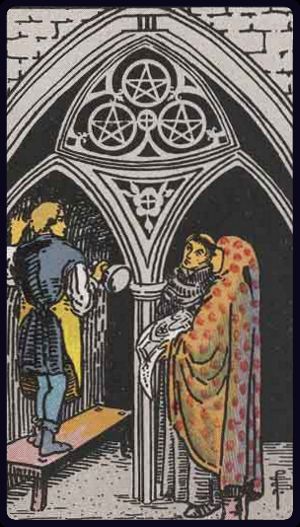
There is a moment in any piece of work where doing it alone stops being a virtue. You have taken it as far as your own skill goes, and the next part needs someone who knows something you do not, or simply needs more hands than you have. The Three of Pentacles is that moment. The imagery is a craftsman in a cathedral, working while two others look at the plans, and the important detail is that he has stopped to talk to them. He is not being supervised. He is being consulted. This card tends to arrive when something you have been building quietly is about to become visible, and the reason people find it encouraging is that being seen is usually the part that changes things. Skill on its own rarely does. If you want a wider sense of how cards like this fit into a reading, our guide on how tarot works walks through it without the mystical jargon.
Upright Meaning
Upright, the Three of Pentacles describes work going well because the right people are involved. Someone has noticed what you can do, or you have found collaborators who make the thing better than your version of it. There is often recognition in this card, though it is quieter than the applause people imagine. It looks like being asked your opinion, being brought into a decision, being trusted with something more difficult. The card also carries a practical instruction about asking. A lot of people stall at exactly the point this card describes, because asking for help feels like admitting the work is beyond them. The Three disagrees. It treats collaboration as a stage of competence rather than a failure of it, and it tends to appear for people who are nearly good enough to get the thing finished but not quite. There is a standards question in here too. This is the card of work done properly, where someone would notice if it were not. If you have been cutting corners, the Three is where that starts to show, because other people are now close enough to see.
Reversed Meaning
Reversed, the Three of Pentacles usually points at one of three things. The first is not being recognised. You are doing the work, it is good, and the credit is going somewhere else, or nowhere. That is worth naming honestly rather than hoping it corrects itself, because it usually does not. The second is the collaboration itself going wrong. People pulling in different directions, a team where nobody has agreed what good looks like, work being redone because two people made different assumptions. The card reversed often means the problem is not effort but alignment. The third is refusing help. You have decided to do this alone, either from pride or from a belief that nobody else will do it properly, and the thing has stalled at the point where one more person would have unlocked it. Reversed, the card is fairly direct about this one. It is not asking you to lower your standards, it is asking whether your standards are the actual reason, or the reason you give.
Love and Relationships
In love, the Three of Pentacles is about building something together rather than about romance. It shows up around the practical joint projects that relationships are actually made of: a home, a move, a family plan, getting through a hard stretch as a unit. The card reads well for those moments because it is fundamentally about two or more people working to the same drawing. If you are single, it often points to meeting someone through work or a shared endeavour rather than through dating. That is not a prediction so much as a description of where your attention currently is. The card also asks about effort being noticed. A common version of this in relationships is one person doing the invisible work, the planning and remembering and organising, and the other not registering it. The Three is not accusatory about that, but it does hold that unseen work is a problem worth raising, because resentment builds quietly and this card is about things being visible.
Career and Money
This is a strong card for work. It marks the stage where your skill meets other people's, and it often coincides with being given more responsibility, being brought into a bigger project, or having your work reviewed favourably by someone who matters. If you have been waiting to be noticed, the Three is usually a good sign. It rewards doing the job properly in front of people who can tell the difference. With money, it tends to relate to earning through skill rather than through luck or timing. A rate rise justified by the quality of your work, a client who pays more because you are worth it, income that follows reputation. It is a slower way to earn than the Ace's opportunity, but it is more durable, because it rests on something you can repeat. The card's one caution is about who is in the room. Collaboration only works when the other people are capable, and the Three assumes they are. If they are not, this is the point at which to say so, before the work carries their name as well as yours.
Yes or No
Yes
The Three of Pentacles is a yes, particularly for anything involving work, skill or other people. It says the thing you are asking about is worth doing and that the conditions around it are favourable. What makes this a reliable yes rather than a hopeful one is that the card describes competence rather than luck, and competence tends to hold up. It is a yes with a small instruction attached: the answer is more likely to stay yes if you involve the right people rather than trying to carry it alone.
When the answer can shift
The answer weakens when the question is about doing something entirely by yourself. The Three of Pentacles is built around other people, and a plan that deliberately excludes them is not really what this card is describing. It also softens if you are asking about something you are not yet skilled enough for. The card assumes real ability and rewards it, so if the honest answer is that you are not ready, the Three tends to be pointing at what you would need to learn first rather than agreeing that now is the moment.
Example Interpretation
A typical situation. Carmen, 31, has been teaching herself web development for two years alongside an admin job. She has built three sites for friends, and they work, but she knows the code is untidy and she has never had anyone experienced look at it. Someone at a meetup has offered to review her work properly, which means showing a stranger something she has only ever shown people who could not judge it. She pulls the Three of Pentacles. For Carmen, the card is about exactly that discomfort. It is not telling her the work is good or bad. It is telling her that the stage she is at now requires being seen by someone who can actually tell the difference, and that this is how skill turns into a career rather than staying a hobby. The Three does not treat the review as a test she might fail. It treats it as the next necessary step, and it notes that the people who progress are usually the ones who let themselves be looked at before they feel ready.
Another quick example
A quicker one for relationships: Jack, 36, and his partner are renovating a flat and have started disagreeing about decisions neither of them has actually stated out loud. He pulls the Three of Pentacles. The card is pointing at the plans on the wall: the problem is not the work, it is that nobody has agreed what they are building.
Common Misconceptions
The most common misreading of the Three of Pentacles is as a card about teamwork generally, which flattens it into something bland. It is more specific than that. It is about skilled people working to a shared standard, and it stops applying when either the skill or the standard is missing. Another mistake is reading it as guaranteed recognition. The card describes the conditions for being seen, not a promise that the right person will look. Sometimes the useful reading is that you need to make the work visible rather than waiting. People also treat it as a card exclusively about work. It applies to anything built with other people, and in practice it turns up for families and relationships nearly as often.
Final Thoughts
The Three of Pentacles is a quietly encouraging card because it rewards something you can control. Not luck, not timing, but doing the work properly and letting the right people see it. If you have pulled it, the thing you are building has probably reached the point where doing it alone has stopped being the fastest route, and the next step involves somebody else. That is worth sitting with if you have a habit of finishing things yourself. The card is not asking you to hand it over. It is noting that the cathedral in the picture is not a solo project, and that the craftsman being consulted is not less skilled for having stopped to talk.
Related Reading
Eight of Pentacles
The solitary practice that comes before this. Repetition, craft and getting properly good at something.
Ace of Pentacles
The practical opening that starts things off. Where the work being reviewed here usually began.
How Tarot Works
A grounded explainer for anyone new to readings. Tarot as interpretation, not prediction.
Want a Free tarot reading
Get a free readingTarot readings are for entertainment and personal reflection. They offer perspective, not predictions, and should not replace professional advice for medical, legal, or financial matters.