Minor Arcana · Pentacles
Six of Pentacles
The card of giving and receiving. It turns up around help changing hands, and asks who holds the scales.
When the card lands in a Tarot Chats session, we read the Six of Pentacles as a card about the terms of help rather than its generosity. What is given matters less here than what comes attached to it.
Introduction
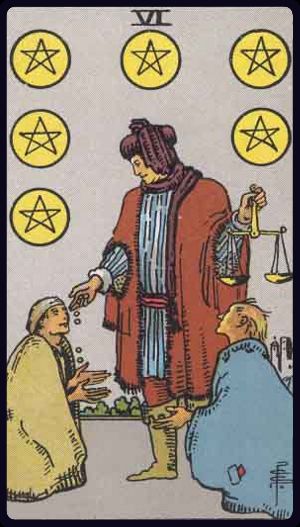
The Six of Pentacles shows a merchant dropping coins into a beggar's hands while holding a set of scales in the other. Most people notice the charity. The scales are the more interesting part, because they mean somebody is measuring, and measured help has conditions even when nobody says so out loud. This is a card about generosity, and it is honest about the fact that generosity is rarely neutral. Someone is standing and someone is kneeling. That does not make the giving false. It does mean there is a shape to the exchange that both people can feel, and the card is asking you to look at it. Whether you are the one giving, receiving, or deciding whether to ask, the useful question here is the same: what comes with this? If you want a wider sense of how cards like this fit into a reading, our guide on how tarot works walks through it without the mystical jargon.
Upright Meaning
Upright, the Six of Pentacles usually describes help arriving or being offered, and it is generally a positive card. After the isolation of the Five, this is the point where something moves: a loan, a favour, a job offer through someone who knows you, a person stepping in. The card supports both sides of that. If you are giving, it endorses it. If you are receiving, it suggests accepting rather than refusing out of pride. What the card adds is attention to balance. Help given freely and help given with expectation look identical at the moment of handover, and they diverge later. The Six is asking you to notice which this is while you still can. That applies in both directions. If you are the one giving, it is worth being honest about what you want in return, including the versions you would not say aloud, like gratitude or loyalty or the sense of being the capable one. There is also a rhythm in this card worth knowing. Most people are on both sides of it over a lifetime, and the Six tends to appear when your position has recently changed.
Reversed Meaning
Reversed, the Six of Pentacles points at the balance being wrong. The most common version is help with strings that are now being pulled. Money lent that has become leverage, a favour brought up repeatedly, someone made to feel indebted long after the debt should have settled. The card reversed names that clearly rather than politely. Another version is one-sided giving. You are the one who always helps, always covers, always steps in, and it has stopped being generosity and become a role. That is exhausting in a way that is hard to complain about, because complaining sounds ungrateful about something you chose. The card is sympathetic to it. Reversed can also describe difficulty receiving. Turning down help you need, insisting on paying your share when you cannot afford to, refusing to be the one who owes. That is its own imbalance, and it usually comes from the same place as the Four's grip: a fear of being in someone's debt.
Love and Relationships
In love, the Six of Pentacles is about what each person contributes and whether that feels fair. Rarely money alone. It covers effort, time, emotional work, being the one who organises or remembers or smooths things over. The card does not require equality, which is unrealistic, but it does ask whether both people know what the other is carrying. There is a specific version of this card about relationships where one person has more power. More money, more stability, more options. That imbalance is not automatically a problem, and the card does not treat it as one. What it asks is whether the power is being used, consciously or otherwise, and whether the person with less of it has a real say. If you are single, the Six can point to a pattern of giving too much too early, or of being drawn to people who need rescuing, which is a way of making sure you are always the one holding the scales. That is worth noticing, because the relationship it produces is stable in a way that is hard to grow out of.
Career and Money
At work, the Six of Pentacles often describes mentoring, sponsorship or being given a chance by someone senior. If you are on the receiving end, the card is encouraging: take it, and be honest with yourself about the fact that it was given rather than earned alone. If you are giving it, the card asks you to give properly, which means giving credit as well as opportunity. It also shows up around fair pay. Being paid what you are worth, or not, and the conversation about it. The scales in the card make it a good one for negotiation, because it treats the question as a legitimate one rather than an imposition. With money, the Six covers lending and borrowing between people who know each other, which is where the card's caution matters most. Money between friends or family changes the relationship whether or not anyone acknowledges it, and the Six suggests being explicit about terms while everyone is still comfortable. The awkward conversation now is shorter than the resentful one later.
Yes or No
Yes
The Six of Pentacles is a yes, particularly when the question involves help, support or another person's involvement. If you are asking whether assistance will come, whether to accept an offer, or whether someone will come through for you, the card generally agrees. It is a warmer yes than most of the suit because it involves someone choosing to act on your behalf. The one thing it attaches is awareness: the answer is yes, and the card would like you to understand the terms before you say yes back.
When the answer can shift
The answer becomes less straightforward when the question is about independence. If you are asking whether you can do something entirely on your own, without support, the Six is not really agreeing, because the whole card is built around an exchange. It also shifts if the help in question comes from someone whose involvement has been difficult before. The card is positive about assistance in general, but it is precise about balance, and help from a source that has previously cost you is exactly the situation it is asking you to look at.
Example Interpretation
A typical situation. Anton, 26, is being offered a deposit for a flat by his father. It is a genuine offer and his father can afford it. It would mean moving out of a shared house he has outgrown and into somewhere he could actually live. He has not said yes, and he cannot entirely explain why. He pulls the Six of Pentacles. For Anton, the card is not about whether to take the money. It is about the scales, and the fact that his hesitation is probably information rather than pride. What does his father expect afterwards: a say in where he lives, more contact, a particular kind of gratitude, or nothing at all? The Six suggests that the answer exists whether or not it is discussed, and that the version of this that works is the one where both of them say it out loud before the money moves rather than three years later.
Another quick example
A quicker one for work: Sophie, 35, has been covering a colleague's workload for two months while he is off, without any adjustment to her own. She pulls the Six of Pentacles. The card is not telling her to stop helping. It is pointing at the scales and noting that nobody has weighed this, including her.
Common Misconceptions
The most common misreading of the Six of Pentacles is as a simple card of charity, which loses the scales entirely. It is not really about generosity, it is about the terms of exchange, and reading it as pure kindness means missing the question it is asking. Another mistake is assuming you are the figure receiving. People often read themselves into the kneeling position when the card is actually describing them as the one giving, and the reading changes completely depending on which you are. People also read it as always positive. It is broadly favourable, but a card about power balance is only comfortable when the balance is fair, and part of its job is checking whether it is.
Final Thoughts
The Six of Pentacles is one of the more grown-up cards in the deck. It does not pretend that help is simple or that generosity is free of self-interest, and it does not treat needing something as shameful. Most relationships, at work and at home, involve one person having more of something at any given time, and the Six suggests that the healthy version is the one where everybody can see the scales. If you have pulled this card, there is probably an exchange happening around you right now that has never been named. Naming it is usually the whole work. It is rarely as awkward as people expect, and it is considerably less awkward than the conversation that happens when it has gone unsaid for years.
Related Reading
Five of Pentacles
The hard stretch this card often follows. Being out in the cold and not asking for help.
Three of Pentacles
Work that needs other people. Collaboration between equals rather than help from above.
How Tarot Works
A grounded explainer for anyone new to readings. Tarot as interpretation, not prediction.
Want a Free tarot reading
Get a free readingTarot readings are for entertainment and personal reflection. They offer perspective, not predictions, and should not replace professional advice for medical, legal, or financial matters.