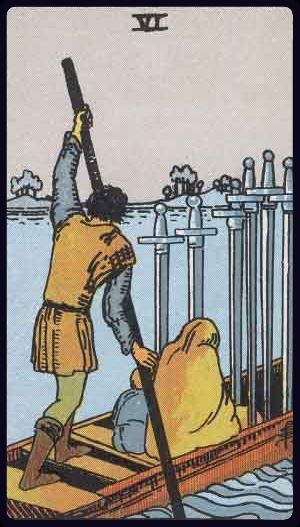
Minor Arcana · Swords
Six of Swords
The card of the quiet crossing. It turns up when you are leaving something difficult, sad and going anyway.
When the card lands in a Tarot Chats session, we read the Six of Swords as a necessary departure. The water ahead is calmer than the water behind, and nobody in the boat is happy about it yet.
Introduction
A ferryman poles a small boat across water, carrying a hooded figure and a child. Six swords are standing upright in the bow. The water on one side of the boat is choppy and on the other it is smooth. Nobody is looking back. This is the card of leaving something difficult for something better, and of the particular flatness of that journey: it is the right thing, it is sad anyway, and the swords are coming with you. That last detail is the honest part. You do not get to leave the difficulty behind entirely, you carry it into the new place and it gets lighter there. The Six of Swords is one of the most quietly hopeful cards in the deck, and it does not feel hopeful while you are in it. If you want a wider sense of how cards like this fit into a reading, our guide on how tarot works walks through it without the mystical jargon.
Upright Meaning
Upright, the Six of Swords describes a transition away from something hard. Moving on after a break-up, leaving a job that was damaging, physically relocating, or simply the passage out of a difficult period into a calmer one. The card is positive about the direction and honest about the mood, which is usually subdued rather than relieved. There is often help involved. Somebody is poling the boat, and the card frequently appears when a friend, a professional or a family member is the reason the crossing is possible. Accepting that help is part of what it describes. There is also a theme of things being carried. The swords are upright in the boat, not discarded, which means the experience and its lessons come along. People who expect to arrive somewhere new and feel immediately better are usually disappointed, and the card is more realistic: what improves is the water, gradually, not the passenger's mood on the day of travel.
Reversed Meaning
Reversed, the Six of Swords usually means the crossing is not happening. Unable to leave, returning to the thing you got out of, or a transition that has stalled midway. The card reversed often describes someone who has made the decision intellectually and cannot yet act on it, which is a distinct and frustrating place to be. Another version is leaving without resolution. Going physically and carrying the whole situation unprocessed, so that the new place quickly starts to resemble the old one. Reversed, the card can be pointing at that, and it is common in people who move cities or jobs repeatedly. There is also a reading about resistance to help. Refusing the ferryman, insisting on doing the crossing alone, which is possible and slower. Reversed, the Six can be describing pride in a situation where accepting assistance is simply the sensible route.
Love and Relationships
In love, the Six of Swords is the card of moving on properly. After a break-up, after a difficult marriage, after a period that took something out of you. It describes the middle of that process rather than the end: past the worst, not yet arrived, still quiet about it. The card treats that as progress even though it does not feel like much. It can also describe a relationship going through a transition together. Leaving a bad patch, relocating, coming out the other side of illness or grief as a couple. The boat holds more than one person for a reason. If you are single, the card often appears when someone is finally starting to be genuinely over something rather than performing it. The tell is usually a decline in intensity rather than a positive feeling: you think about them less, you mind less, and none of it arrives as a moment you could point to.
Career and Money
At work, the Six of Swords describes leaving a bad situation. Resigning from somewhere toxic, moving on after a redundancy, changing fields after something went wrong. It is not the card of the exciting new opportunity, it is the card of getting out, and the improvement it describes is relief rather than triumph. That is worth expecting, because people leaving difficult jobs often feel flat in the new one and assume they have made a mistake. With money, the Six can describe a slow improvement after a difficult period. Coming out of debt, a gradual stabilisation, the stage where things are no longer frightening but not yet comfortable. The card is encouraging about it and specific about the pace: this is a crossing rather than a rescue, and the water gets calmer by degrees rather than suddenly.
Yes or No
Yes
The Six of Swords is a yes, particularly for questions about leaving, moving on or making a change away from something difficult. The card describes a transition that leads somewhere better, so it supports going. Its yes is calm rather than enthusiastic, which reflects what the process actually feels like, and it is one of the more reliable answers for anyone asking whether to get out of something.
When the answer can shift
The answer becomes less useful if you are hoping for something dramatic or immediate. This card describes gradual improvement, so a question about whether things will get better quickly gets a yes that does not mean what the person wants. It also shifts if the question is about staying and repairing. The Six is entirely oriented toward departure, and it will tend to recommend leaving even where mending might have been possible.
Example Interpretation
A typical situation. Martina, 36, left an abusive relationship in February. She is staying with her sister, three hours from where she lived, and she has a job interview next week. She expected to feel free and mostly feels numb and a bit ashamed, and she keeps replaying conversations. Her sister has been extraordinary and Martina has started apologising for still being there. She pulls the Six of Swords. For Martina, the card is describing precisely where she is rather than telling her anything she does not know. She is in the boat. The water behind is rough and the water ahead is not, and neither of those facts makes the crossing enjoyable. The swords standing in the bow are the replaying, which she is treating as a sign she has not moved on and which is simply what people carry. The sister is the ferryman, and the apologising is the part worth dropping first.
Another quick example
A quicker one for work: Ade, 45, handed in his notice at a firm where he had been miserable for two years, and has spent the week feeling oddly deflated rather than relieved. He pulls the Six of Swords. The card is not suggesting he made a mistake. It is noting that crossings are quiet, and that relief arrives later than people expect.
Common Misconceptions
The most common misreading of the Six of Swords is as a sad card, which mistakes the mood for the meaning. The direction is unambiguously good even though the journey is subdued. Another mistake is reading it as escape. The swords come along, which means this is a considered departure rather than a flight. People also assume it always means literal travel. It sometimes does, and far more often it describes an internal transition, which is why so many people pull it during a period where nothing external has changed at all.
Final Thoughts
The Six of Swords is the card of getting out, and almost nobody enjoys it while it is happening. It is the stage between the bad thing and the better one, where you are no longer in danger and not yet anywhere, and the main feeling available is tiredness. If you have pulled it, you are probably further along than you feel. The water ahead really is calmer. It just takes longer to arrive than anyone tells you, and the swords in the boat are not evidence that you have failed to leave.
Related Reading
Want a Free tarot reading
Get a free readingTarot readings are for entertainment and personal reflection. They offer perspective, not predictions, and should not replace professional advice for medical, legal, or financial matters.