Minor Arcana · Swords
Five of Swords
The card of the win that cost too much. It turns up after conflict, and asks whether being right was worth what it took.
When the card lands in a Tarot Chats session, we read the Five of Swords as a victory with damage attached. Somebody won, and the card is interested in what it cost.
Introduction
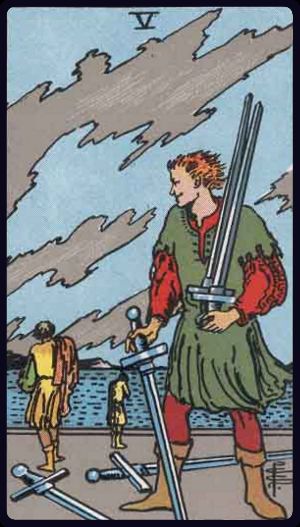
A man stands holding three swords with a smirk, while two figures walk away from him with their backs turned, one of them apparently in tears. Two more swords lie on the ground. The sky is ragged. He has won, and everyone has left. This is the card of the argument you took all the way, the point proven at the expense of the relationship, the victory that turns out to have been the expensive option. It is not a card about losing, which is what people often expect from a five. It is about winning badly, and it is uncomfortable precisely because most people recognise the smirk from the inside. If you want a wider sense of how cards like this fit into a reading, our guide on how tarot works walks through it without the mystical jargon.
Upright Meaning
Upright, the Five of Swords describes conflict in which winning has cost more than losing would have. An argument pursued past the point of usefulness, a position defended until the other person gave up rather than agreed, being right in a way that has left you isolated. The card does not say you were wrong on the facts. It is quite prepared to accept that you were entirely correct, and it points at the two people walking away. There is also a reading where you are the one leaving. Conceding not because you were beaten but because the fight was not worth continuing, which the card treats as a legitimate and often intelligent choice. Knowing which figure you are in the image is the first useful step. The other theme is hollow victory more broadly: getting the thing and finding the getting has spoiled it. The practical question the card asks is simple and hard, which is whether you want to win this or resolve it, because at this stage those have separated.
Reversed Meaning
Reversed, the Five of Swords usually means the aftermath. Regret about how something was handled, the desire to repair a relationship damaged in a conflict, or the point where somebody decides that being right is no longer the priority. That is often the beginning of an apology, and the card reversed can mark the moment it becomes possible. Another version is conflict avoided at cost. Backing down from something that mattered, letting someone else win to keep the peace, and the quiet resentment that follows. Reversed, the card can describe that pattern, which is the mirror image of the upright and equally damaging over time. There is also a reading about ongoing hostility. Reversed, the Five can describe a dispute that has not ended and has simply gone underground, which is generally worse than the open version.
Love and Relationships
In love, the Five of Swords is the card of the argument that damaged something. Not the disagreement itself, but the way it was conducted: the thing said to wound rather than to explain, the point scored, the old grievance introduced because it was effective. The card is unsparing about this and it is not taking sides on the original issue. It also describes relationships that have become adversarial. Keeping score, winning conversations, a dynamic where being right matters more than being close. That rarely arrives suddenly and it is usually visible to both people long before either says so. If you are single, the card can describe a break-up that involved real hostility, or a pattern of conflict in relationships that is worth examining rather than attributing to the succession of people you have chosen. The card's practical suggestion is almost always the same: decide whether you want this resolved or won, because you cannot have both.
Career and Money
At work, the Five of Swords describes political conflict and its costs. Winning a disagreement in a meeting and losing a colleague, getting the decision you wanted and being marked as difficult, a rivalry that has become the point rather than the work. The card is particularly common in competitive environments where people are rewarded for the win and not charged for the damage, which is how the damage accumulates invisibly. It also describes being on the losing end: overruled, sidelined, treated unfairly in a way that stung. With money, the Five can describe a financial dispute where the cost of fighting exceeds the amount at stake. Legal action over a small sum, a family argument about an inheritance, chasing something on principle. The card is not saying let it go. It is saying count properly, including the things that do not appear on the invoice.
Yes or No
No
The Five of Swords is a no, even where the immediate outcome is a win. It describes situations where the result is achieved and the cost outweighs it, so for questions about whether to pursue something, push a point or engage in a conflict, the card advises against. It is one of the few cards that will say no to something you would technically succeed at.
When the answer can shift
The answer changes if the question is about walking away. Should I let this go, should I stop arguing, should I concede: the card supports all of those clearly, and walking away is one of the two roles in the image. It also shifts if the thing at stake genuinely matters more than the relationship. That happens occasionally, and the card's objection is to fighting on autopilot rather than to fighting at all.
Example Interpretation
A typical situation. Duncan, 53, has been in a dispute with a neighbour about a boundary fence for fourteen months. He is right. He has the deeds, a surveyor's report and correspondence going back to the start. He has recently instructed a solicitor. He has also stopped speaking to two other neighbours who suggested he let it go, and he thinks about the fence most days. His wife has stopped asking about it. He pulls the Five of Swords. For Duncan, the card is not disputing the deeds. It accepts entirely that he will win. What it is pointing at is fourteen months, two friendships, a wife who no longer raises the subject, and the fact that he thinks about a fence daily. The card's question is not whether he is entitled to the strip of land. It is what he has already paid for it, in a currency that will not appear in the solicitor's account.
Another quick example
A quicker one for family: Meera, 38, won an argument with her sister at Christmas by bringing up something from years ago that she knew would land. She pulls the Five of Swords. The card is not relitigating the argument. It is noting that she knew exactly what she was doing, and that it worked.
Common Misconceptions
The most common misreading of the Five of Swords is as defeat, which misses that the central figure has won. The loss in this card is relational rather than competitive. Another mistake is assuming you are the one with the swords. Very often the card is describing something done to you, and the two figures walking away are the more useful identification. People also read it as advising you to avoid conflict entirely. It is not pacifist, it is arguing about method and cost, and the reversed version shows that backing down has its own price.
Final Thoughts
The Five of Swords is the card of the hollow win, and the reason it stings is that almost everyone has one. A time you were right and pressed it, and were still right afterwards, and something did not recover. If you have pulled it, there is probably a conflict in your life where the question of who is correct has quietly replaced the question of what you actually want to happen. Those are not the same, and the card's only real contribution is to separate them again before the two figures in the picture have got too far up the hill.
Related Reading
Want a Free tarot reading
Get a free readingTarot readings are for entertainment and personal reflection. They offer perspective, not predictions, and should not replace professional advice for medical, legal, or financial matters.