Minor Arcana · Wands
Five of Wands
The card of everyone talking at once. It turns up around friction and competition, and asks whether the fight is real or just noisy.
When the card lands in a Tarot Chats session, we read the Five of Wands as friction rather than war. It describes a messy, competitive situation, and it usually turns on whether anyone has agreed what they are actually arguing about.
Introduction
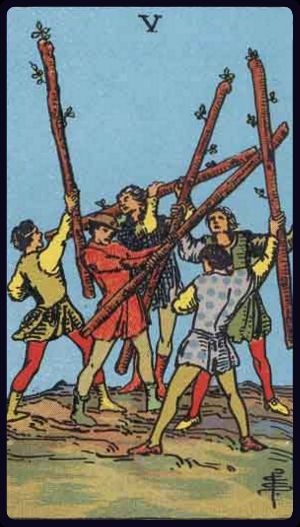
Five figures are waving staves at each other and none of them appear to be aiming. Nobody is hurt. It looks less like a battle than like a scuffle that got out of hand, which is exactly the point of the card. The Five of Wands is the most common form of conflict in real life: not a clean disagreement with two sides, but a situation where several people want different things, nobody has said so clearly, and everyone is competing for space. Families do this. Workplaces do this constantly. The card is not doom-laden about it. Friction is normal and some of it is even useful. What it asks is whether the energy being spent is going anywhere, because the figures in the picture are working hard and achieving nothing. If you want a wider sense of how cards like this fit into a reading, our guide on how tarot works walks through it without the mystical jargon.
Upright Meaning
Upright, the Five of Wands describes competition and friction that is real but not dangerous. Several people want the same thing, or want different things and are in each other's way. It shows up around rivalry at work, arguments in groups, families where everyone is talking over each other, or any situation where too many people have an opinion. The card treats this as a stage rather than a disaster. Sometimes competition sharpens things. It can also describe a productive kind of struggle, where the difficulty is what makes the outcome good: training, arguing something out properly, a team that disagrees openly and gets to a better answer. The card is not against conflict, it is against pointless conflict. The practical question it asks is whether the disagreement has ever been made explicit. Most Five of Wands situations continue because nobody has said plainly what they want, so everybody is arguing with a version of everyone else that they have invented.
Reversed Meaning
Reversed, the Five of Wands can go two ways. The first is conflict avoided: tension that everyone can feel and nobody will name, a group that is polite and simmering, a household where the argument has been going on for months without ever being had. That is often worse than the upright version, because at least the scuffle is honest. The card reversed can be pointing at the cost of keeping the peace. The second reading is the conflict ending. People stepping back, a rivalry resolving, an argument burning out. That is a relief and it usually means someone chose to stop rather than someone winning. There is also a version about internal conflict. Competing impulses, wanting two incompatible things, arguing with yourself in circles. Reversed, the Five can describe that noise accurately, and the useful reading there is usually that you are trying to decide something you have not defined.
Love and Relationships
In love, the Five of Wands describes recurring friction rather than a crisis. Bickering, the same argument in different clothes, two people whose styles grate on each other in ways neither can quite explain. It is a card of irritation more than of damage. What it asks is whether the arguments are about anything, because a surprising number of them are about something else entirely and have simply found a convenient subject. The card can also describe competition within a relationship: whose career matters more, who is more tired, who did more this week. That is corrosive in a quiet way and worth naming. If you are single, the Five can describe a messy situation with several people involved, or the general exhausting scrum of dating: too many options, too much noise, not much clarity. There is also a reading about competing for someone's attention, which the card is fairly unsentimental about. It tends to note that the competing is not producing anything.
Career and Money
At work, this card is extremely common. It describes offices where everyone has an opinion and nobody has authority, projects with too many stakeholders, teams competing for the same budget or the same recognition. It is the card of the meeting that goes round in circles. Its advice is practical: get the disagreement into the open, because most of the friction is coming from things being implied rather than stated. It also covers genuine competition. Pitching against others, applying for the same role as a colleague, a crowded market. The card is not discouraging about that, it just notes that you are one of several and that standing out matters more than working harder. With money, the Five can describe disputes: shared costs, contested bills, disagreements about spending between people. It is rarely about large sums and often about fairness, which is why it generates more heat than the amounts involved would suggest.
Yes or No
Unclear
The Five of Wands does not answer cleanly, which is honest rather than evasive. It describes a situation with several people pulling in different directions, and the outcome depends on things that have not been settled yet. If you push it, it leans slightly no, because the card describes obstruction and competing interests rather than a clear path. What it is really saying is that the answer is not currently determined and that the determining will involve other people.
When the answer can shift
The answer improves if you are willing to be direct. This card responds well to someone naming the disagreement, stating what they want, or simply standing out from the noise, and the situations it describes often resolve the moment somebody does. It becomes a clearer no if you are hoping things will settle on their own. The figures in the card can keep going indefinitely, and nothing in the Five suggests that the scuffle ends without an intervention.
Example Interpretation
A typical situation. Gareth, 45, is one of four siblings sorting out what happens to their mother's house now that she has moved into care. Everyone agrees it should be sold. Nobody agrees on when, or which agent, or what to do with the contents, and there have been eleven weeks of group messages that get heated and then go quiet. Two of them are barely speaking. He pulls the Five of Wands. For Gareth, the card is not saying the family is falling apart. It is describing four people who each have a different private priority, none of which has ever been said out loud: one needs the money soon, one cannot face clearing the house, one wants it done properly, one wants it over with. The messages are about agents because the real subjects are harder. The Five's practical suggestion is unglamorous, which is that someone calls a meeting and asks each person plainly what they actually want.
Another quick example
A quicker one for work: Lucia, 31, is in a team where three people keep redoing each other's work because nobody has decided who owns what. She pulls the Five of Wands. The card is not about the colleagues. It is about the absence of a decision, and the fact that everyone is working hard to no effect.
Common Misconceptions
The most common misreading of the Five of Wands is as serious conflict. It is a scrappy card rather than a violent one, and treating it as a warning of real hostility usually overstates the situation. Nobody in the image is winning or losing. Another mistake is assuming it means you are being attacked. More often it describes a muddle in which you are one of several participants, including some contribution of your own. People also read it as always negative, which misses the productive version: competition that sharpens people, argument that gets to a better answer, the useful friction of a group that actually says what it thinks.
Final Thoughts
The Five of Wands is the card of energy going nowhere, and it is one of the easiest situations to fix and one of the least often fixed. Almost every version of it continues because the actual disagreement has never been stated, so everyone is defending a position nobody has heard. If you have pulled this card, the useful move is probably not to fight harder or to withdraw. It is to say clearly what you want and ask the others to do the same. That is uncomfortable for about a minute and it ends more of these situations than any amount of effort.
Related Reading
Want a Free tarot reading
Get a free readingTarot readings are for entertainment and personal reflection. They offer perspective, not predictions, and should not replace professional advice for medical, legal, or financial matters.