Minor Arcana · Wands
Six of Wands
The card of the win everyone can see. It turns up around recognition, and asks whether you can accept it without flinching.
When the card lands in a Tarot Chats session, we read the Six of Wands as public recognition rather than private satisfaction. Something has gone well and people have noticed, and the reading often turns on how you handle being seen.
Introduction
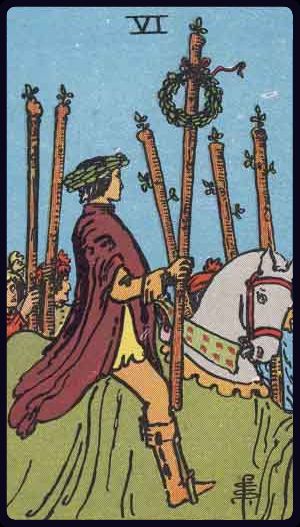
The Six of Wands is a man on a horse with a laurel wreath, riding through a crowd. The crowd is the part that matters. The Four of Wands was coming home to people who love you; this is being applauded by people who are watching. It is the card of the visible win: the promotion announced in a meeting, the exam results, the thing you did that other people now know about. That should be straightforwardly pleasant and for a lot of people it is not, because being seen succeeding brings its own discomfort. The card is usually positive and it frequently arrives with a question underneath it about whether you can let the recognition land, or whether you will immediately explain why it was not really that impressive. If you want a wider sense of how cards like this fit into a reading, our guide on how tarot works walks through it without the mystical jargon.
Upright Meaning
Upright, the Six of Wands describes success that is acknowledged by other people. You have won something, finished something or been chosen for something, and it is public. The card is confident in a way few others are: it does not hedge and it does not warn. If you have been working toward something and this card appears, it is a good sign. There is also a theme of leadership. The rider is out in front, and the card often marks the point where someone stops being one of the group and becomes the person others are following, whether or not they wanted that. That transition is rarely discussed and is usually more uncomfortable than the achievement itself. The card's main instruction is about accepting the win properly. Not performing modesty, not immediately raising the next target, not attributing it entirely to luck. People who cannot accept recognition tend to keep chasing it, and the Six is quietly pointing at that pattern.
Reversed Meaning
Reversed, the Six of Wands usually means recognition that has gone wrong. The most common version is not receiving it: doing the work and watching someone else be congratulated, or succeeding at something nobody noticed. That is a real and disheartening experience and the card reversed names it rather than dressing it up. Another version is success that feels hollow. The win arrived and did not produce the feeling you expected, which often means the thing you were chasing was standing in for something else. Reversed, the card can be pointing at that gap. There is also a reading about ego. Needing the applause too much, managing your image rather than doing the work, or a victory being enjoyed rather too visibly in front of people who lost. The card reversed can be blunt about that, and it tends to appear when the person has half-noticed it themselves.
Love and Relationships
In love, the Six of Wands is about a relationship being seen and affirmed. Going public, being introduced, the moment where something private becomes something you both acknowledge in front of other people. It reads well for that. It can also describe confidence in dating: someone arriving at a point where they feel good about themselves and it shows, which changes how things go for reasons that have little to do with strategy. If you are single, the card often marks that shift. There is a harder reading about status in relationships. Wanting to be seen with someone, or wanting a relationship that looks a particular way to other people, which is a thing that happens and is rarely admitted. The card is not moralistic about it, it just notices where the satisfaction is coming from. If the applause matters more than the person, the Six is usually the card that surfaces it.
Career and Money
At work, this is one of the strongest cards in the deck. Promotion, an award, a successful pitch, public credit for something that went well. It describes not just success but being known for it, which tends to compound in a way that quiet success does not. If you are asking about an application, an interview or a competitive situation, it is a very good card to see. With money, it often accompanies a rise that reflects status as well as work: a better title with better pay, a rate increase because your reputation now supports it, a business that has started attracting clients through word of mouth rather than effort. The card's one caution is about what comes after. The rider is on the way somewhere, not at the end, and the danger in this position is believing your own coverage. People who succeed publicly sometimes stop doing the thing that made them successful, and the Six is the moment just before that becomes a risk.
Yes or No
Yes
The Six of Wands is one of the most confident yeses in the deck. It describes winning, being chosen and being recognised, so for questions about applications, competitions, interviews or whether something will go well publicly, it agrees without much qualification. What makes it particularly reliable is that it describes an outcome rather than a possibility. This card tends to appear when something has already gone in your favour or is about to.
When the answer can shift
The answer softens if your question is about private satisfaction rather than outcome. The Six is good at external results and less interested in whether they will make you happy, and those diverge more often than people expect. It also shifts if the question involves something you would rather do quietly. This card brings attention with it, and if the situation would be better handled without an audience, the yes comes with a complication the card does not mention.
Example Interpretation
A typical situation. Eshe, 41, was promoted to head of department six weeks ago, having been in the team for nine years. People she used to complain about management with now report to her. The announcement went round and several people congratulated her warmly, and she responded to almost all of them by saying it was mostly timing and that the previous head had left a good structure. She has started to feel like a fraud, which she has told nobody. She pulls the Six of Wands. For Eshe, the card is not reassuring her that she deserves it, which would not land anyway. It is pointing at the six weeks of deflection, and at the fact that every time she explains the promotion away she makes it harder to inhabit. The Six's argument is practical rather than emotional: people follow someone who has accepted the role, and the accepting is a decision rather than a feeling she has to wait for.
Another quick example
A quicker one for work: Karl, 26, had an idea that his manager presented in a meeting without mentioning where it came from. He pulls the Six of Wands reversed in a reading about the job. The card is not telling him to let it go. It is naming the thing he has been trying to talk himself out of being annoyed about.
Common Misconceptions
The most common misreading of the Six of Wands is as a card of arrogance, usually by people who are uncomfortable with success being visible. The card describes earned recognition, and there is nothing in it about boasting unless it is reversed. Another mistake is reading it as the end of something. It is a six, and the rider is still moving. People also assume it guarantees a good feeling, which it does not. It guarantees the outcome and says nothing about whether you will be able to enjoy it, and those are genuinely separate questions that this card often raises together.
Final Thoughts
The Six of Wands is a good card and an oddly uncomfortable one for a lot of people. Being recognised means being visible, and visibility invites judgement, which is why so many capable people become strange when they are praised. If you have pulled this card, something has gone well and it has been noticed. The work the card is asking for is not further achievement. It is the much smaller and harder task of saying thank you and letting it be true, without the qualification you were about to add.
Related Reading
Want a Free tarot reading
Get a free readingTarot readings are for entertainment and personal reflection. They offer perspective, not predictions, and should not replace professional advice for medical, legal, or financial matters.