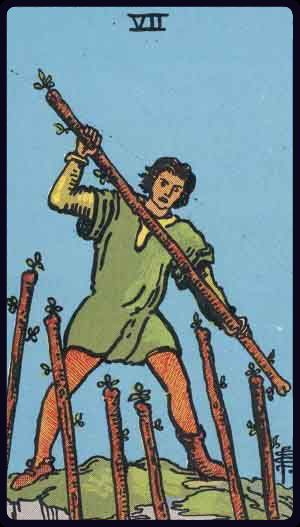
Minor Arcana · Wands
Seven of Wands
The card of holding your ground. It turns up when you have something worth defending, and asks whether the fight is still worth having.
When the card lands in a Tarot Chats session, we read the Seven of Wands as defence rather than attack. It describes standing firm under pressure, and it usually asks how long you have been standing there.
Introduction
The figure in the Seven of Wands is on high ground, holding off six staves coming up at him from below. He is winning, which people often miss. He also looks tired, and one of his shoes does not match the other, as though he got dressed in a hurry and has been up there a while. That is the card: you have something worth having, other people want it or want to challenge it, and you are holding the position. It comes straight after the public win of the Six, which is deliberate. Getting something is one event. Keeping it is a longer and less celebrated business. Most people pull this card partway through a defence they did not expect to be conducting, and the card's sympathy is real. So is its question about whether the hill is the right one. If you want a wider sense of how cards like this fit into a reading, our guide on how tarot works walks through it without the mystical jargon.
Upright Meaning
Upright, the Seven of Wands describes standing your ground successfully. You are being challenged, criticised or competed with, and you are holding. The card is encouraging: the high ground in the image is a real advantage, and the fact that you are up there rather than down among the others means something. It often appears when someone has taken a position that is unpopular, or is defending a boundary they have only recently learned to set. There is a theme of conviction here. The card tends to arrive when you believe something and the believing is costing you, and it is firmly on the side of continuing. It also describes being tested. New responsibility, a role you have just taken, a decision people are waiting to see you fail at. That pressure is normal and the Seven treats it as the ordinary consequence of having something worth challenging. The practical instruction is to keep the high ground rather than descending to argue on their terms, which is almost always the mistake.
Reversed Meaning
Reversed, the Seven of Wands usually means the defending has become too expensive. You are exhausted, the challenges keep coming, and you have started to wonder whether any of it matters. The card reversed is more sympathetic than critical, and it does raise the question everyone avoids at this point: is this position worth what it is costing, or are you holding it because retreating feels like losing? Another version is giving way under pressure. Backing down on something you believed, conceding to avoid the conflict, or being worn down by people who simply had more stamina than you. That happens and the card names it without shame. There is also a reading about defensiveness with no threat. Reacting to criticism that was not an attack, treating disagreement as opposition, fighting people who were not actually fighting you. Reversed, the Seven can be pointing at that, and it is usually a sign of being tired rather than of being wrong.
Love and Relationships
In love, the Seven of Wands often describes defending a relationship against outside pressure. Family who disapprove, friends with opinions, circumstances that make it difficult. The card is supportive if you believe in it, and it does ask you to check that you are choosing the relationship rather than winning the argument about it. Those become confused surprisingly easily. It can also describe holding a boundary inside a relationship. Saying no repeatedly, defending your time or your money or your decisions, being the one who has to keep restating something that should have been settled. That is tiring in a specific way and the card recognises it. If you are single, the Seven can describe defending your choices to other people. Why you are not dating, why you left someone, why you will not settle for what somebody thinks you should. The card's view is straightforward: you do not owe the explanation, and continuing to give it is what keeps the conversation going.
Career and Money
At work, the Seven of Wands is the card of having to justify yourself. Defending a decision, protecting your team from something, holding a position in a meeting where everyone disagrees. It often follows promotion, because new authority attracts testing, and it frequently appears for people who have been put in charge of something contested. The card says you can hold it. It also describes competitive pressure: rivals, a crowded market, someone actively trying to take what you have built. It is more reassuring here than most cards, because the figure is winning. With money, the Seven can describe protecting your finances against pressure. Being asked for loans, resisting spending that other people expect, holding a budget when everyone around you is comfortable spending. That is a lonely position and the card is on your side in it. Its practical instruction at work is to pick which challenges to answer. Not all six staves need a response, and treating every criticism as requiring defence is how people exhaust themselves.
Yes or No
Yes, with effort
The Seven of Wands leans yes, and the yes comes with work attached. The card describes successfully holding a position, so for questions about whether you can keep something, win a dispute or withstand pressure, it generally agrees. What it will not do is promise that it happens easily. This is a yes for someone who is prepared to keep showing up, and it is a no for someone hoping the pressure will simply stop on its own.
When the answer can shift
The answer weakens if you have already been defending for a long time. The card assumes some reserves, and if this has been going on for years, it starts describing the exhaustion rather than the victory. It also shifts if the question is about starting something new. The Seven is entirely about protecting what you already have, and it has almost nothing useful to say about beginnings, so a question about a fresh venture tends to get an answer about the thing you are currently holding on to instead.
Example Interpretation
A typical situation. Robert, 52, runs a small independent bookshop that has been in the same street for twenty years. A chain opened a larger branch two streets over eight months ago. His regulars have mostly stayed, his events are still busy, and his takings are down about fifteen percent. He has started opening on Sundays, which he swore he never would, and he is tired in a way he was not last year. He pulls the Seven of Wands. For Robert, the card is noting that he is still standing, which after eight months against a chain is not nothing. It is also asking about the Sundays. The high ground in his case is the thing the chain cannot copy, which is him and the regulars and twenty years of knowing what people read. Competing on opening hours is descending to fight on their terms, and the Seven is fairly clear that this is how defenders lose positions they could otherwise have held.
Another quick example
A quicker one for family: Sinead, 36, has told her parents three times that she is not coming home for the whole of Christmas, and they keep raising it as though it is undecided. She pulls the Seven of Wands. The card is not telling her to soften. It is noting that she has already said it and that repeating the reasons is what keeps the conversation alive.
Common Misconceptions
The most common misreading of the Seven of Wands is as a card about being attacked, which makes it sound more hostile than it usually is. Most of what this card describes is disagreement, competition and pressure rather than genuine hostility, and treating ordinary challenge as an attack tends to make things worse. Another mistake is missing that the figure is winning. People read the six staves and see a losing battle, when the card is actually describing a defence that is working. People also assume it means you must fight. Choosing not to defend something is a legitimate reading of this card, particularly reversed, and not every hill needs holding.
Final Thoughts
The Seven of Wands is about the unglamorous part of having something good, which is that other people will test it. That is not a sign you have done something wrong. It is usually a sign you have something worth testing. If you have pulled this card, you are probably tired and probably doing better than you think, and the useful question is not whether you can hold on. The card thinks you can. The question is whether this particular hill is the one you meant to be defending, because a lot of people end up fighting hard for a position they took by accident and never chose.
Related Reading
Want a Free tarot reading
Get a free readingTarot readings are for entertainment and personal reflection. They offer perspective, not predictions, and should not replace professional advice for medical, legal, or financial matters.