Minor Arcana · Wands
Nine of Wands
The card of being nearly there and nearly done in. It turns up when you have taken a beating and are still standing, and asks you to keep going a little longer.
When the card lands in a Tarot Chats session, we read the Nine of Wands as exhaustion with something still left in it. It respects how tired you are, and it generally thinks you are closer to the end than you believe.
Introduction
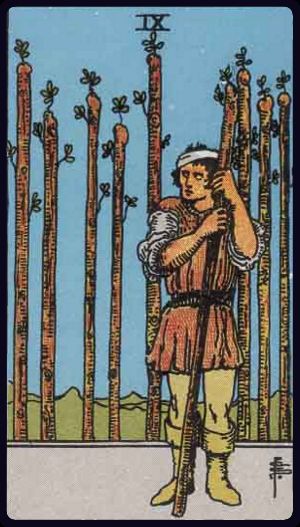
The figure in the Nine of Wands has a bandage round his head, and he is leaning on one stave while eight more stand behind him like a fence. He is watching for the next thing. That posture, braced and wary and tired, is one of the most recognisable states in the deck. It is what happens after a long run of difficulty: not defeat, but the particular weariness of someone who has been knocked about enough times to expect it again. The card is not gentle, exactly. It is realistic. It acknowledges that you have taken more than your share and it does not offer to make it stop. What it says is that you have more left than you think and that the end is nearer than it looks from here. If you want a wider sense of how cards like this fit into a reading, our guide on how tarot works walks through it without the mystical jargon.
Upright Meaning
Upright, the Nine of Wands describes resilience under strain. You have been through something, it has cost you, and you are still here. The card is quietly admiring of that. It usually appears near the end of a difficult stretch rather than the middle, which is the most useful thing about it: when this card comes up, the finish is generally closer than the person believes. There is also a strong theme of wariness. The figure is braced for another attack, and often the caution has outlasted the danger. That guardedness was earned and it may now be costing more than it protects. The card does not tell you to drop your guard, which would be glib. It does ask whether the thing you are bracing against is still coming. The practical instruction is endurance. Not a new strategy, not a burst of effort, just continuing a bit longer than feels reasonable, which is what the card thinks the situation requires.
Reversed Meaning
Reversed, the Nine of Wands usually means the reserves are gone. Not tired but finished, at the point where continuing is doing damage rather than progress. The card reversed is one of the clearer signals in the deck that something needs to stop, or at least pause, and it is worth taking seriously rather than pushing through again. Another version is paranoia. The guard has become permanent, every interaction is treated as a threat, and the defences are now keeping out things that were never dangerous. Reversed, the card can be describing someone who came through something hard and has not yet noticed that it ended. There is a third reading about refusing help while insisting on carrying on. Stubbornness that looks like strength and functions like isolation. Reversed, the Nine can be pointing at that, usually in someone who would rather collapse than admit they need something.
Love and Relationships
In love, the Nine of Wands describes guardedness that came from somewhere. Someone who has been hurt before and is not going to be caught out again, who tests people, who holds something back even when things are going well. The card is sympathetic to why, and it does raise the cost. A relationship conducted from behind a fence stays at fence distance. If you are in a long relationship, the Nine can describe a stretch where you are both worn down: by circumstances, by illness, by a hard year, by each other. The card's reading there is usually that you are further through it than you feel. It also appears for people staying in something difficult out of sheer persistence, which it neither endorses nor condemns. The honest question it asks is whether you are enduring toward something or just enduring, because those look identical day to day and lead to completely different places.
Career and Money
At work, the Nine of Wands describes the last stretch of something hard. A long project nearly finished, a difficult year nearly over, a job you have been surviving rather than enjoying. The card's main contribution is timing: it tends to appear near the end, which means the temptation to give up now is worth resisting slightly longer than feels sensible. It also describes people who have been through several rounds of difficulty at work and have become defensive as a result. Expecting the reorganisation, waiting for the bad news, never fully unpacking. That is a rational response to experience and it does affect how you are seen. With money, the Nine often describes a long grind that is nearly done: the last year of the debt, the final stretch before things ease, a period of going without that has gone on for ages. The card generally says keep going, and it says it with more warmth than most.
Yes or No
Yes, just about
The Nine of Wands leans yes, and the yes is hard-won rather than comfortable. It suggests that what you are asking about will work out, provided you can keep going a bit longer than you currently want to. The card is fundamentally about surviving the last stretch, so it tends to answer yes to questions about whether something will hold, whether you will get through, or whether it is worth continuing. It does not promise the process will be pleasant.
When the answer can shift
The answer changes if you are genuinely depleted rather than tired. There is a real difference between having something left and having nothing, and the card reversed says stop. If you are asking whether to take on something new, the Nine is not encouraging: it describes someone already carrying more than enough, and adding to it is not what the card has in mind. Its yes is specifically about finishing rather than starting.
Example Interpretation
A typical situation. Yuki, 47, has been her father's main carer for two years alongside part-time work. A place in a good home has come up and the family have agreed it is the right move, and there are six weeks of paperwork, assessments and one more hospital appointment before it happens. She has managed two years and is finding these six weeks harder than any of it. She pulls the Nine of Wands. For Yuki, the card is not telling her she is strong, which she has heard enough. It is naming something specific and true: the last stretch is often worse than the middle, because the end is visible and the reserves are gone, and people routinely fall apart at the point where they can finally see the finish. The Nine's reading is that this is normal rather than a failure after two years of coping, and that six weeks is genuinely the end rather than another beginning.
Another quick example
A quicker one for work: Femi, 39, is four months into a restructure at his company and has stopped volunteering for anything because he assumes his role is going. He pulls the Nine of Wands. The card is describing the bracing rather than the restructure, and asking whether the defensive crouch is still serving him.
Common Misconceptions
The most common misreading of the Nine of Wands is as a card about giving up, because the figure looks beaten. He is not beaten, he is standing, and the eight staves behind him are the things he has already got through rather than threats. Another mistake is reading it as pure encouragement, as though the answer is always push on. Reversed it frequently means stop, and even upright it is asking a real question about the cost. People also miss the wariness, which is often the most useful part of the reading: the defences that were built for a specific danger and are still up long after that danger passed.
Final Thoughts
The Nine of Wands is the card of the last bit, and the last bit is usually harder than anyone admits. Most people can cope with difficulty when they cannot see the end of it, and then buckle when it comes into view, which is a strange feature of endurance that almost nobody is warned about. If you have pulled this card, you have probably been going for a long time and you are probably nearer the end than you feel. The card is not asking for heroics. It is asking for a little more of what you have already been doing, and it is fairly confident that you have it.
Related Reading
Seven of Wands
The defending that came before this. Holding ground while you still had energy for it.
Ten of Wands
The burden at the end of the suit. Carrying everything, and whether all of it is yours.
How Tarot Works
A grounded explainer for anyone new to readings. Tarot as interpretation, not prediction.
Want a Free tarot reading
Get a free readingTarot readings are for entertainment and personal reflection. They offer perspective, not predictions, and should not replace professional advice for medical, legal, or financial matters.