Minor Arcana · Wands
Ten of Wands
The card of carrying too much. It turns up when the load has become the whole life, and asks how much of it is actually yours.
When the card lands in a Tarot Chats session, we read the Ten of Wands as a question about the load rather than about strength. It assumes you can carry it. It wants to know why you are.
Introduction
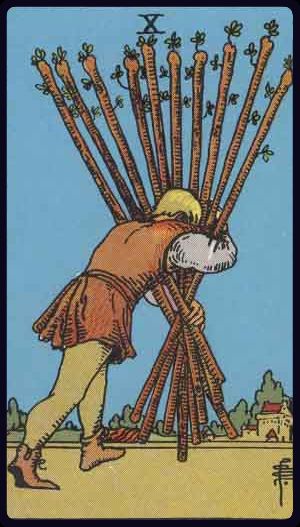
The figure in the Ten of Wands is bent forward under an armful of staves, so many that he cannot see over them. There is a town in the distance, which he is presumably heading for and cannot look at. It is the last card of a suit that began with a single spark, and this is what unmanaged enthusiasm eventually produces: everything you said yes to, all at once, carried at the same time. The card is not about failure. The person is still walking. It is about the point where the thing you wanted has become the thing weighing you down, and where competence has quietly turned into obligation. Almost everyone recognises this card, usually with a slight wince. If you want a wider sense of how cards like this fit into a reading, our guide on how tarot works walks through it without the mystical jargon.
Upright Meaning
Upright, the Ten of Wands describes being overloaded. Too much responsibility, too many commitments, a life where everything is a duty and nothing is a choice. The card is not accusing you of poor planning. Most people get here honestly, by being capable, by saying yes when it mattered, by picking things up that nobody else would. That is precisely how the load accumulates. There is usually an element of not delegating. The figure is carrying all ten himself, and in most real situations some of them could be handed over, shared or simply put down. The reason they are not is worth examining, because it is rarely practical. It is usually about being the person who copes. The other thing the card notices is the town. There is a destination, which means the work has a purpose, and the person is too weighed down to look at it. If you have forgotten what all this effort is for, the Ten is where that usually becomes obvious.
Reversed Meaning
Reversed, the Ten of Wands generally means something is being put down, either deliberately or not. The good version is release: delegating, resigning, ending a commitment, admitting you cannot do all of it. That is a relief and the card reversed can be genuinely positive. The harder version is collapse. The load being dropped because you ran out rather than because you chose, which usually happens suddenly and takes other things with it. Reversed, the card can be a warning about that arriving. There is also a reading about carrying things that were never yours. Other people's problems, responsibilities that got handed to you without discussion, guilt that belongs to someone else. Reversed, the Ten can be pointing at a specific item in the pile that could be given back, and usually the person already knows which one it is.
Love and Relationships
In love, the Ten of Wands describes a relationship that has become work. Not one big problem, but the accumulated weight of everything: logistics, obligations, family, money, the effort of keeping it all running. The card is sympathetic and it does ask whether the burden is shared. Very often it is not, and very often the person carrying more has never said so, because saying so feels like complaining about a life they chose. If you are single, the card can describe dating as another task on a list that is already too long, which is a real and unromantic reason why people stop. There is a version about carrying someone else. Being the one who holds a relationship together, who does the emotional labour, who props up a partner going through something. The card does not judge that, and it does note that it is unsustainable as a permanent arrangement, and that nobody ever announces the point at which it became permanent.
Career and Money
At work, this is the card of the person doing three jobs. A role that has grown without recognition, responsibilities absorbed from people who left, a workload that everyone agrees is unreasonable and nobody is changing. The Ten is the most common card in the deck for quiet burnout. Its practical instruction is to name the load, in writing if possible, because these situations persist mainly because nobody has counted. It also describes running a business alone past the point where that works. Doing the delivery and the admin and the sales and the accounts, and being too busy working to build anything. That is the version where the town in the distance matters most. With money, the Ten often describes financial obligations that have stacked up: supporting people, debts taken on for good reasons, commitments that individually made sense. The card asks the same question here. Which of these did you actually agree to, and which arrived while you were being helpful?
Yes or No
No
The Ten of Wands is generally a no, mostly because it describes someone already at capacity. If you are asking whether to take something on, commit to something or add anything, the card is fairly clear that there is no room. It is not saying the thing is bad. It is saying that you are the wrong person to add it to right now, which is a different objection and usually the more relevant one.
When the answer can shift
The answer turns to yes when the question is about putting something down. Should I step back, hand this over, resign, say no: the Ten agrees with all of those, and it is one of the few cards that actively encourages retreat. It also softens if the end is genuinely in sight. The card is more tolerable when the load is temporary and has a date on it, so a question about pushing through a defined final stretch gets a more sympathetic answer than one about an open-ended arrangement.
Example Interpretation
A typical situation. Vikram, 50, is a partner in a small architecture practice. He runs two projects, does all the client relationships, handles the invoicing because the bookkeeper left in March and nobody replaced her, sits on a professional committee he joined out of flattery, and is the point of contact for a difficult planning appeal that has run for fourteen months. His wife has asked him twice when it gets easier. He pulls the Ten of Wands. For Vikram, the card is not about working less, which he would dismiss. It is about the list. Two of those things are the actual business, one is admin that should have been replaced eight months ago, one is a committee he does not enjoy, and one is an appeal that could be handed to a specialist. The Ten's argument is that he has stopped distinguishing between them, and that everything in the pile now feels equally unavoidable because it is all being carried the same way.
Another quick example
A quicker one for family: Joanne, 43, has become the person who organises every birthday, Christmas and hospital visit for her extended family, without anyone deciding this. She pulls the Ten of Wands. The card is not suggesting she stop caring. It is noting that a role she never agreed to has become a job.
Common Misconceptions
The most common misreading of the Ten of Wands is as a card about hard work, which makes it sound almost admirable. It is about excess rather than effort, and the distinction matters: plenty of people work extremely hard without being in this card at all. Another mistake is treating it as inevitable, as though the load is just the situation. The card is fairly insistent that some of it is optional, which is the uncomfortable part. People also read it as the end of the suit meaning the end of the story. It is the last card and it is not a conclusion, and the next thing after a Ten of Wands is usually something being put down rather than something arriving.
Final Thoughts
The Ten of Wands is the card almost everyone recognises and almost nobody acts on, because the load is made of things that all seemed reasonable when they were picked up. If you have pulled it, the useful work is not finding more strength. You clearly have plenty, which is how you ended up here. It is going through the pile item by item and asking which of these you chose, which you inherited, and which could be handed to somebody else tomorrow if you were willing to be slightly less indispensable.
Related Reading
Want a Free tarot reading
Get a free readingTarot readings are for entertainment and personal reflection. They offer perspective, not predictions, and should not replace professional advice for medical, legal, or financial matters.