Minor Arcana · Cups
Ten of Cups
The card of the life you actually wanted. It turns up around shared contentment, and asks whether you can see it while you are in it.
When the card lands in a Tarot Chats session, we read the Ten of Cups as contentment shared with other people. It is the warmest card in the deck, and it usually asks whether you are present for it.
Introduction
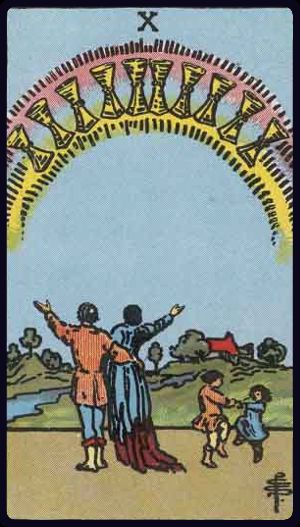
A couple stand with their arms raised, two children dancing beside them, a rainbow of ten cups above and a house in the distance. It is the most openly happy image in the deck and it is easy to be cynical about. What saves it from being a greetings card is the specificity: nobody in the picture is achieving anything. They are standing in a field near their house, together, and that is the whole of it. The Ten of Cups describes emotional fulfilment of the ordinary kind, the sort that is made of years rather than moments. It is the end of the suit that began with a single cup being offered, and this is what that becomes if it is accepted and then tended. If you want a wider sense of how cards like this fit into a reading, our guide on how tarot works walks through it without the mystical jargon.
Upright Meaning
Upright, the Ten of Cups describes emotional fulfilment shared with other people. A family that works, a home that feels like one, relationships that are not being endured. It is the most straightforwardly positive card in the deck and it does not need much interpreting: if it appears in answer to a question about happiness, the answer is yes. What is worth adding is that this card describes something built rather than something that arrived. Ten cups is a lot of cups. The contentment in the image rests on years of the smaller cards: connection, friendship, grief survived, things left behind, wishes granted. The other thing the card asks, quietly, is whether you can see it. A surprising number of people are in a Ten of Cups situation and cannot feel it, usually because they are braced for something or busy with something. The card is not adding to the list of things to achieve. It is pointing at what is already there.
Reversed Meaning
Reversed, the Ten of Cups usually means a gap between how things look and how they feel. The family that photographs well and is tense at home, a relationship that meets every external requirement and is hollow, a life that should make you happy and does not. That is a lonely position because it is hard to complain about, and the card reversed names it without demanding an explanation. Another version is disruption to the home or family. Conflict, separation, a rift between people who used to be close. Reversed, the card can describe that directly. There is also a reading about someone else's idea of happiness. Building the life you were supposed to want, hitting all the markers, and discovering the picture was never yours. Reversed, the Ten can be pointing at that, and it tends to appear when the realisation has become too loud to keep ignoring.
Love and Relationships
This is the card's home. In love, the Ten of Cups describes a relationship that has become a life: settled, mutual, held up by years rather than by intensity. It reads well for marriage, family, long partnerships, and for the point where two people stop being a couple and become a household. If you are single, the card usually describes what you are looking for rather than what is imminent, and it is worth reading carefully rather than hopefully. It can also describe fulfilment through family or chosen family rather than romance, which is a legitimate version of this card that tends to get overlooked. The other honest note is that the Ten is a picture of ordinary life, not of romance. The people in it are not having a wonderful evening, they are standing outside their house on a normal day. Anyone waiting for this card to feel like the beginning of something has misread what it shows.
Career and Money
At work, the Ten of Cups is less about achievement than about whether the work fits the life. It can describe a job that leaves room for the people you care about, a workplace that feels like a community, or the point where you stop sacrificing the rest of your life for your career. It also appears when someone realises that the promotion would cost the thing in the picture, and the card is fairly clear about which it would choose. With money, the Ten has little direct relevance, though it does describe enough. Not wealth, but the financial conditions that let a family be at ease: the bills covered, no one lying awake. Its reading on money questions is usually that the amount is not the issue and the arrangement is, which is unhelpful if you are short and accurate if you are not.
Yes or No
Yes
The Ten of Cups is the strongest yes in the deck for anything about happiness, family or long-term relationships. It describes fulfilment that lasts rather than a good moment, so it answers well to questions about whether something will work out, whether a relationship has a future, or whether you will be happy. There is very little qualification in it.
When the answer can shift
The answer becomes less reliable for practical or commercial questions. This card has almost nothing to say about money, business or logistics, and its warmth in those areas is generic rather than informative. It also shifts if the question is about whether one specific person is the one. The Ten describes the kind of life rather than the individual, and it can indicate lasting happiness that does not arrive with the person currently in mind.
Example Interpretation
A typical situation. Hannah, 46, has two teenagers, a husband she still likes, a house that needs a new boiler, and a job she finds mildly boring. She spends a lot of her time feeling that she should be doing more with her life, and she has recently started comparing herself unfavourably to people she went to university with. She pulls the Ten of Cups. For Hannah, the card is not telling her to be grateful, which would be irritating and useless. It is pointing at the arrangement she has built, which is the thing most people in the pictures she is comparing herself to are still trying to construct. The boiler and the boring job are real. So is the fact that four people in that house are basically all right, which took twenty years and is not nothing. The Ten's only argument is that she is standing in it and looking somewhere else.
Another quick example
A quicker one for family: Yusuf, 52, has started dreading the family Christmas because of a long-running tension between his brother and his mother. He pulls the Ten of Cups reversed. The card is not predicting a row. It is naming the gap between the occasion everyone is performing and the thing nobody will address.
Common Misconceptions
The most common misreading of the Ten of Cups is as a fairytale, which invites people to dismiss it as unrealistic. It describes ordinary contentment rather than perfection, and the people in the image have a boiler that needs replacing too. Another mistake is reading it as exclusively about the nuclear family. Friendship groups, chosen families and households of all shapes sit here. People also treat it as a destination card, as though everything is finished. The suit ends here and life does not, and the cups have to keep being tended after the picture was taken.
Final Thoughts
The Ten of Cups is the card of a good ordinary life, which is the thing almost everyone says they want and almost nobody notices having. It is made of years of small things rather than one big arrival, and the people in it are doing nothing remarkable at all. If you have pulled this card, something in your life is genuinely working. The card is not asking you to appreciate it, exactly, which never helps when someone tells you to. It is just pointing at the field, the house and the people in it, and suggesting you look while you are still standing there.
Related Reading
Want a Free tarot reading
Get a free readingTarot readings are for entertainment and personal reflection. They offer perspective, not predictions, and should not replace professional advice for medical, legal, or financial matters.