Minor Arcana · Swords
Two of Swords
The card of the decision you are refusing to make. It turns up in stalemate, and asks what you would have to admit in order to choose.
When the card lands in a Tarot Chats session, we read the Two of Swords as an avoided decision rather than a difficult one. The blindfold is the subject, and it is usually self-applied.
Introduction
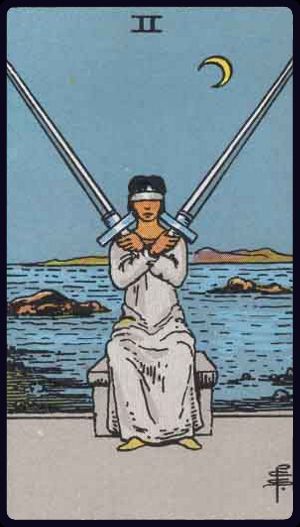
A blindfolded figure sits with her back to the water, holding two crossed swords, arms folded across her chest. She is balanced and she is stuck, and she cannot see anything because of a blindfold that nobody appears to be making her wear. This is the card of the decision that is being held rather than made, usually by someone who is telling themselves they do not have enough information. Sometimes that is true. More often the information is behind her, in the water, and the blindfold is doing exactly what it was put on to do. The Two of Swords is one of the most recognisable states in the deck, and one of the most comfortable, which is why people stay in it far longer than they intend. If you want a wider sense of how cards like this fit into a reading, our guide on how tarot works walks through it without the mystical jargon.
Upright Meaning
Upright, the Two of Swords describes a stalemate. Two options that seem equally weighted, a decision postponed, a situation held in balance by refusing to move. The card is not scornful about it. Sometimes the pause is genuinely wise, and the crossed swords suggest a defensive position that may be protecting something worth protecting. What it does ask is whether the balance is real. Very often one option is obviously better and choosing it would require admitting something uncomfortable: that you were wrong, that you want something you disapprove of wanting, that a person you love is not good for you. The blindfold is usually covering that admission rather than the options. There is also a reading about emotional avoidance specifically. The water behind her is feeling, and she is facing away from it, deciding with her arms folded. The card tends to appear when someone is trying to think their way through something that is not actually a thinking problem.
Reversed Meaning
Reversed, the Two of Swords usually means the stalemate breaking. Information arriving, the blindfold coming off, or a decision finally being made, often not by you. That is frequently a relief even when the outcome is not ideal, because the holding was costing more than anyone admitted. Another version is the decision being made badly. Acting out of exhaustion rather than judgement, choosing whichever option ends the discomfort, or letting circumstances decide by default. Reversed, the card can describe that, and it usually follows a long period of the upright version. There is also a reading about seeing something you did not want to see. Reversed, the Two can mark the moment the avoidance stops working, which is unpleasant and is generally the beginning of things improving rather than the opposite.
Love and Relationships
In love, the Two of Swords is the card of the relationship nobody is ending. Both people know, neither will say, and the arrangement continues because ending it would require someone to be the one who did it. It also describes being stuck between two people, or between a relationship and something else you want, and refusing to choose because choosing means losing one. The card is honest that not choosing is also a choice, made repeatedly, usually in favour of whichever option requires no announcement. If you are single, it can describe emotional numbness after something difficult: arms folded, feelings behind you, deciding not to feel anything about it for a while. That is a reasonable short-term strategy and the card tends to appear when the short term has gone on for a year. The practical instruction is nearly always the same: the missing information is emotional rather than factual, and it is available if you turn round.
Career and Money
At work, the Two of Swords describes a decision in deadlock. Two job offers, whether to leave, a choice between two directions where every analysis produces the same tie. The card's contribution is to suggest that the tie is doing something for you: as long as it is unresolved, nothing has to change and nobody has to be disappointed. It also describes workplace situations where someone is refusing to take a side, sometimes wisely and sometimes because the cost of clarity is high. With money, the card often describes not looking. Avoiding the statement, not opening the letter, leaving a financial decision unmade because the numbers will say something you do not want to hear. That is extremely common and the card is unusually direct about it: the position exists whether or not you look at it, and the looking is generally less bad than the anticipating.
Yes or No
Unclear
The Two of Swords does not answer, which is not evasion but description. It appears precisely when a situation is unresolved and being deliberately held that way. If you want a direction, it leans no, because nothing in this card is moving. The more accurate reading is that the question cannot be answered while the blindfold is on, and that removing it is the thing being asked of you rather than a yes or a no.
When the answer can shift
The answer becomes available when you take the emotional information into account. This card blocks most readings while feelings are being excluded from the calculation, and questions reframed to include them tend to resolve quickly. It also shifts if somebody else is about to decide for you. In that situation the card is often describing a window that is closing, and the choice becomes theirs by default if you keep holding the swords.
Example Interpretation
A typical situation. Owen, 47, has been offered voluntary redundancy with a reasonable package. He has three weeks to decide. He has made a spreadsheet comparing the payout against staying, has run several versions, and it comes out almost exactly even every time, which he finds frustrating and has taken as evidence that he needs more data. He has not mentioned to anyone that he cried in the car park in February. He pulls the Two of Swords. For Owen, the card is not helping with the spreadsheet, which has already done its job and returned a tie. It is pointing at the car park. The financial case is genuinely balanced, which means the decision was always going to be made on the thing he has excluded from the model, and he has excluded it because including it would make the answer obvious and he is not sure he is ready for it to be.
Another quick example
A quicker one for love: Anja, 29, has been asked directly by her partner whether she wants to move in together and has said she needs to think about it. That was in March. She pulls the Two of Swords. The card is noting how long she has been thinking, and that the thinking has not been the activity.
Common Misconceptions
The most common misreading of the Two of Swords is as a card about genuinely difficult choices, which flatters the situation. It is more often about choices that are clear and unwelcome. Another mistake is reading the blindfold as something being done to you. Nobody in the image is holding it on. People also treat the balance as peaceful. It is a defensive posture with two blades held up, which is tiring to maintain, and part of the card's point is that stalemates cost something even though nothing appears to be happening.
Final Thoughts
The Two of Swords is the card of the decision you have already made and are not yet admitting. Most stalemates are not really balanced, they are being held in balance by somebody who would rather not be responsible for the outcome. If you have pulled it, the useful question is not which option is better. It is what you would have to acknowledge in order to choose, because that is usually the thing the blindfold is for, and it is the only part of this situation that has not yet been looked at.
Related Reading
Want a Free tarot reading
Get a free readingTarot readings are for entertainment and personal reflection. They offer perspective, not predictions, and should not replace professional advice for medical, legal, or financial matters.