Minor Arcana · Swords
Ace of Swords
The card of sudden clarity. It turns up when you finally see something plainly, and asks what you will do now that you cannot unsee it.
When the card lands in a Tarot Chats session, we read the Ace of Swords as clarity arriving, usually uninvited. The truth in it is useful and it is rarely comfortable.
Introduction
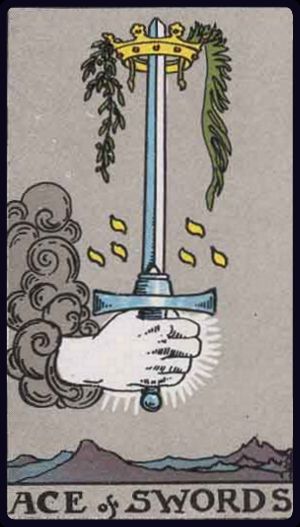
A hand comes out of a cloud holding a sword upright, with a crown on its point and a bleak mountain range below. There is nothing warm in this image at all, which is the honest signal of the suit it opens. Swords deal with thought, truth, communication and conflict, and the Ace is the moment something becomes clear. Not gently. It is the card of the realisation you have been circling for months arriving all at once, usually at an inconvenient hour, after which the situation you were in becomes impossible to describe the way you had been describing it. Clarity is genuinely valuable and it has a cost, which is that you cannot go back to not knowing. If you want a wider sense of how cards like this fit into a reading, our guide on how tarot works walks through it without the mystical jargon.
Upright Meaning
Upright, the Ace of Swords describes a breakthrough in understanding. Seeing a situation for what it is, working out what has actually been going on, or finding the words for something you have felt for a long time without being able to say. The card is positive about this even when the content is unwelcome, because it treats accurate information as better than comfortable confusion. There is also a theme of cutting through. Swords separate things, and this one is good at removing what is irrelevant: the excuses, the versions everyone has agreed to repeat, the complications that were protecting somebody. If you have been stuck in something tangled, this card usually marks the point where one clean question makes most of it fall away. The practical instruction is to use it. Realisations have a short half-life, and an Ace of Swords insight that is not acted on within a few weeks tends to be quietly reabsorbed into the story it interrupted.
Reversed Meaning
Reversed, the Ace of Swords usually means the clarity is missing or misused. Confusion that will not resolve, a situation where nobody can get to the bottom of anything, or a decision that keeps being made on incomplete information. The card reversed often describes someone going round and round on something that would be settled by one honest conversation nobody is willing to start. Another version is truth used badly. Being right in a way that damages, honesty deployed as a weapon, the person who says the brutal thing and calls it integrity. Reversed, the card can be pointing at that, in you or someone else. There is also a reading about information withheld. Something being kept from you, a half-explanation you have accepted, or a situation where the missing piece is deliberate rather than accidental. Reversed, the Ace sometimes shows up right before that piece appears.
Love and Relationships
In love, the Ace of Swords is the card of the honest conversation. The thing that needs saying, the question that has been avoided, the point where a situation gets defined rather than drifting. It is not romantic and it is frequently what a relationship needs most. If you are single, it can describe seeing a pattern clearly for the first time: what you keep choosing, why the last three ended the same way, what you have been telling yourself about someone. That clarity is worth more than any amount of dating advice. In a relationship, the card often marks the moment one person realises something has to be addressed. It does not tell you the outcome. It tells you the conversation is now unavoidable, and that continuing to manage around it is no longer available to you. The one caution is delivery. This card is sharp by nature, and being right is not the same as being useful, particularly with someone you intend to keep.
Career and Money
At work, the Ace of Swords is one of the more useful cards in the deck. It describes a clear idea, a plan that suddenly makes sense, or understanding a problem properly after a long stretch of guessing. It is good for anything involving strategy, analysis, writing, law, or any situation that rewards thinking precisely. It also describes speaking plainly: the meeting where someone finally names the actual issue, which is usually the most productive thing that happens all quarter. With money, the card is about seeing your real position. Looking at the numbers rather than the impression, working out what something genuinely costs, understanding the terms of an agreement you signed without reading. That is not glamorous and it is nearly always worth doing. If this card appears for a financial question, the reading is usually that the information you need exists and you have been avoiding looking at it.
Yes or No
Yes
The Ace of Swords is a yes, and a clean one. It describes clarity and decisive understanding, so for questions about whether to proceed, whether you are seeing something correctly, or whether to have the conversation, the card agrees firmly. Its yes is intellectual rather than emotional: it is confirming that the thinking is sound rather than promising the experience will be pleasant.
When the answer can shift
The answer becomes harder to use when the question is about feelings. This suit is not equipped for emotional nuance, and a clean yes to something that needed a gentler answer can be technically correct and practically unhelpful. It also shifts if you are asking whether to say something. The card will generally say yes to truth regardless of timing, and timing is frequently the whole question.
Example Interpretation
A typical situation. Beth, 39, has spent two years being told by her manager that a promotion is coming. There has always been a reason: restructuring, budget, the new director settling in. Last week a colleague with less experience was promoted into a role Beth had been told did not exist. She has spent the days since composing an email she has not sent, and at four in the morning she realised, with complete clarity, that she has known for at least a year and has been choosing not to. She pulls the Ace of Swords. For Beth, the card is not telling her to resign or to complain. It is confirming the four in the morning. The information was available for a year and the realisation only arrived now because it was finally more uncomfortable to keep the story than to drop it. What the Ace asks is what she does in the next fortnight, because the clarity is sharpest now and will start blurring back into reasons by the end of the month.
Another quick example
A quicker one for love: Sunil, 33, has finally admitted to himself that the person he has been seeing is not going to leave their relationship. He pulls the Ace of Swords. The card is not offering a way to change it. It is confirming that he already knows, which is the only part that was ever in doubt.
Common Misconceptions
The most common misreading of the Ace of Swords is as bad news. It is neutral about content and positive about accuracy, and a great many of the clarities it describes are a relief. Another mistake is treating it as permission to be blunt with people. The card is about seeing clearly, not about saying everything you see. People also read it as an ending because swords look severe. It is an Ace, which means a beginning, and what usually begins here is a period of doing something about what you have understood.
Final Thoughts
The Ace of Swords is the card of the thing you cannot unsee. Most people pulling it have been most of the way to the realisation for a while and have been finding it useful not to arrive. If that is where you are, the card is fairly unsentimental: you know now, and knowing has consequences that not-knowing did not have. It does not tell you what to do with it. It just notes that the clarity is at its sharpest today and that most people let it go soft rather than act on it.
Related Reading
Want a Free tarot reading
Get a free readingTarot readings are for entertainment and personal reflection. They offer perspective, not predictions, and should not replace professional advice for medical, legal, or financial matters.