Minor Arcana · Swords
Eight of Swords
The card of feeling trapped by something that would move. It turns up when the restriction is real and smaller than it looks.
When the card lands in a Tarot Chats session, we read the Eight of Swords as a trap with a gap in it. The constraint is real and the card keeps pointing at the space nobody has looked at.
Introduction
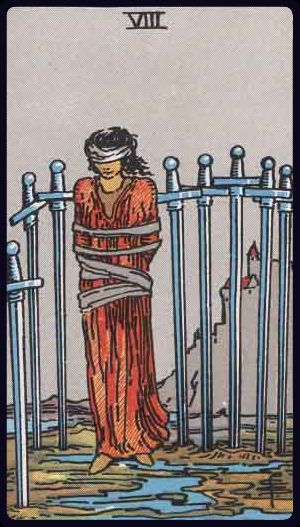
A blindfolded woman is loosely bound, standing between eight swords planted in the mud. The swords do not form a circle; there is a clear gap behind her. The bindings are not tight. She is on soft ground with a castle on the hill and could, physically, walk out. That is the entire card and it is one of the most uncomfortable in the deck, because it describes a genuine feeling of being trapped in a situation that has more give in it than the person can see. The card is not calling anyone stupid. Most of these traps are built from real constraints, reinforced by other people, and then maintained by a story that has stopped being examined. If you want a wider sense of how cards like this fit into a reading, our guide on how tarot works walks through it without the mystical jargon.
Upright Meaning
Upright, the Eight of Swords describes feeling stuck with no good options. I have no choice, I cannot leave, there is nothing I can do. The card takes the feeling seriously and disputes the conclusion, gently. The restrictions are usually real: money, children, health, a visa, a contract, an obligation to someone. What the card notices is that the list has not been reviewed for a while, and that some items on it have changed without anyone updating the story. There is also a strong theme of thought as the trap. Swords are mental, and the binding here is largely interior: the anticipated disaster, the conversation you have already had in your head and lost, the certainty about how someone will react. Almost nobody in this card has tested their assumptions recently. The practical instruction is small and specific: identify one constraint and check whether it is still true. That is nearly always the first thing that moves.
Reversed Meaning
Reversed, the Eight of Swords usually means the bindings loosening. Seeing an option you had ruled out, realising that a restriction has expired, asking somebody and discovering they would help. It is one of the more hopeful reversals, and it often follows a long upright period. Another version is the trap tightening. Reversed, the card can describe someone whose situation has genuinely worsened, or who has responded to the discomfort by narrowing their world further. There is also a reading about a period of self-imposed restriction ending. Leaving a situation, saying the thing, finally making the move that had felt impossible. The tell with the positive reversal is usually that the person is surprised by how manageable the consequences turn out to be, having spent months certain they would be unsurvivable.
Love and Relationships
In love, the Eight of Swords describes feeling unable to leave or unable to speak. A relationship that has become a situation you are managing, where the reasons for staying have been recited so often that nobody examines them. The card is careful here, because some of these situations involve genuine danger or genuine dependence, and it does not pretend otherwise. Where it applies most cleanly is the relationship maintained by prediction: I cannot say this because they would react like that, I cannot leave because it would destroy them. Those are forecasts rather than facts and they are rarely tested. If you are single, the card can describe beliefs about yourself that have hardened into rules. Too old, too damaged, too much history, nobody would want this. The card treats those as swords in the mud rather than walls, and its position is that they are standing there because nobody has walked past them.
Career and Money
At work, the Eight of Swords is the card of the job you cannot leave. The mortgage, the sector you are too specialised in, the age you have reached, the reference you need. Some of those are real and most are less absolute than they feel by the time this card appears. The useful work is usually arithmetic rather than courage: what would actually happen, for how long, and what is the smallest version of a move. It also describes being silenced. Unable to raise something at work, trapped by a dynamic where speaking up is understood to be career-limiting. With money, the Eight often describes a situation someone has stopped looking at because looking feels unbearable. Debt, an unaffordable commitment, a financial arrangement with somebody else. Almost every version of this improves the moment the numbers are actually laid out, which is precisely the action the blindfold prevents.
Yes or No
No, for now
The Eight of Swords leans no, because it describes a situation where movement feels impossible and largely is not happening. It is not a permanent no. The card is unusual in that its answer changes as soon as the person does one thing differently, so the no describes the current state rather than the possibility. If nothing is examined, nothing moves, and the answer stays where it is.
When the answer can shift
The answer turns positive when the question is about testing a constraint. Should I ask, should I find out what it would cost, should I check whether that is still true: the card supports all of those, and they are the exact actions it is asking for. It also shifts if you are already taking steps. The Eight describes paralysis rather than difficulty, so a situation where somebody is moving slowly is not really the one this card is about.
Example Interpretation
A typical situation. Fiona, 50, has worked for the same company for nineteen years and has been unhappy for the last four. She believes she cannot leave: her salary is above market for her role, she is too old to start again, the pension is tied up, and there is nothing else locally. She has not looked at a job advert in two years, has not checked what her pension actually does if she moves, and has not spoken to anyone in her field about what they pay. She pulls the Eight of Swords. For Fiona, the card is not telling her to resign, which would be reckless given what she believes. It is pointing out that all four of her reasons are beliefs that were formed at different times and have never been checked. The pension is a phone call. The market rate is an afternoon. The card's whole argument is that she is currently choosing between staying and a version of leaving that she invented.
Another quick example
A quicker one for family: Marek, 39, has not told his parents about something significant because he is certain how they will react. He pulls the Eight of Swords. The card is not promising they will react well. It is noting that the conversation he is avoiding is one he has only ever had by himself.
Common Misconceptions
The most common misreading of the Eight of Swords is that it means the person is imagining the problem, which is both untrue and unkind. The swords are real and the mud is real. What the card disputes is the completeness of the enclosure, not the difficulty. Another mistake is reading it as a card about powerlessness in situations of genuine abuse or coercion, where the honest answer involves support rather than perspective. People also assume the way out must be dramatic. It is usually one small verifiable fact, and the card is pointing at the gap rather than at an escape.
Final Thoughts
The Eight of Swords is the card of the cage with an opening behind you. The feeling of being trapped is not a mistake and it is not the whole picture, and the difference between those two is where everything in this card lives. If you have pulled it, there is probably a constraint in your situation that was true when you first accepted it and has not been examined since. You do not have to escape anything today. You have to check one thing, which is a much smaller request, and it is almost always the thing that turns out to have changed.
Related Reading
Two of Swords
The decision refused rather than the situation endured. Blindfolded, and choosing not to look.
Nine of Swords
The three in the morning version. Fear at its loudest, disconnected from the daylight.
How Tarot Works
A grounded explainer for anyone new to readings. Tarot as interpretation, not prediction.
Want a Free tarot reading
Get a free readingTarot readings are for entertainment and personal reflection. They offer perspective, not predictions, and should not replace professional advice for medical, legal, or financial matters.