Minor Arcana · Swords
Nine of Swords
The card of three in the morning. It turns up around anxiety and dread, and separates what is happening from what your mind is doing with it.
When the card lands in a Tarot Chats session, we read the Nine of Swords as suffering that happens at night. The distress is real, and the card is careful to separate it from the situation causing it.
Introduction
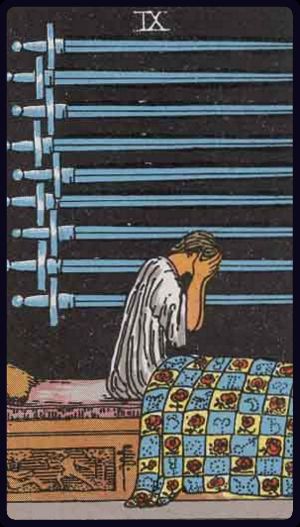
A figure sits up in bed with their face in their hands, nine swords on the wall behind them in the dark. The bed has carved panels showing a fight, and the blanket is covered in roses and signs. Nothing is happening. There is no threat in the room. It is the card of three in the morning, when a manageable problem has become enormous and the version of it in your head has stopped resembling the thing itself. Almost everyone who pulls this card knows it immediately. It is one of the most personal images in the deck because the suffering in it is entirely private, and because the swords are on the wall rather than anywhere near the person. If you want a wider sense of how cards like this fit into a reading, our guide on how tarot works walks through it without the mystical jargon.
Upright Meaning
Upright, the Nine of Swords describes anxiety, dread and the specific misery of night-time thinking. Worry that has outgrown its subject, guilt turned over repeatedly, the anticipation of something that has not happened. The card is sympathetic and it does something quite useful: it separates the distress from the situation. Both are real and they are not the same size. Most of what this card describes is a mind doing what minds do at four in the morning, and the useful information is that the reasoning done in that state is not reliable, however convincing it feels. There is also a theme of isolation. The figure is alone in the dark and nobody knows. People in this card have frequently told no one, partly because it seems disproportionate in daylight, and the not telling is part of what keeps it going. The practical instruction is unglamorous: say it out loud to someone, and where this is persistent rather than occasional, say it to a professional.
Reversed Meaning
Reversed, the Nine of Swords usually means the worst of it lifting. Anxiety easing, sleep returning, the situation turning out to be more manageable than the night version suggested. It often follows either telling somebody or simply the passage of time, and the card reversed can mark the point where perspective comes back. Another version is the anxiety deepening. Reversed, the card can describe distress that has become chronic, or someone who has been carrying this long enough that it has stopped feeling like an event and started feeling like their personality. That is worth naming clearly, because it is also the point at which proper support makes the most difference. There is a third reading about facing the fear. Reversed, the Nine sometimes describes the moment someone finally looks directly at what they have been dreading, which is nearly always less annihilating than the anticipation.
Love and Relationships
In love, the Nine of Swords describes lying awake about a relationship. Fear that they will leave, suspicion that has no evidence, going over a conversation from six weeks ago. The card does not adjudicate whether the fear is founded: it describes the state, which is corrosive whether or not the underlying worry is accurate. If there is something real to address, the card's contribution is that the addressing happens in daylight, with the person, rather than at 4am alone. It can also describe guilt about something you did, or shame about something you are, that you have never said aloud in a relationship. That tends to be heavier than the thing itself. If you are single, the card often describes anticipatory loneliness or a dread about the future that is being treated as a forecast. The card is clear that it is a feeling rather than information, which does not make it lighter and does change what to do with it.
Career and Money
At work, the Nine of Swords is the Sunday night card. Dread about the week, replaying a meeting, waiting for an email, a fear of being found out that is out of all proportion to your actual competence. It is extremely common in capable people, which is worth knowing if you are in it and convinced you are the exception. With money, the card describes financial anxiety specifically: lying awake about debt, about a bill, about whether you can keep this up. The card is unusually practical here. Financial dread is one of the few forms of anxiety that reliably shrinks when you look at the actual numbers, because the nocturnal version has no figures in it at all. That is not a promise that the situation is fine. It is an observation that the version you are suffering is not the version on the statement, and only one of them can be acted on.
Yes or No
No
The Nine of Swords is a no, though it is more a description of a state than a verdict on the question. It appears when somebody is in distress, and answers given from that position tend to be about the fear rather than the situation. If you are asking whether the thing you are dreading will happen, the card is not confirming it. It is confirming that you are afraid of it, which is a different fact.
When the answer can shift
The answer becomes useful when the question is about seeking help. Should I tell someone, should I speak to a professional, should I say it out loud: the card supports all of those firmly, and they are the only actions it actually recommends. It also shifts once daylight is involved. Questions revisited in a calmer state frequently get a completely different answer, and the card would rather you asked again then.
Example Interpretation
A typical situation. Alan, 58, made a mistake at work in October that was noticed, addressed and, as far as anyone else is concerned, closed. It cost the company some money and his manager was reasonable about it. Since then he has woken at four most mornings and gone through it, and has begun to believe he will be quietly managed out. Nobody has suggested anything of the kind. He has not mentioned any of this to his wife, because it sounds ridiculous in the morning. He pulls the Nine of Swords. For Alan, the card is not assessing his job security, which by every available piece of evidence is fine. It is describing the four o'clock version of the event, which has now been running for five months and bears very little resemblance to what happened. The card's only real suggestion is the one he keeps deciding against: saying it out loud, in daylight, to somebody who can tell him what the mistake actually looked like from outside.
Another quick example
A quicker one for health: Ruth, 44, has had a symptom for three weeks, has not booked an appointment, and has read a great deal about it at night. She pulls the Nine of Swords. The card is not telling her the news will be good. It is noting that the three weeks of not knowing have been worse than any appointment could be.
Common Misconceptions
The most common misreading of the Nine of Swords is as a prediction of disaster. It describes fear rather than outcome, and the swords in the image are on the wall rather than in anybody. Another mistake is dismissing it as just anxiety, which minimises something genuinely painful. The card takes it seriously and simply declines to treat it as accurate reporting. People also read it as a purely private card, when the most useful thing in it is almost always another person: the distress in this image is sustained by the fact that nobody else knows.
Final Thoughts
The Nine of Swords is the card of the thing that is much worse at night. Everyone has a version of this and almost nobody talks about theirs, which is precisely what allows it to grow. If you have pulled it, something has been taking up your early hours, and the version you have been dealing with in the dark is not the same size as the version that exists. That does not make the fear invalid. It makes it treatable, mostly by the unremarkable act of saying it to someone while the sun is up. If it has been going on a long time, say it to a professional rather than a friend.
Related Reading
Want a Free tarot reading
Get a free readingTarot readings are for entertainment and personal reflection. They offer perspective, not predictions, and should not replace professional advice for medical, legal, or financial matters.