Minor Arcana · Swords
Four of Swords
The card of stopping before you have to. It turns up when rest is overdue, and treats that as necessary rather than indulgent.
When the card lands in a Tarot Chats session, we read the Four of Swords as recovery rather than defeat. Stopping is the instruction, and the card is usually arriving later than it should have.
Introduction
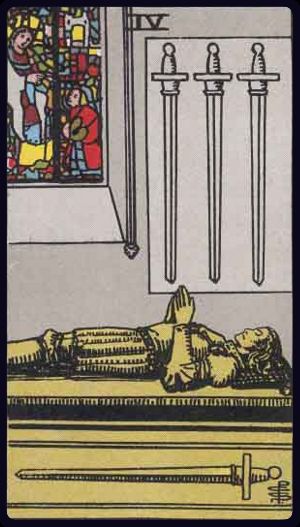
A stone figure lies on a tomb in a church, hands together, with three swords on the wall above and one beneath him. It looks like death and it is not: the figure is resting, and the fourth sword is out of use. This is the card of deliberate stillness after something difficult. Not collapse, not giving up, but the decision to stop and let something heal. It follows the Three of Swords for a reason, and most people pull it either when they are at the point of needing this badly, or when they have been resisting it for months. It is one of the quietest cards in the deck and one of the most practical, and the fact that it looks like a tomb is probably why so many people misread it as the end of something. If you want a wider sense of how cards like this fit into a reading, our guide on how tarot works walks through it without the mystical jargon.
Upright Meaning
Upright, the Four of Swords describes rest, recovery and withdrawal on purpose. Taking the time off, stepping back from a situation, letting a wound close rather than testing it repeatedly. The card is unambiguous that this is the right move, which is rare: most cards ask a question, and this one gives an instruction. It usually appears when someone has been running on reserves for long enough that they have stopped noticing. There is also a reading about mental quiet specifically. Swords are thought, and this is the one card in the suit that turns the thinking off. Not solving, not planning, not going over it again. For anyone stuck in a loop of analysis, the card is suggesting that the answer will not arrive through more of it. The practical version is unglamorous and specific: sleep, take the leave, cancel the thing, stop answering messages for a week. It is also worth saying that this card frequently appears before a crisis rather than after, as a chance to stop voluntarily.
Reversed Meaning
Reversed, the Four of Swords usually means rest that is not happening or not working. Exhaustion pushed through, a holiday spent anxious, sleep that does not restore anything. The card reversed often describes someone whose body has started making the decision for them, which is how most people eventually stop. Another version is restlessness. Being unable to settle, guilt about resting, the sense that stopping is somehow not allowed. That is common in people whose worth has become attached to output, and the card reversed names it. There is also a more hopeful reading, which is coming out of a period of withdrawal. Reversed, the Four can describe re-entering the world after a difficult stretch: going back to work, starting to see people again, the tentative return to ordinary life. That is worth distinguishing, because the two readings point in opposite directions and the context usually makes it clear which.
Love and Relationships
In love, the Four of Swords describes a pause. Taking a break from dating, a relationship that needs space rather than a conversation, or a period of deliberately not pursuing anything while you recover from something. The card is supportive of all of it and it is not describing avoidance, which is a different card. There is a specific reading about a relationship in a quiet phase. Both people tired, nothing much happening, an absence of drama that is restorative rather than worrying. Not every flat period is a problem and this card is one of the few that says so. If you are single after something painful, the Four is usually confirming that the not-dating is correct for now. It tends to appear when someone is being pushed, by friends or by their own restlessness, to get back out there before they have healed, and its position is that healing first produces better outcomes than healing in company.
Career and Money
At work, the Four of Swords describes the need to stop. Burnout approaching or arrived, leave that has not been taken, a workload that has been unsustainable for long enough to feel normal. The card is direct: the productivity argument for resting is real, and the health argument is more important. It also describes strategic pause. Stepping back from a project to think, pausing a launch, waiting rather than pushing. Sometimes the best professional move is visible inaction, which is difficult in cultures that reward visible effort. With money, the Four has little direct application, though it can describe a deliberate financial quiet period: not making decisions while you are exhausted or grieving, which is one of the more useful pieces of advice in the deck. Decisions made in the state this card describes are reliably worse than decisions made a month later, and the card would rather you waited.
Yes or No
Not yet
The Four of Swords is a pause rather than a yes or no. It generally counsels waiting, so for questions about whether to act, launch, confront or commit, the answer is not now. That is not the same as no. The card tends to describe situations where the timing is the problem rather than the plan, and where acting from your current state would produce a worse version of something that could work later.
When the answer can shift
The answer becomes a clear yes when the question is about resting. Should I take the time off, should I step back, do I need a break: the card agrees without qualification and is one of the few that actively prescribes it. It also shifts if you have already been paused for a long time. At that point the card can be describing avoidance rather than recovery, and the more honest reading is about re-entry.
Example Interpretation
A typical situation. Rachel, 41, is a GP. She has worked through a difficult two years and has not taken more than a long weekend since the spring of last year. She is competent and nobody has complained. She has started forgetting small things, snapping at her partner about nothing, and lying awake running through patients. She has annual leave she keeps rolling over because the rota is short and she does not want to make it worse for everyone else. She pulls the Four of Swords. For Rachel, the card is not asking whether she can afford to stop, which is how she has been framing it. It is pointing out that the forgetting and the lying awake are the early part of a process that ends with her stopping anyway, at a time not of her choosing. The rota will be short whether or not she takes the leave. The card's position is that the version where she books it now is the only one where she gets to choose the dates.
Another quick example
A quicker one for love: Danny, 34, came out of a five-year relationship in June and his friends have started setting him up with people. He pulls the Four of Swords. The card is not against the friends. It is noting that he has not had a single week of not thinking about it, and that three months is not long.
Common Misconceptions
The most common misreading of the Four of Swords is as death or an ending, because of the tomb. The figure is resting, and the card is one of the more hopeful in a difficult suit. Another mistake is reading it as depression or withdrawal in the negative sense. This is deliberate recovery, not collapse, and the distinction matters for what you do about it. People also treat the rest as optional, a nice suggestion to take on board when convenient. The card is more insistent than that, and it usually appears when the choice is between resting now and resting later under worse terms.
Final Thoughts
The Four of Swords is the card that tells you to stop, and almost everyone who pulls it has a reason why they cannot. That reason is usually genuine and it is usually not as immovable as it feels. What the card understands is that recovery is not a reward for having finished everything; it is the thing that makes finishing anything possible. If you have pulled it, you are probably tireder than you have admitted, and the rest you keep postponing is going to happen one way or another. The only variable is whether you arrange it or it arranges itself.
Related Reading
Want a Free tarot reading
Get a free readingTarot readings are for entertainment and personal reflection. They offer perspective, not predictions, and should not replace professional advice for medical, legal, or financial matters.