Minor Arcana · Swords
Three of Swords
The card of the thing that hurt. It appears after heartbreak or hard truth, and does not pretend it was anything else.
When the card lands in a Tarot Chats session, we read the Three of Swords as honest pain. It does not soften what happened, and it tends to appear when someone has been minimising it.
Introduction
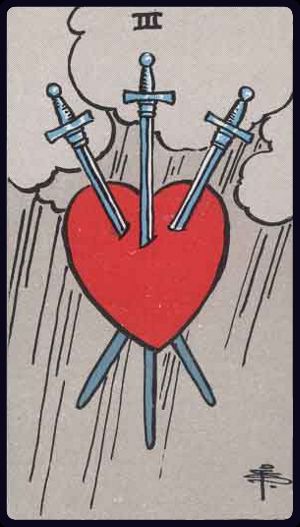
Three swords through a red heart, rain, grey sky. There is no figure and no scene, just the fact of it. It is the least decorated image in the deck and the most immediately understood: everyone knows what this card is about before anyone explains. The Three of Swords is heartbreak, and more broadly it is the pain that comes from something being true. Betrayal, rejection, words that cannot be taken back, a loss that was caused by someone rather than by circumstance. What makes it bearable, slightly, is the weather. Rain passes. The card is not promising that quickly and it does show a sky rather than a permanent condition. If you want a wider sense of how cards like this fit into a reading, our guide on how tarot works walks through it without the mystical jargon.
Upright Meaning
Upright, the Three of Swords describes painful truth. A betrayal, a rejection, something said that revealed what someone actually thought, a piece of information that hurt and was accurate. The card does not offer comfort and it is not cruel either: what it offers is confirmation that the pain is proportionate. People who pull this card are frequently being told, by themselves or others, that they are overreacting. The card disagrees. There is also a specific reading about the truth being the thing that hurts rather than a lie. Swords are clarity, and the pain in this card usually comes from finally knowing rather than from being deceived. That makes it different from simple sadness. It carries a hard-won quality: something has been understood, at cost, and the understanding does not go away when the pain does. The only instruction the card gives is to let it be as bad as it is, on the grounds that pain that gets managed rather than felt tends to last considerably longer.
Reversed Meaning
Reversed, the Three of Swords usually means the beginning of recovery. The acute stage passing, the ability to think about it without the same weight, the point where it stops being the first thing in your head every morning. That is rarely linear and the card reversed marks the direction rather than the completion. Another version is pain being held on to. Grievance nursed, a wound revisited, an old hurt kept current because letting it heal would mean letting someone off. Reversed, the card can name that without much sympathy, since it is one of the more self-damaging things people do. There is also a reading about suppression. Refusing to feel it, staying busy, insisting you are fine. Reversed, the Three can describe someone whose recovery is entirely performed, and the tell is usually that they can talk about the facts without any difficulty at all.
Love and Relationships
This is where the card is most often pulled. In love, the Three of Swords describes heartbreak in its various forms: being left, being cheated on, learning something about someone that changes everything, or a relationship ending in a way that involved real damage rather than drifting. It is honest about the severity and it does not tell you it was for the best, which is usually the least useful thing anybody says. It can also describe the moment of telling or being told the truth. The conversation where somebody says the thing, which is painful and necessary and afterwards nothing is the same. The card treats that as better than the alternative, at some distance. If you are single and this card appears, it frequently describes an old injury that is still shaping how you choose: guardedness that came from something specific, which is worth identifying rather than treating as your personality.
Career and Money
At work, the Three of Swords describes professional hurt. Being passed over in a way that was personal, criticism that was unfair or that was fair and landed badly, a colleague you trusted who did not behave well. It can also describe redundancy handled callously, which is more common than employers like to think and does real damage. The card names it rather than advising. With money, the Three is less frequent and can describe a financial betrayal specifically: money lent and not returned, being taken advantage of by someone close, a partner's spending discovered. Those situations hurt in a way that is out of proportion to the amount, because the subject is not really the money. If this card appears for a financial question, the useful reading is usually about the relationship rather than the sum, and about the fact that the two have become impossible to separate.
Yes or No
No
The Three of Swords is a no, and one of the clearest in the deck. It describes pain and rupture, so for questions about whether something will work out, whether a relationship can be saved, or whether the news will be good, the card is not offering encouragement. It is an honest no rather than a dramatic one, and it usually confirms something the person already suspects.
When the answer can shift
The answer changes if the question is about whether to face something. Should I ask, should I find out, should I have the conversation: the Three says yes, because it holds that the truth is better than the not knowing even when it hurts. It also shifts over time. This card describes a current state rather than a permanent one, and a question about the longer term is not really what it is answering.
Example Interpretation
A typical situation. Leonie, 44, found out three weeks ago that her husband had been having an affair for over a year with someone they both know socially. They are still in the house together while they work out what happens. She has told two friends and has been noticeably composed about it, and has started organising things: the finances, the children's schedules, a list of questions. Several people have said how well she is handling it. She pulls the Three of Swords. For Leonie, the card is not advising her about the marriage, which is not a question anyone can answer three weeks in. It is pointing at the composure. The organising is genuine and useful and it is also a way of staying in the part of her that can still function, and the card is unusually direct that this will not work indefinitely. What has happened is as bad as it feels, and the compliments about how well she is coping are the least helpful thing currently being said to her.
Another quick example
A quicker one for work: Tobias, 36, was told by a manager he respected that he was not seen as a long-term fit, in a meeting that lasted four minutes. He pulls the Three of Swords. The card is not assessing whether the judgement was fair. It is noting that it hurt, which he has not said to anyone.
Common Misconceptions
The most common misreading of the Three of Swords is as a prediction of heartbreak coming, when it far more often describes something that has already happened. Another mistake is rushing to the silver lining. The card carries no instruction to grow from this, and the people who say that are usually more uncomfortable than the person grieving. People also read it as exclusively romantic. Betrayal by a friend, a family rupture, or a professional wound all sit in this card, and the romantic version is simply the loudest.
Final Thoughts
The Three of Swords is the card nobody wants and everybody recognises. Its one virtue is that it does not pretend. If you have pulled it, something hurt, and it was probably worse than you have been letting on, and the version of events where you are fine is not serving you. The rain in the image is the only comfort on offer and it is a real one: this is weather rather than climate. It will not always be this. It is, for now, and the card is not asking you to feel differently about it yet.
Related Reading
Want a Free tarot reading
Get a free readingTarot readings are for entertainment and personal reflection. They offer perspective, not predictions, and should not replace professional advice for medical, legal, or financial matters.