Major Arcana
Justice
The card of clear consequence. About honest accounting, fair outcomes, and the discipline of seeing a situation as it actually is rather than as you wish it were.
Our working read at Tarot Chats takes Justice as the card of clear consequence, not punishment. Real fairness is unsentimental and impersonal.
Introduction
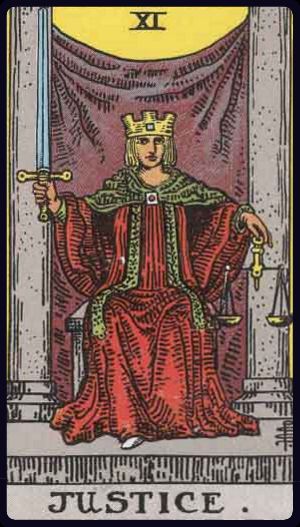
Most people want fairness when it favors them and mercy when it does not. Justice the card is honest about that and does not particularly care which side of the equation you are on. The figure in the classic image holds a sword in one hand and scales in the other. The sword is for clarity. The scales are for weighing. There is no warmth in the figure, but there is no cruelty either. The card is asking you to see a situation accurately, including your own role in it, and to be willing to live with what an honest assessment turns up. People sometimes find Justice uncomfortable because it asks them to set down the version of the story where they are entirely the wronged party. Once that version is set down, the actual situation usually looks different.
Upright Meaning
Upright, Justice is asking for honest accounting. Where The Emperor is the structure that makes accountability possible, Justice is the accounting itself. The card often shows up around legal matters, contracts, formal decisions, performance reviews, or any situation where consequence is actively being weighed. It is also a card of personal accounting, the quiet kind that happens between you and yourself when you stop telling the convenient version of a story. People who pull Justice during a conflict are often being asked whether their version of events is actually accurate, or whether they have been editing for sympathy. The card does not punish that editing. It just notices it. The next move tends to clarify once the editing stops. There is also a balance theme here. Justice respects situations where the give and take has been roughly fair, and it surfaces uncomfortably in situations where one side has been quietly carrying more weight than the other for a long time.
Reversed Meaning
Reversed, Justice usually arrives in one of two forms. The first is avoidance of accountability. You have been ducking responsibility for something, possibly for so long that you have stopped seeing it as ducking. A debt. A conversation you owe someone. A pattern you keep telling yourself is not really yours. The card is naming the avoidance and asking what it would take to actually face it. The second pattern is the opposite. Sometimes Justice reversed appears for someone who is genuinely being treated unfairly, who has been carrying a version of events that does not reflect what really happened. The card is validating that and asking what the next move is. Naming the unfairness is the first step. Acting on it is the second. Both flavors are about restoring a balance that has slipped.
Love and Relationships
Justice in love is unsentimental in a way that can feel uncomfortable but tends to be useful. The card asks for honesty, both about what each person is bringing to the relationship and about what each person is taking from it. Couples in long relationships often pull Justice when something has been quietly out of balance for a while. One partner doing more of the emotional work. One person carrying more of the financial weight than was originally agreed. One person making more of the daily compromises. The card is not handing out blame. It is naming the imbalance and asking whether both people are willing to look at it and adjust, or whether the imbalance has become structural. Justice can also appear at the legal end of a relationship. Divorce. Separation. Custody arrangements. Estate questions. The reading is asking both people to handle the formal end of the partnership with the same honesty the relationship deserved at its best, even when the temptation is to handle it with maximum self-protection.
Career and Money
At work, Justice often shows up around contracts, formal reviews, legal matters, or situations where the official record is being decided. The card supports decisions made from accurate assessment rather than from politics or fear. People who pull Justice during a workplace conflict are usually being asked to look at the actual record. What was agreed. What was delivered. What was not. The card has no patience for the version where everything is someone else's fault, and equally no patience for the version where you absorb every problem as your own. With money, Justice is about the honest ledger. Debts that need paying. Income that needs reporting. Agreements that need honoring. Those who draw this card during a money question are often being told to handle the financial paperwork they have been avoiding, because the avoidance is creating a quieter cost than the paperwork itself would. The King of Swords is the person version of this card: someone whose decisions hold up because they are reasoned and applied evenly.
Yes or No
Yes if it is deserved
In most readings, Justice gives a conditional yes. The card leans toward outcomes that match what has actually been done. If your question involves an honest position, fair process, and actions that match your stated values, the answer leans yes. If your question involves hoping for an outcome you have not earned or avoiding a consequence you have, the card declines. Justice is unusual in that it is not particularly interested in what you want. It is interested in what is fair given what has actually happened.
When the answer can shift
Where it can lean the other way toward no: when the honest accounting is unflattering. If the question is about whether you can dodge a consequence that is roughly proportional to something you actually did, the card is a clear no. The shift back toward yes usually comes when you address the underlying imbalance, even partially. Justice softens for honest effort to make things right. It does not soften for a hope that the problem will quietly disappear.
Example Interpretation
Meet Anita, 41, who runs a small consulting firm and has been in a contract dispute with a former client for four months. The client is refusing to pay the final invoice, citing dissatisfaction with the work. Anita is convinced she is being treated unfairly. She pulls Justice. The reading is not telling her she is right, and it is not telling her she is wrong. What it asks is for her to look honestly at the original contract, the actual deliverables, the documented communications, and the specific complaints, and to assess whether her own work fully met what was agreed. Sometimes that honest review confirms her position and gives her the clarity to escalate to a lawyer with confidence. Sometimes it surfaces a real gap in the deliverable that she had been minimizing in her own head. The card here is asking her to do the review before deciding the strategy. Either outcome leads somewhere honest. Strategy built on a story that does not survive scrutiny tends to fall apart in the actual dispute.
Another quick example
A typical case in relationships: Tomas and his partner of nine years pull Justice during a conversation about household labor. Both of them have been quietly resentful for a year. The reading is asking them to actually map out who is doing what, in writing if necessary, and to handle the conversation as adults assessing a structural problem rather than as opponents scoring points.
Common Misconceptions
The most common misread of Justice is treating it as punishment. The card is not punitive. It is descriptive. It tells you what is, not what should hurt. Another way people get the card wrong is reading Justice as karma in a mystical sense, like the universe is keeping score and is about to even things out for you. The card is more practical than that. It is about the actual cause and effect happening in your specific situation, not a cosmic ledger. A third common error is assuming Justice always favors the person reading the card. It does not. The card is impartial. If you are in the wrong, Justice will tell you, and the only useful response is to address it.
Final Thoughts
Justice is one of the more grown-up cards in the deck. For help shaping the kind of question this card can actually answer, our tarot questions guide is a useful starting point. Justice does not flatter you. It does not promise you what you want. What it offers is something rarer, which is the chance to see a situation clearly and act from that clarity instead of from emotion or self-protection. If you pulled this card, the task is usually to set down the most defended version of your story long enough to look at the actual record. The decisions made from that record tend to hold up better than the ones made from how the situation feels. For the more dramatic counterpart that handles consequence after a real breakdown, The Tower is the next conversation.
Related Reading
The Emperor
The structural authority that often runs the systems Justice rules through. Read together for a full picture of order.
The Hierophant
The card of inherited tradition and institution. A useful pairing when Justice is being weighed inside formal systems.
The Hanged Man
The card that often follows Justice, when the verdict requires a real shift in how you see the situation.
Want a Free tarot reading
Get a free readingTarot readings are for entertainment and personal reflection. They offer perspective, not predictions, and should not replace professional advice for medical, legal, or financial matters.