Minor Arcana · Swords
Knight of Swords
The card of charging in with a point to make. It turns up around conviction and speed, and asks whether you have thought past the first move.
When the card lands in a Tarot Chats session, we read the Knight of Swords as conviction moving at speed. The thinking is sharp and the card is usually asking what happens after impact.
Introduction
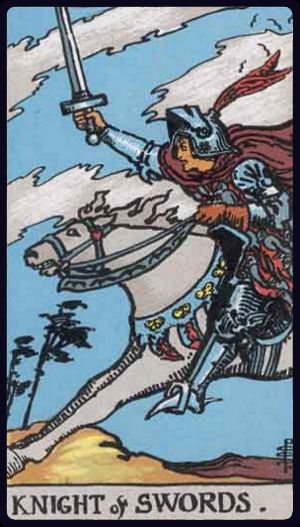
The Knight of Swords is at full gallop with his sword raised, leaning forward into a wind that is bending the trees. Everything in the picture is moving except him: he is fixed on something ahead and going at it directly. This is the fastest card in the deck and the least interested in consequences. He is the person who says the thing in the meeting, sends the email at midnight, makes the argument properly and does not notice the room. There is genuine courage in that and genuine cost, and the two are inseparable. Most people pull this card either because they are about to do something decisive, or because somebody has just done something decisive to them. If you want a wider sense of how cards like this fit into a reading, our guide on how tarot works walks through it without the mystical jargon.
Upright Meaning
Upright, the Knight of Swords describes decisive action driven by conviction. Making the argument, confronting the problem, moving fast because you can see clearly and waiting feels intolerable. The card respects it. Plenty of situations are only ever fixed by someone willing to be direct while everybody else is being careful, and this is the energy that does it. It also describes a certain sort of person: quick, articulate, impatient, often right, and exhausting in quantity. If the card is pointing at someone in your life, that is usually the description, and the useful question is whether they are on your side. There is intellectual force here too. Ideas pursued hard, a mind that cuts through things, a willingness to follow reasoning to an uncomfortable conclusion. The card's limit is that it only handles the first move. What happens after the email is sent is not something this knight has considered, and that is where most of the damage occurs.
Reversed Meaning
Reversed, the Knight of Swords usually means the speed has become the problem. Rushing in, arguing badly, saying something irretrievable, acting on partial information with complete confidence. The card reversed is blunt about this because the pattern is reliable: the conviction was genuine, the facts were incomplete, and the apology afterwards does not undo the meeting. Another version is aggression dressed as honesty. Cruelty delivered as directness, attacking someone and calling it debate. Reversed, this knight can be genuinely unpleasant, and if the card describes somebody in your life it is worth taking seriously rather than treating as a personality quirk. There is also a quieter reading about being stalled. All that energy and nowhere to point it, thinking in circles, unable to act on conclusions you have already reached. Reversed, the Knight can describe frustration rather than recklessness, which is the same force with the brakes on.
Love and Relationships
In love, the Knight of Swords describes directness that is usually too fast. The conversation started without warning, the ultimatum, the question asked in the middle of something else. It can be clarifying and it is rarely gentle. If the card describes a person, they are likely to be exciting, mentally sharp and difficult to feel safe with, because their honesty arrives without much padding. If you are single, the card can describe your own approach: being upfront about what you want, cutting things off quickly when they do not fit, a style that saves a great deal of time and occasionally discards people too early. In an existing relationship, the Knight often marks a confrontation about to happen. The card is not telling you to avoid it. It is pointing out that you are going in at a gallop, and that the difference between resolving something and detonating it is usually the first thirty seconds.
Career and Money
At work, the Knight of Swords is the card of the person who says what everyone is thinking. It describes decisive intervention, a sharp argument, taking a stand, pushing a project through by force of will. It is genuinely useful in stuck organisations and genuinely costly in political ones. The card is best where being right matters more than being liked, and worst where you need people's cooperation afterwards. It also describes rapid change: a sudden departure, a fast decision, a situation that moves in days rather than months. With money, the Knight is impulsive and confident, which is a poor combination. Decisions made quickly on strong conviction and thin research sit here. The card is not saying the instinct is wrong. It is saying the instinct has not been checked, and that the speed which makes this energy effective at arguing makes it expensive at committing.
Yes or No
Yes
The Knight of Swords is a yes, delivered at speed and without much reflection. It supports acting, confronting and pushing forward, so for questions about whether to do the decisive thing, the card agrees. What it cannot tell you is whether you should, since it evaluates the first move only. Its confidence is real and it is not the same as good judgement.
When the answer can shift
The answer needs treating carefully when the situation requires other people afterwards. Anything where you need ongoing cooperation, a relationship to survive the conversation, or a reputation to remain intact deserves a slower card's opinion as well. It also shifts if you are angry. The Knight does not distinguish between conviction and temper, and it says yes to both with exactly the same enthusiasm.
Example Interpretation
A typical situation. Kemi, 34, has discovered that a colleague has been taking credit for work she did, and has evidence: dates, drafts, an email chain. She has drafted a message to the head of department laying it out, with the colleague copied in. It is accurate, it is well argued, and she wrote it at eleven last night. She has not sent it. She pulls the Knight of Swords. For Kemi, the card is entirely on the side of raising this, and it is describing the state she wrote the message in. The evidence will be just as good on Thursday. What changes is whether the first thing the head of department reads is a case or an ambush, and whether the colleague, copied in, has any option other than defending himself. The Knight's instinct is right and its timing is the part that has never served anyone well, which is precisely why she has not sent it yet.
Another quick example
A quicker one for love: Felix, 41, has decided to end things and intends to do it tonight, over the phone, because waiting feels dishonest. He pulls the Knight of Swords. The card is not disputing the decision. It is noting that the urgency he is feeling is about his own discomfort rather than about her.
Common Misconceptions
The most common misreading of the Knight of Swords is as straightforwardly heroic, which ignores the trees bending in the background. The card shows force and not control. Another mistake is assuming it means somebody is being aggressive toward you. It frequently describes your own impulse, and that is usually the more useful reading. People also treat the speed as decisiveness, which it resembles closely. Decisiveness includes having considered the aftermath, and this card characteristically has not.
Final Thoughts
The Knight of Swords is the card of being right and going in hard, which is a combination that wins the argument and loses a surprising amount else. Almost everyone has sent a version of that email. If you have pulled this card, you probably have a point, and the point will still be valid tomorrow. The only thing the delay costs you is the satisfaction of the gallop, and the only thing it buys you is every relationship in the room afterwards, which is usually the better trade.
Related Reading
Want a Free tarot reading
Get a free readingTarot readings are for entertainment and personal reflection. They offer perspective, not predictions, and should not replace professional advice for medical, legal, or financial matters.