Minor Arcana · Swords
Page of Swords
The card of the person who wants to know. It turns up around curiosity and sharp questions, and asks whether you are ready for the answers.
When the card lands in a Tarot Chats session, we read the Page of Swords as curiosity with an edge. The questions are good, and the card is usually asking what they are for.
Introduction
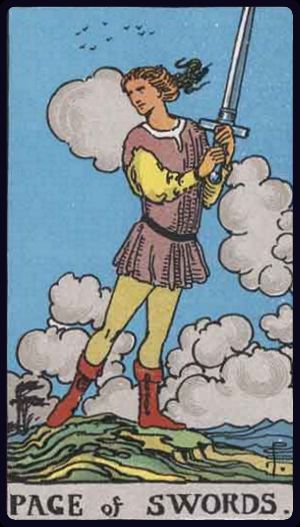
A young figure stands on a hill holding a sword in both hands, looking back over his shoulder, with clouds scudding and birds blown across the sky. The wind is up and he is alert, watching for something. This is the card of the person who wants to find out: asking questions, gathering information, testing things by poking at them. It is a vigorous, slightly restless energy and it is easy to enjoy. The looking over the shoulder is the part worth noticing. There is a watchfulness here that shades into suspicion, and the sword is being held in a way that could be either learning or defending. Most people pull this card when a situation has made them curious, and the card's interest is in what they intend to do with what they find. If you want a wider sense of how cards like this fit into a reading, our guide on how tarot works walks through it without the mystical jargon.
Upright Meaning
Upright, the Page of Swords describes curiosity, mental energy and the willingness to ask. Researching something properly, questioning an assumption everyone else has accepted, taking an interest in how a thing actually works. The card is encouraging about it, particularly the version that annoys people slightly. There is also a messenger quality, as with all Pages, and in this suit the news tends to be information rather than feeling: something you find out, a message that changes the picture, a fact that arrives and rearranges things. The card often appears just before that. There is a theme of honesty too, of the blunt rather than tactful kind. This Page says the thing, usually accurately and often without much attention to how it lands. That is genuinely valuable in rooms full of people being careful, and it is a young version of a skill that improves with judgement. The practical instruction is usually to go and find out rather than to keep speculating.
Reversed Meaning
Reversed, the Page of Swords usually means the curiosity has gone somewhere unhelpful. Snooping, gossip, checking someone's messages, the sort of investigating that is really about anxiety. The card reversed is fairly direct that looking for information you are not entitled to tends to produce misery rather than clarity. Another version is cleverness without substance. Winning arguments for the sake of it, contrarianism, knowing a little about a great deal and using it to sound authoritative. Reversed, the card can describe that in someone else, and it is worth recognising because it is persuasive from the outside. There is also a reading about scattered attention. Too many things being looked into at once, research that never becomes a decision, an alertness that has turned into being unable to settle. Reversed, the Page can be pointing at a mind that has become busy rather than sharp.
Love and Relationships
In love, the Page of Swords describes wanting to know. Asking the direct question, establishing what this actually is, or the early stage of a relationship conducted with more honesty than is customary. That can be refreshing and it can be blunt, and the card carries both. If you are single, it often describes a period of working things out: why the last one ended, what you actually want, asking better questions of yourself and the people you meet. The less comfortable reading is suspicion. Checking up, reading into things, an alertness to betrayal that may or may not have evidence behind it. The card does not tell you whether you are right. It does note that surveillance is a poor way to obtain trust, and that the question you have not asked directly is usually the one doing the damage. The Page's whole nature is to ask, and reversed is what happens when the asking goes sideways instead.
Career and Money
At work, the Page of Swords is a good card. It describes learning something new, investigating a problem properly, asking the questions nobody else will. It is strong for anything analytical, for journalism and research, for the early stage of a role where you are absorbing how things work. It also describes someone junior whose questions are more useful than their experience would suggest, and the card's advice to anyone managing that person is to let them ask. With money, the Page describes doing the homework. Reading the terms, comparing the options, finding out what something really costs before committing. It is one of the more sensible cards for financial questions in this suit, mainly because its instinct is to check rather than assume. Its failure mode is analysis that never resolves into a decision, which is worth watching if you have been researching the same purchase for months.
Yes or No
Yes
The Page of Swords is a yes, particularly for anything involving finding out, asking or learning. Should I look into it, should I ask the question, is it worth investigating: the card agrees readily. Its yes is about the enquiry rather than the outcome, so it is more a green light for the next step than a prediction about where the step leads.
When the answer can shift
The answer becomes less comfortable when the question is whether to investigate someone. Checking a partner's phone, digging into a person's history, pursuing information you have not been offered: the card's curiosity says yes and the reversed reading says this rarely ends well. It also shifts for anything requiring experience or authority, since this is a beginner's card and its confidence outruns its judgement.
Example Interpretation
A typical situation. Ewan, 27, has started a job at a company where a particular process has always been done a certain way. He has asked three times why, and has been given three different answers, none of which explain it. His manager has begun to look slightly tired when he raises it. He is now wondering whether to drop it, because he is new and does not want to be the difficult one. He pulls the Page of Swords. For Ewan, the card is on the side of the question, and it is also asking him to be strategic about it. Three inconsistent answers is genuine information: nobody knows why. The card's suggestion is not to ask a fourth time in a meeting, which is where the difficulty is coming from, but to find out properly himself and bring the answer rather than the question. The Page's instinct is right. The delivery is the part that is still young.
Another quick example
A quicker one for love: Tanya, 35, has been seeing someone for two months and has no idea whether they are seeing anyone else. She pulls the Page of Swords. The card is not speculating. It is noting that there is a question available, and that two months of wondering is a decision she keeps making.
Common Misconceptions
The most common misreading of the Page of Swords is as a warning about gossip or betrayal, which is the reversed reading applied to the upright card. Upright, this is curiosity rather than intrigue. Another mistake is reading it as a literal young person. The energy appears at any age and is particularly common in people starting something new. People also treat the bluntness as a flaw. It is a genuine asset in most rooms, and the thing that improves with time is the timing rather than the honesty.
Final Thoughts
The Page of Swords is the card of wanting to know, which is one of the more useful instincts a person can have and one of the easiest to misdirect. Pointed at a problem it produces understanding. Pointed at a person it produces anxiety, and the difference is mostly about whether you have a right to the information and what you plan to do with it. If you have pulled this card, there is a question in your situation that you have been circling. The card's position is that asking it directly, of the person who can answer, will do more in five minutes than a fortnight of working it out from the outside.
Related Reading
Want a Free tarot reading
Get a free readingTarot readings are for entertainment and personal reflection. They offer perspective, not predictions, and should not replace professional advice for medical, legal, or financial matters.