Minor Arcana · Swords
Seven of Swords
The card of getting away with something. It turns up around deception and shortcuts, and asks who is actually being fooled.
When the card lands in a Tarot Chats session, we read the Seven of Swords as something being done quietly rather than openly. The deception may be someone else's and it is often the reader's own.
Introduction
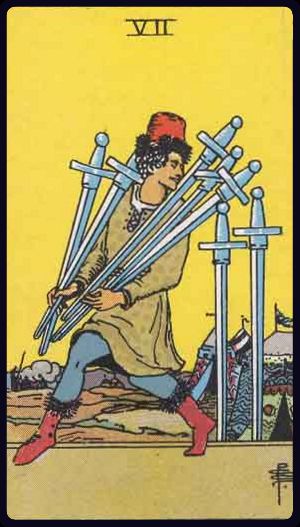
A man creeps away from a camp carrying five swords, looking back over his shoulder with a slightly pleased expression. Two swords are still stuck in the ground behind him. He has not taken everything and he is not being chased. It is the card of the quiet exit, the corner cut, the thing done without telling anyone, and the two swords left behind are the detail that makes it interesting: whatever this is, it is incomplete, and he will have to come back or go without. The Seven of Swords is about deception in the broad sense, including the versions people perform on themselves, which is usually why it appears in a reading for someone who is not obviously deceiving anybody. If you want a wider sense of how cards like this fit into a reading, our guide on how tarot works walks through it without the mystical jargon.
Upright Meaning
Upright, the Seven of Swords describes acting alone and out of sight. Sometimes that is straightforward dishonesty: taking something, hiding something, telling a version of events that suits you. Sometimes it is strategy, which is the more interesting reading: doing the clever thing rather than the direct one, avoiding a confrontation you would lose, taking what you can rather than demanding what you are owed. The card does not moralise as much as people expect. What it does insist on is that you know which you are doing. There is also a strong self-deception reading. The card frequently appears when somebody is running a story about a situation that they have not examined, usually because examining it would cost them something. The two swords left behind matter here. Whatever this approach gains, it does not get you everything, and the part that is left is generally the part that needed doing properly.
Reversed Meaning
Reversed, the Seven of Swords usually means the deception is coming apart. Being found out, confessing, or a truth arriving that reorganises the situation. That can be uncomfortable and it is generally a relief, because the maintenance of a concealed thing costs more than people account for. Another version is the decision to stop. Coming clean, returning something, choosing the direct route after a period of managing things sideways. Reversed, the card can describe that turn, which is usually harder than the original decision. There is also a reading about being on the receiving end. Discovering that somebody has been dishonest with you, or that a situation you trusted has been arranged rather than natural. Reversed, the Seven can mark the moment that becomes visible, and the aftermath tends to have more to do with your judgement of yourself than with them.
Love and Relationships
In love, the Seven of Swords describes things done behind someone's back. Not always dramatic: the account they do not know about, the friendship that has become something else, the version of your week that omits an evening. The card is not always pointing at infidelity and it is always pointing at concealment. If you are worried about a partner, the card is worth taking seriously and it is not evidence, and acting on suspicion alone reliably makes things worse. There is also a reading about withholding. Keeping part of yourself out of a relationship, managing what someone knows about you, presenting a curated version. That is extremely common and it is usually protective rather than malicious, and it has the same effect over time: nobody is close to a person they have not met. If you are single, the card can describe not being straight about what you want, which tends to produce exactly the situations people complain about.
Career and Money
At work, the Seven of Swords covers a range from sensible discretion to genuine misconduct. Job hunting quietly, keeping an idea to yourself until it is ready, not sharing everything with a colleague who has used information badly before: all legitimate, all in this card. At the other end: taking credit, hiding a mistake, expenses that would not survive scrutiny. The card asks you to be honest with yourself about which end you are at, because the middle is where people drift without deciding. It can also describe someone doing this to you, and the practical instruction there is to document things rather than to confront on instinct. With money, the Seven can describe financial concealment: debt nobody knows about, spending hidden from a partner, an arrangement that is technically defensible and would embarrass you if explained. That last test is the one the card keeps returning to.
Yes or No
No
The Seven of Swords is generally a no, because it describes approaches that work in the short term and leave something unresolved. If you are asking whether to take a shortcut, keep something quiet or handle a situation indirectly, the card is not encouraging. It is also a no in the sense of a warning: it frequently indicates that something in the situation is not as it is being presented.
When the answer can shift
The answer turns to yes when discretion is genuinely the right tool. Should I keep this to myself for now, should I look for another job without announcing it, should I avoid a confrontation I cannot win: the card supports strategic quiet. It also shifts if you are asking whether someone is being straight with you. There the Seven is fairly direct, and the answer is usually that it is worth checking rather than assuming.
Example Interpretation
A typical situation. Greg, 48, has been quietly interviewing elsewhere for four months while telling his manager he is committed to a project that runs into next year. He has also been using work time to prepare, which he has decided is fair given how much unpaid overtime he has done. He is a decent person and this has started to sit badly. He pulls the Seven of Swords. For Greg, the card is not condemning the job search, which is entirely his business and reasonably kept quiet. It is separating two things he has merged. Looking for another job privately is ordinary discretion. The reassurance he gave his manager about next year is a different item, and the unpaid overtime argument is the two swords left in the ground: a justification that does the work of a decision he has not actually made. The card would have him notice that the discomfort is specific rather than general.
Another quick example
A quicker one for love: Nadine, 31, has been messaging an ex and has deleted the thread each time before her partner gets home. She pulls the Seven of Swords. The card is not accusing her of anything. It is noting that the deleting is the part she already understands.
Common Misconceptions
The most common misreading of the Seven of Swords is as a warning that someone is stealing from you, which is dramatic and usually wrong. It far more often describes ordinary concealment, including your own. Another mistake is treating it as always immoral. Strategy, discretion and picking your battles all live here, and the card is more interested in self-awareness than in ethics. People also miss the two swords left behind, which is the practically useful part: this approach does not get you everything, and the remainder tends to be the thing that mattered.
Final Thoughts
The Seven of Swords is the card of the quiet route, and its question is always the same: does this work because it is clever, or because nobody is looking? Those feel identical at the time and diverge completely afterwards. If you have pulled it, something in your situation is being handled sideways rather than directly, by you or by somebody else. The card is not necessarily telling you to stop. It is telling you to know, precisely, what you are doing and what it is leaving behind, because the man in the picture is going to have to come back for those two swords eventually.
Related Reading
Want a Free tarot reading
Get a free readingTarot readings are for entertainment and personal reflection. They offer perspective, not predictions, and should not replace professional advice for medical, legal, or financial matters.