Minor Arcana · Swords
Ten of Swords
The card of the worst having happened. It turns up at rock bottom, and points out that the sky behind it is already getting light.
When the card lands in a Tarot Chats session, we read the Ten of Swords as the end of something rather than the end of everything. It is the most theatrical card in the deck and the one most often followed by relief.
Introduction
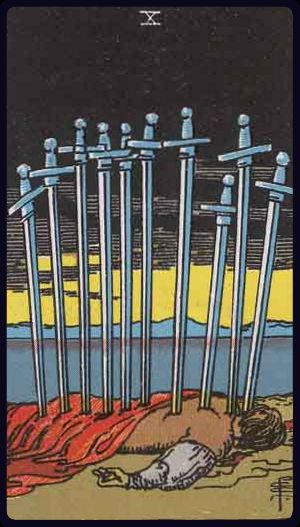
A figure lies face down with ten swords in his back, by the water, under a black sky. It is the most dramatic image in the deck and slightly absurd, because ten swords is more than anyone needs. That excess is the point. This is rock bottom rendered exactly as it feels rather than as it is, and it is the end of the suit that began with a single moment of clarity. Look at the horizon, though: it is yellow. The sky is black overhead and the day is already starting at the edge of the picture. The Ten of Swords describes the worst of something having happened, which is genuinely terrible and is also, in a way people rarely accept at the time, the end of the waiting. If you want a wider sense of how cards like this fit into a reading, our guide on how tarot works walks through it without the mystical jargon.
Upright Meaning
Upright, the Ten of Swords describes a definitive ending, usually a painful one. The relationship is over, the job has gone, the thing you were dreading has arrived. The card does not soften it and it is not a card of ambiguity: whatever this is, it is finished rather than damaged. There is a particular quality of overkill in it. People in this card have often been hit by more than seems fair, or have had a bad situation end in the most comprehensive way available. The theatrical excess is part of the experience and worth naming, because it is why this card so often comes with a sense of disbelief. There is also a hard consolation, which the card offers without much warmth: nothing further can happen. The dread that occupied the Nine of Swords has resolved into an event, and events can be dealt with in a way that anticipation cannot. The dawn is on the horizon rather than overhead, so it is not comfort exactly. It is information.
Reversed Meaning
Reversed, the Ten of Swords usually means recovery beginning. Getting up, the worst being behind you, the slow return of ordinary life. It is one of the better reversals in the deck and it rarely feels dramatic: mostly it looks like a person doing normal things again. Another version is resisting the ending. Refusing to accept that something is over, prolonging a situation that has already finished, going back to something that ended for good reasons. Reversed, the card can describe that, and it tends to be more painful than the ending was. There is also a reading about fearing the worst rather than being in it. Reversed, the Ten sometimes appears when someone is braced for a catastrophic ending that is not going to arrive in the form they expect, which is worth knowing when the anticipation has become the main problem.
Love and Relationships
In love, the Ten of Swords is the definitive end of a relationship. Not a rough patch, not a conversation that needs having: over. It frequently appears when the ending was one-sided, unexpected or handled badly, which is why the card carries a sense of injury rather than mutual conclusion. It can also describe betrayal that finishes something. The card does not counsel reconciliation and it does not forbid it either; what it describes is that this version of the relationship has ended, whatever happens next. If you are single, the Ten can describe the end of a pattern rather than a person: the last time you do that particular thing, the relationship that finally made something unignorable. That is a better reading than it sounds. The card is the bottom of the suit, and the suit does not go any further down, which is the only genuinely reassuring thing it has to say.
Career and Money
At work, the Ten of Swords describes an ending that was not chosen. Redundancy, dismissal, a business failing, a project cancelled after everything was put into it. The card is honest that this is a real loss rather than an opportunity in disguise, which is the thing people are usually being told at exactly the moment it is least useful. It can also describe being comprehensively undermined: a situation where several things went wrong at once and the position became untenable. With money, the Ten can describe a financial low point. The bottom of a bad period, a loss crystallising, something you had been holding off finally arriving. The card's practical contribution is that the uncertainty is over, which sounds thin and is actually the point at which people start making better decisions. You cannot plan around a dread. You can plan around a number, even a bad one.
Yes or No
No
The Ten of Swords is the clearest no in the deck. It describes endings and comprehensive failure, so for questions about whether something will work, survive or recover in its current form, the answer is no. There is not much nuance available. What the card adds is finality rather than judgement: this is not a situation that improves with more effort, it is one that has concluded.
When the answer can shift
The answer changes for questions about what comes next. Will I recover, will things improve, is this the bottom: the card is quietly positive on all three, because the dawn is in the image and the suit does not continue downward. It also shifts if you are asking whether to let something go. There the Ten agrees, and it is usually confirming something the person has already worked out.
Example Interpretation
A typical situation. Nisha, 43, ran a small events company for eleven years. Two large clients left within a month of each other, a supplier dispute went badly, and she has spent the last six weeks discovering that the business cannot be saved. She is closing it. She has told the two staff, and she has not told most of her friends, who still ask how it is going. She feels flattened and is finding it hard to explain why she is not relieved, given how bad the last year has been. She pulls the Ten of Swords. For Nisha, the card is not offering perspective, which would be premature. It is confirming the scale of it: eleven years, and it ended in six weeks, and more went wrong at once than seems reasonable. The only thing the card adds is that the not-knowing is over, and that the version of the last year where she woke up every day trying to hold it together is also over, which she has not yet counted as anything.
Another quick example
A quicker one for love: Sean, 29, was left by someone who then made it public before he had told his own family. He pulls the Ten of Swords. The card is not looking for the lesson in it. It is confirming that it was as bad as it felt, and that the excess was real rather than his imagination.
Common Misconceptions
The most common misreading of the Ten of Swords is as literal disaster or death, which frightens people unnecessarily. It describes an ending and a low point, not a catastrophe of that kind. Another mistake is rushing to the dawn on the horizon. It is there, and pointing at it too early is the tarot equivalent of telling someone everything happens for a reason. People also read it as a card that predicts something coming, when it far more often describes something that has just happened and is still being absorbed.
Final Thoughts
The Ten of Swords is the bottom of the deck's hardest suit, and its one mercy is that bottoms are locatable. Something has ended, comprehensively, and probably in a way that involved more damage than was necessary. The card does not ask you to see the opportunity in it or to be grateful for the growth. It sits with the fact that this is where you are. The yellow at the horizon is not a consolation prize and it is not decoration either: the night part of this is finished, and whatever comes next starts from here rather than from further down.
Related Reading
Want a Free tarot reading
Get a free readingTarot readings are for entertainment and personal reflection. They offer perspective, not predictions, and should not replace professional advice for medical, legal, or financial matters.