Major Arcana
The Devil
The card of voluntary captivity. About the patterns you participate in even though you know better, and the chains that are looser than they look.
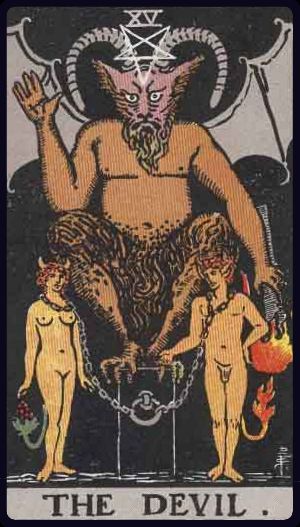
On the Tarot Chats side of things, we treat The Devil as the card of voluntary captivity. The chains in the imagery are loose. The figures could lift them off whenever they decide to.
Introduction
The most important detail in the Devil card is also the one most readers miss. The two figures chained beneath the horned figure are not actually trapped. The chains around their necks are loose. They could lift them off and walk away. They have not. The Devil is not the card of being a victim of an external force. It is the card of the patterns you keep participating in even though you know better. The relationship you keep returning to. The job you stay inside long past the point of usefulness. The substance, the habit, the dynamic, the story about yourself, that you have grown attached to even though it is costing you something real. The card is unflinching and not particularly mean about it. It sits across the deck from The Lovers, which is about choice from real values rather than attachment from fear.
Upright Meaning
Upright, the Devil is naming an attachment that is not serving you anymore. The card is unusual in that it does not tell you what to do about the attachment. It just makes it visible. When someone pulls this card, they often already know exactly what the chain is. They have known for a while. The card is just asking whether they are ready to admit it out loud. Sometimes the Devil shows up around literal addictions. More often it shows up around the subtler attachments. A self-image. A person you should have stopped contacting six months ago. A level of comfort you have become unwilling to risk losing. A version of being right that you defend even when it costs you the relationships that matter. The card has no patience for the story where the chain is happening to you. It wants you to look at why you have not removed it yet. The Eight of Swords is the Minor Arcana's version of the same loose chain: a trap that is real, and less complete than it feels.
Reversed Meaning
Reversed, the Devil tends to mean one of two specific things. The first is the moment of recognition. The card reversed sometimes appears when someone is just beginning to see the chain for what it is, and is starting to feel both the discomfort of seeing it and the relief of not having to keep pretending. The card is encouraging in that moment. The second pattern is recommitment to the chain. You saw the pattern, started to leave it, and went back. Maybe the loneliness was sharper than expected. Maybe the financial loss was real. Maybe the identity loss was harder than the chain itself had been. The card is not judging this. It is naming it. The next round of leaving usually requires more support than you used last time, not less.
Love and Relationships
In love, the Devil is the card of attachments mistaken for love. Toxic dynamics. Codependency. The chemistry that keeps pulling two people back together even when the partnership is corrosive when they are actually inside it. Those who draw this card during a relationship reading are usually already aware that something is not right. The card is naming what they have been minimizing. There is also a quieter version of this card in long-term relationships. Comfort that has slipped into something more like avoidance. Staying together because the alternative feels logistically impossible, not because the relationship itself is alive. The Devil is not telling these couples to leave. It is suggesting that they be honest about why they are staying, and whether the version of the relationship they are inside is one either of them would actually choose if they were starting from scratch.
Career and Money
At work, the Devil is the card of golden handcuffs. The role that pays too well to leave even though it is slowly eating you. The title that has become more important to you than the work itself. The career trajectory that fit who you were a decade ago and does not fit who you are now, and that you keep climbing because climbing is what you know how to do. The card is asking whether the chain you have not removed is the income, the status, the identity, or some combination of all three. With money, the Devil shows up around financial patterns that have become hard to question. Lifestyle creep. Subscriptions you no longer use. Spending that anchors you to a version of life you keep wanting to leave. The card is naming the cost of staying inside the comfort, which is sometimes a larger cost than the discomfort of changing it would be.
Yes or No
No, with honesty
In most readings, the Devil leans no, especially for questions about whether to keep doing what you have been doing. The card is honest. The question it asks is whether the pattern you are inside is one you actually want to stay in, and the answer it tends to find is no. If your question is about whether to break free of an attachment, the card is supportive in a hard-edged way. The freedom is available. The chain is loose. The work is whether you are ready to leave it.
When the answer can shift
Where the answer turns toward yes: when the question is about facing the attachment honestly rather than running from it. The Devil rewards naming the chain out loud, even before you remove it. If your real question is whether to admit the pattern you have been hiding from yourself, the card endorses that. The honesty is itself the move that loosens the chain enough to make leaving possible.
Example Interpretation
Meet Diana, 38, who has been on and off with the same person for three years. Every breakup is final until it is not. Each reunion comes with promises that this time will be different. Each cycle ends roughly the same way, with one of them saying something that the other cannot quite forgive, and then six weeks of distance, and then a long late-night text that starts the cycle again. She pulls the Devil. The card is not telling her she is weak. What it is after is for her to look at what the attachment actually is. Not the person, exactly. The cycle itself. The familiarity of it. The way it organizes her emotional life. The way it gives her something to think about, something to hope for, something to grieve. The card is suggesting that until she names what the relationship is doing for her, separately from what the person is, she will not actually be free to leave. The chain is not the partner. The chain is what staying in the cycle has been protecting her from feeling. Naming that is the first move. Leaving is the second.
Another quick example
Quick one for work: Mark, 44, is in a senior role at a company he no longer believes in, making more money than he could replicate easily elsewhere. He pulls the Devil. It is not asking him to quit on Monday. The card is asking him to be honest that he has been calling the income a reason to stay when it might actually be a fear of being someone other than the person this job has made him.
Common Misconceptions
Where people most often get the Devil wrong is taking it literally as evil or as a sign that something dark is happening to you. It is not a curse and it is not a moral judgment. The card is descriptive, not punitive. A second common misreading is reading the Devil as a card about other people. Sometimes a relationship is the chain, but the card is asking about your participation in the dynamic, not just the other person's behavior. A third common error is assuming the Devil means you have to make a dramatic break. Sometimes the work is more granular. Naming the pattern. Talking to someone honest about it. Loosening the chain by one notch at a time. Quiet, sustained work usually produces more lasting change than a single dramatic exit. The honest reflection of The Hermit is often where that work begins.
Final Thoughts
The Devil is one of the more uncomfortable cards in the deck because it does not let you off the hook. The chain is loose. You knew it was loose. The card is just naming what you have been quietly aware of. Drawing this card, the work in front of you is usually to stop pretending the situation is happening to you and start asking what you have been getting out of staying inside it. The honest answer is rarely flattering. It is usually some combination of comfort, identity protection, and a fear of the loneliness or uncertainty on the other side of the change. None of those are character flaws. They are just the actual reasons. Naming them tends to be the move that loosens the chain enough to leave. For the card that handles the abrupt collapse that sometimes follows when an attachment finally breaks, The Tower is the next conversation.
Related Reading
The Lovers
The Devil's mirror. Where the Lovers is about choice from values, the Devil is about staying from attachment. Read together for contrast.
The Tower
The card that often arrives when a Devil chain finally breaks under its own weight. The collapse that creates room for honesty.
Temperance
The card of skillful blending that often becomes possible once a Devil pattern has been named and released.
Want a Free tarot reading
Get a free readingTarot readings are for entertainment and personal reflection. They offer perspective, not predictions, and should not replace professional advice for medical, legal, or financial matters.